Compare the minimum deposit casino nz for 2026. Expert-ranked, NZD-friendly, fast payouts. Updated guide.

Minimum Deposit Casinos in New Zealand: How $1, $5 and $10 Sites Work

Depositing NZ$1, NZ$5 or NZ$10 is the smallest practical way to open an online casino account, and it has become a common starting point for New Zealanders who want to try a site before committing real money. A low first deposit lets you see how a cashier handles New Zealand dollars, how quickly a withdrawal clears and whether the games suit you — all for less than the price of a coffee. This guide explains how these low-stakes accounts work, what a small balance realistically buys, how New Zealand’s gambling rules are changing through 2026 and 2027, and the trade-offs worth weighing before you type in a card number.
What a minimum deposit casino actually means
A “minimum deposit” is simply the smallest amount a site will let you add to your balance in a single transaction. If a casino advertises a $5 minimum, you cannot top up with less than $5 at a time, though you are free to deposit more. The phrase “minimum deposit casino” has become shorthand for sites that set that floor unusually low — around $1, $5 or $10 in New Zealand dollars — rather than the $20 or more that some operators require.
It helps to keep three separate limits in mind, because sites often set them at different levels:
- Minimum deposit: the least you can pay in. This is the figure the marketing usually highlights.
- Minimum bet: the least you can stake on a single spin or hand. Many pokies start at $0.10 or $0.20 a spin regardless of how much you deposited.
- Minimum withdrawal: the least you can cash out, which is frequently higher than the minimum deposit — sometimes $20 or more.
A genuinely low deposit only stretches your money if the minimum bet and the withdrawal floor are reasonable too. A $1 deposit is of little use if the smallest cash-out is $50.
Key Facts
- What it is: an online casino that accepts a first deposit as small as about NZ$1, NZ$5 or NZ$10.
- Typical tiers: $1 sites are rare, $5 sites are growing, and $10 is the most common entry point.
- Minimum age: 18 for online casino play under New Zealand’s new rules (physical casinos require 20).
- Regulator: the Department of Internal Affairs (DIA), which is phasing in a licensed-only market through 2026–2027.
- Bonuses: many welcome offers and reloads still need at least a $10 deposit to activate.
- Withdrawals: you must clear any wagering and pass identity (KYC) checks before cashing out, no matter how little you deposited.
How $1, $5 and $10 deposits work
The three tiers are not equally available, and they behave differently in practice:
- $1 deposits are rare. Where they exist, they are usually a way to test the sign-up and cashier process rather than a route to a bonus, and they often sit behind specific payment methods. Our dedicated look at $1 deposit casinos covers what a single dollar actually unlocks.
- $5 deposits are becoming more common. They give you enough balance for a short session of low-stake pokies but often only partial access to welcome offers.
- $10 deposits are the most widely supported entry point and the level at which most welcome bonuses, free spins and reload offers are designed to activate.
The practical lesson is that the headline number is not the whole story. A site that accepts $1 may still require $10 to trigger a bonus, so the effective “useful” minimum is often higher than the advertised one. The table below summarises how the tiers typically compare.
Deposit Tiers Compared
| Deposit tier | How common | Bonus access | Methods that usually work | Best suited to |
|---|---|---|---|---|
| NZ$1 | Rare | Often none; offers frequently gated at $10+ | Debit cards, POLi or PayID where offered | Testing a site’s interface and payout speed |
| NZ$5 | Growing | Limited; smaller matched amounts | Debit cards, some e-wallets, small crypto | A short, low-risk session |
| NZ$10 | Most common | Usually unlocks the standard welcome offer | Cards, Skrill, Neteller, paysafecard, crypto | Getting the advertised bonus value |
New Zealand’s 2026 rules for online casinos
The legal backdrop for playing online in New Zealand is changing, and it directly affects which sites are allowed to take your deposit. The Online Casino Gambling Act introduced a licensing system administered by the Department of Internal Affairs (DIA), the government agency responsible for regulating gambling. Our wider explainer on New Zealand’s gambling laws gives the full background; the key points for a would-be depositor are these:
- A licensed-only market is being phased in. Operators that already served New Zealand before 1 May 2026 may keep operating during a transition period but must not advertise to people in New Zealand. From 1 December 2026, only licensed operators may provide online casino gambling to New Zealand customers, and all others must leave the market.
- Licences are issued through an auction. Up to 15 online casinos can win places at auction and gain the right to apply for a licence. The DIA expects to begin issuing licences from early 2027.
- Licensed sites will be identifiable. Each licensed operator must display a unique registration icon on its platform and in its advertising, and the DIA will publish a public register of licensed casinos. If a site cannot be found on that register, it is not licensed in New Zealand.
- The minimum age is 18. Online casino play is restricted to adults aged 18 and over, and age verification must take place before a deposit is allowed. New Zealand’s physical casinos keep a higher entry age of 20.
- Player protections are built in. Licensed operators must take steps to reduce harm, offer limit-setting tools, honour self-exclusion and problem-gambler exclusions, and must not provide credit for gambling.
Enforcement falls on operators rather than players: unlicensed offshore sites can face significant fines, while individual customers who play on them do not commit an offence. In plain terms, during the transition the legal position is shifting, so before depositing it is worth checking whether a site intends to be — or already is — licensed here. The DIA register is the authoritative place to confirm that.
Paying in: methods that support small NZD deposits
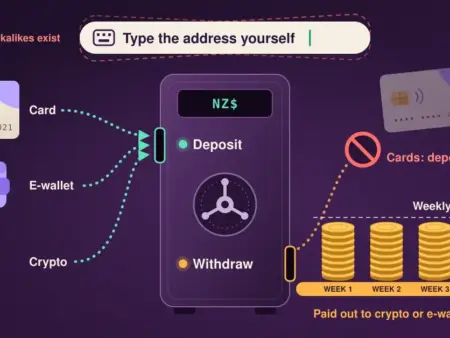
Not every payment method handles tiny amounts gracefully. Fees, minimums and processing quirks vary, so the method you choose can matter as much as the casino. You can read more about each option in our rundown of casino deposit methods, but here is how the main choices behave at the low end:
- Visa and Mastercard debit cards can work from as little as $1 where a site allows it. One caveat worth knowing: some banks code gambling card payments as a cash advance, which can attract a separate fee and interest from your bank rather than the casino.
- Local bank options such as POLi or PayID are sometimes supported for very small deposits and keep everything in New Zealand dollars, avoiding currency conversion.
- E-wallets like Skrill and Neteller usually set their own minimum of around $10, so they are better suited to the $10 tier than to $1 play.
- Paysafecard relies on prepaid vouchers, commonly sold in $10 denominations, which naturally sets a $10 floor.
- Cryptocurrency is practically limited to around $5 and up, because network transaction fees can swallow a large share of anything smaller.
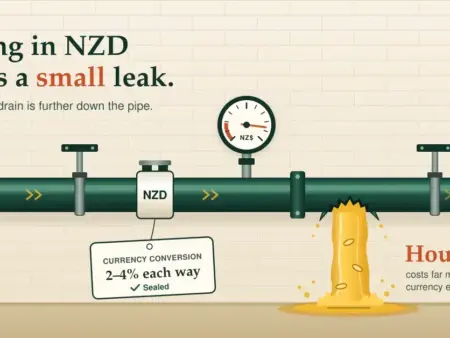
As a rule, the lower the deposit tier, the fewer methods are available. Choosing a site that banks in New Zealand dollars avoids conversion costs that can quietly eat into a small balance.
Bonuses and wagering on a small deposit
The biggest misunderstanding about low deposits is that they unlock the same bonuses as larger ones. Usually they do not. Many matched-deposit offers and reloads set their own minimum — frequently $10 — so a $1 or $5 payment may leave you with no bonus at all, or only a scaled-down version.
Where a small deposit does earn a bonus, the terms tend to be stricter. Industry reviews report wagering requirements on small-deposit offers running as high as 50x to 200x, compared with roughly 35x to 50x on standard $10 to $20 promotions. A wagering requirement is the number of times you must stake the bonus (and sometimes the deposit) before any winnings can be withdrawn; the higher it is, the harder the money is to convert to cash. Our guide to wagering requirements walks through the arithmetic in detail.
Before opting in to any offer on a small deposit, it is worth checking:
- The minimum deposit needed to qualify, which may be higher than the site’s own deposit floor.
- The wagering multiplier and whether it applies to the bonus only or the bonus plus deposit.
- Maximum bet limits while a bonus is active — breaching them can void winnings.
- Game weighting, since pokies usually count 100% toward wagering while table games count far less or not at all.
- Any cap on the amount you can withdraw from bonus winnings.
Getting money out: withdrawals, verification and fees
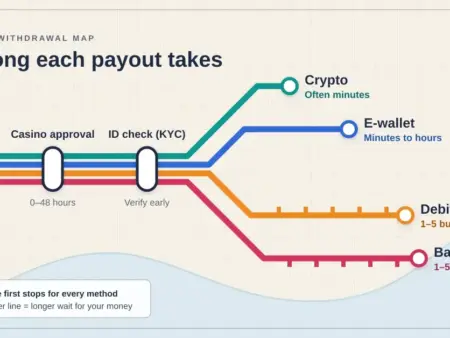
Depositing a small amount does not shortcut the cash-out process. Regardless of how little you paid in, a site will still require you to clear any outstanding wagering and to pass identity verification — often called KYC, for “know your customer” — before releasing a withdrawal. That typically means supplying proof of identity and address once your balance grows.
Two points catch small-deposit players out most often. First, the minimum withdrawal is frequently higher than the minimum deposit, so winnings from a $1 or $5 start may need to build up before you can take anything out. Second, processing times and fees vary widely by method; e-wallets and crypto are generally quicker than card or bank withdrawals. If payout speed matters to you, compare the field of fast-payout casinos before committing.
What a small bankroll realistically buys
A low deposit is best understood as entertainment with a known cost, not an investment. Every casino game carries a built-in mathematical advantage for the house, known as the house edge — the average percentage of each wager the operator expects to keep over time. The flip side is a game’s return-to-player (RTP) percentage: a pokie advertised at 96% RTP has, on average, a 4% house edge over the long run.
What that means for a $10 balance is straightforward. If you stake $0.20 a spin on a 96% RTP pokie, the maths predicts you lose about 4% of everything you wager over many spins — but short sessions are dominated by variance (the natural swing of wins and losses), so your actual result can be anything from busting out quickly to a lucky run. The smaller the deposit, the shorter the expected session and the larger the role of luck. A minimum deposit casino lowers the amount at risk; it does not change the underlying odds, and no deposit size, strategy or “demo” practice improves the house edge on games of chance.
Common mistakes to avoid
- Assuming the deposit floor unlocks the bonus. Check the bonus’s own minimum — it is often higher.
- Ignoring the minimum withdrawal. A $1 deposit means little if you cannot cash out under $20.
- Overlooking cash-advance coding. A card deposit flagged as a cash advance can cost more than the deposit itself in bank fees.
- Chasing high wagering for a tiny bonus. A small match with 100x wagering is rarely worth the effort.
- Skipping the licence check. With New Zealand moving to a licensed-only market, confirm a site’s status on the DIA register rather than trusting on-site claims.
- Treating low stakes as risk-free. Frequent small deposits can add up and can be just as habit-forming as larger ones.
Who a minimum deposit casino suits
Low-deposit play fits some players well and others poorly. It makes most sense for:
- Newcomers who want to learn an interface and test a withdrawal with minimal money at stake.
- Budget-conscious players who treat gambling as a small, fixed entertainment cost and value a long, low-stake session over a big swing.
- Cautious testers checking a new site’s payout speed and support before depositing more.
It suits bonus hunters far less, because the best-value welcome offers are usually calibrated for $10-plus deposits, and the strict terms on small-deposit bonuses erode their worth. If your main goal is bonus value, the $10 tier generally delivers more than $1 or $5.
Responsible gambling
This article is general information about how minimum deposit casinos work in New Zealand; it is not gambling, financial or legal advice, and nothing here should be read as encouragement to gamble. Online casino play is restricted to adults aged 18 and over. Gambling outcomes are determined by chance, the house edge means the odds favour the operator over time, and a small deposit does not change that maths — it only limits the amount at risk.
Treat any deposit as money you can afford to lose, set time and spending limits before you start, never gamble to recover losses or to cover bills, and use the limit-setting and self-exclusion tools a site offers. Our overview of responsible gambling tools explains these in more depth. If gambling is causing harm to you or someone you know, free and confidential help is available in New Zealand around the clock: call the Gambling Helpline on 0800 654 655 or text 8006, contact the Problem Gambling Foundation on 0800 664 262, or visit Safer Gambling Aotearoa.
Sources
Frequently asked questions
What is the lowest deposit I can make at an online casino in New Zealand?
Some sites advertise deposits as low as NZ$1, but $1 options are rare and usually limited to specific payment methods. A $5 minimum is increasingly common, and $10 is the most widely supported entry point. The lowest practical amount also depends on your payment method, since e-wallets and vouchers often set their own $10 floor.
Does a $1 or $5 deposit still qualify me for a welcome bonus?
Often not. Many welcome offers and reloads require a minimum deposit of around $10 to activate, so a smaller payment may earn no bonus or only a reduced one. Where a small deposit does earn a bonus, the wagering requirements tend to be higher, which makes any winnings harder to withdraw. Always read the specific offer terms before opting in.
Is it legal to play at an online casino in New Zealand right now?
New Zealand is moving to a licensed-only market. Operators that served the country before 1 May 2026 may continue during a transition period, and from 1 December 2026 only licensed operators may offer online casino gambling to New Zealand customers. The Department of Internal Affairs expects to start issuing licences from early 2027 and will publish a public register. Individual players do not commit an offence, but it is sensible to check a site’s licensing status before depositing.
Can I withdraw winnings from a small deposit?
Yes, but the same rules apply as for any deposit. You must clear any outstanding wagering requirements and complete identity (KYC) verification before cashing out. Note that the minimum withdrawal is frequently higher than the minimum deposit, so winnings from a $1 or $5 start may need to build up before you can take money out.
Does depositing less reduce my chances of losing?
No. A smaller deposit lowers the amount of money you have at risk, but it does not change the house edge or a game’s return-to-player percentage. The odds of each game stay the same regardless of deposit size, and no strategy or demo practice improves them on games of chance. Depositing less simply means a shorter expected session.
Recent Gambling News