Find the best $1 deposit casino NZ sites for 2024. Compare top-rated low deposit platforms, claim free spins for $1, and play real money pokies today.

$1 Deposit Casino NZ

For a long time a single New Zealand dollar was genuinely enough to open a real-money account at several offshore casinos, claim a bundle of spins on a jackpot pokie, and test whether the cashier, the withdrawal process and the support team actually worked before committing anything larger.
Two things have changed that. The affiliated network that dominated the dollar-deposit offer closed to new New Zealand registrations at the end of April 2026, and the country’s new online-gambling rules contain a provision that effectively ends the category for any operator that wants a licence.
This guide explains what a dollar actually bought, what it bought the operator in return, why most “top $1 casino” lists were really a list of one company, and where the offer stands now. It is information, not a recommendation to gamble.
Key points
- What a dollar buys: about 80 spins (roughly 1.25c each) on a progressive jackpot pokie, with a long-run expected return near 88 cents.
- “80 chances to win millions” is marketing. The jackpot is an extremely unlikely, tens-of-millions-to-one event per spin; eighty spins does not change that.
- Most “top $1 casino” lists were one company. A single network of sixteen brands shared a cashier, a loyalty account and a single weekly withdrawal cap.
- That network closed to new New Zealand registrations at the end of April 2026.
- Most payment methods will not process $1. E-wallets are usually the only reliable route; cards and vouchers carry higher minimums.
- Licensing ends the format. From 2026 a licensed operator’s inducement is capped at NZ$100 or 200% of the deposit — just $2 on a $1 deposit.
- No online casino currently holds a New Zealand licence. A public register is expected from 2027.
- You must be 18 or older to gamble online in New Zealand.
What a dollar deposit actually buys
A “$1 minimum deposit casino” is simply a site that lets you fund a real-money account with as little as one dollar. The headline is usually paired with a reward such as “80 chances to win a million”, which sounds like a different kind of offer from an ordinary deposit match. It is worth working out exactly what that dollar converts into.
Eighty chances from one dollar is 1.25 cents per spin. Those spins are almost always tied to a progressive jackpot pokie, and the best-known of those returns roughly 88% in its base game — well below the 96% or so of a standard pokie, because around 5% of every wager is diverted to feed the jackpot pool instead of being paid back to players.
So a dollar spread across eighty spins carries an expected return of about 88 cents. The jackpot itself is a vanishingly unlikely event — the exact trigger mechanics are not published, but independent analysts put it on the order of tens of millions to one per spin, and eighty spins does not move that number in any meaningful way. Our guide to winning jackpots on pokies works through the same trade-off in more detail.
Read plainly, that is a fair price for roughly twenty minutes of entertainment. It is not a lottery ticket, even though the language of “chances to win millions” is designed to make it feel like one.
And there is another side to the transaction. For that one dollar the operator receives a registered account, a verified identity, a payment method saved on file and a confirmed email address — in other words, a customer who has crossed the single hardest threshold in the business: the first deposit. Once a card is on file, the second deposit takes two taps. That is the real product being sold here, and to the operator it is worth far more than a dollar.
None of which makes a dollar deposit a bad idea in itself. Testing a cashier, a support queue and a withdrawal for one dollar is genuinely sensible, and far better than discovering a problem after depositing fifty. The point is simply to read the offer as what it is: a very cheap trial with a marketing purpose, not a cheap route to a jackpot.
Most “$1 casino” lists were one company
If you compared several “best $1 deposit casino” lists, the same brand names kept appearing — Zodiac, Casino Classic, Quatro, Casino Kingdom, Cosmo and others. That is not a coincidence. In New Zealand the dollar-deposit format has been dominated by a single affiliated network of sixteen brands, all running on one shared platform with a shared cashier, a shared loyalty account and a shared withdrawal cap.
A list of five “top $1 casinos” was very often a list of one business wearing five logos. The practical consequences matter:
- One licence, not Malta. The brands operate under companies including Apollo Entertainment Limited and Fresh Horizons Limited, licensed in Kahnawake in Canada — not Malta, whatever an individual listing may claim.
- Shared wagering terms. The network applied a wagering requirement of 200× on the first two deposits, dropping to around 30× afterwards — identical across the brands because it is the same platform.
- One withdrawal cap for all of them. The weekly withdrawal limit of roughly US$4,000 is counted across every brand in the network rather than per site. Holding accounts at four of these casinos gives you one cap, not four — the single most useful thing to know about any list that recommends several of them.
- A compliance record worth knowing. In August 2023 the Alcohol and Gaming Commission of Ontario issued a CA$100,000 penalty over failures to intervene with players showing signs of harm. It is a matter of public record, not a claim of current wrongdoing, but a reader opening an account is entitled to know it.
Our reviews of Zodiac Casino and Casino Classic cover two of these brands in detail, and the Cosmo Casino review covers a third.
As of the end of April 2026 that network closed to new New Zealand registrations. Existing account holders continue under transitional arrangements, but the sign-up route is shut — so any dollar-deposit offer from these brands that you now see advertised is simply not available to open. No replacement list is offered here, because no online casino currently holds a New Zealand licence, and so no site — this one included — can verify one against a New Zealand standard. From 2027 a public register will make that possible, and it will be worth more than any ranking.
Can you actually deposit one dollar?
A casino can advertise a $1 minimum and still refuse your dollar if you arrive with the wrong payment method. In practice most methods will not process a single dollar, whatever the headline says, because the payment provider or the casino sets a higher floor for that method.
Deposit methods compared
| Method | $1 deposit possible? | What to expect |
|---|---|---|
| Skrill / Neteller (e-wallets) | Usually yes | The only reliable route to exactly one dollar. New Zealand dollars supported and instant. |
| Paysafecard (prepaid voucher) | Rarely | Vouchers start at $10, and partial redemption needs support many casinos do not offer. |
| POLi (bank transfer) | Rarely | Most casinos set a $10 to $20 POLi minimum — and it asks for your internet-banking login (see the caution above). |
| Visa / Mastercard | Rarely | Card minimums are usually $10, and your bank may decline gambling transactions regardless. |
| Open banking (from Dec 2025) | Depends on the casino | Authorisation stays inside your own bank’s app; minimums are set by the operator, often $10+. |
The pattern is consistent: e-wallets such as Skrill and Neteller are usually the only reliable way to put exactly one dollar in, while cards, vouchers and bank-transfer services almost always carry a $10 to $20 minimum regardless of the advertised figure. It is worth confirming before you register rather than discovering it at the cashier. Our casino deposit methods guide covers the alternatives and their fees.
One caution on POLi. It connects to your bank without a card, which is true — but it does so by having you enter your internet-banking username and password into a third party’s interface. Consumer NZ has warned that this probably breaches your bank’s terms and conditions, and the major New Zealand banks have told customers not to share their login details with anyone. Regulated open banking went live in New Zealand on 1 December 2025 for the four largest banks, and it keeps the authorisation inside your own bank’s app rather than passing your credentials to a middleman.
The four bonus terms that decide everything
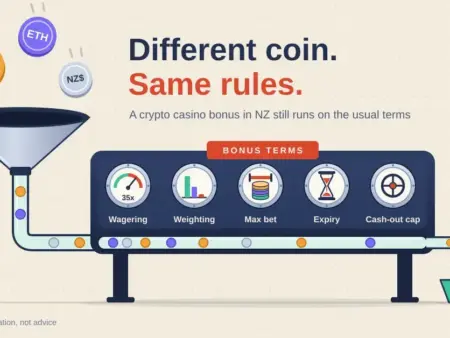
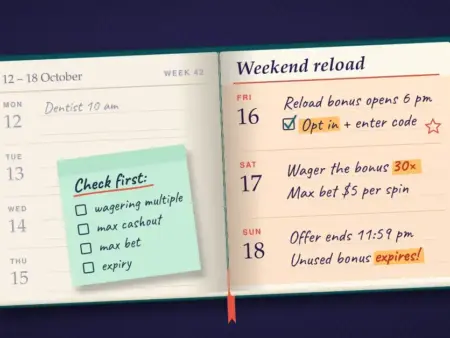
Whether a dollar-deposit bonus is worth claiming comes down to four numbers in the terms, not the headline figure. Find all four before you deposit; if any is missing or vague, treat the absence as your answer.
- The wagering requirement. This is how many times you must turn over the bonus before any winnings can be withdrawn. At 70×, a $1 bonus means $70 of turnover; at 200× — the figure the dominant network applied to its first two deposits — it means $200. Our wagering requirements explainer sets out how the maths works.
- Sticky or non-sticky. A sticky bonus can never be withdrawn itself; only the winnings generated from it can. This is standard on dollar-deposit offers, so the dollar and the bonus are effectively play-through credit, not cash.
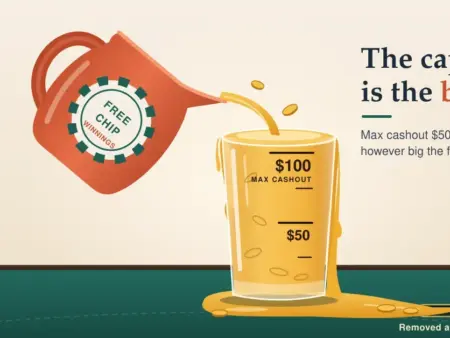
- The maximum win cap. Commonly $20 to $50. Turn a $1 bonus into $500 under a $20 cap and you collect $20. This is the term most likely to disappoint, and the one that quietly limits what a “chance to win millions” can ever pay out from the bonus.
- The expiry. Usually 7 to 30 days. Miss it and the bonus, plus everything won with it, is forfeited.
If you want a genuinely risk-free way to learn these terms, a free offer that needs no deposit teaches the same vocabulary — our no-deposit bonuses guide applies the same four checks to those.
Why the 2026 licensing rules end this offer
The dollar-deposit format is not just winding down commercially; it is being closed off by regulation. Under the Online Casino Gambling Regulations 2026, a licensed New Zealand operator may offer an inducement worth no more than NZ$100, or 200% of the deposit, whichever is lower.
On a one-dollar deposit, 200% is two dollars. Eighty spins on a jackpot pokie are worth a good deal more than two dollars, so a licensed operator simply will not be able to offer the classic dollar-deposit bundle. Tying the reward to a proportion of the deposit removes the mechanism where a tiny payment unlocks something disproportionately large — which is precisely the mechanism that turns a dollar deposit from a trial into an acquisition tool, and precisely what the cap is aimed at.
The wider timetable explains why the offer is disappearing now:
- 1 May 2026 — the Online Casino Gambling Act 2026 commenced, with the regulations following on 3 July. Advertising offshore casinos to New Zealanders became prohibited.
- Mid-July 2026 — expressions of interest opened at a fee of NZ$19,000 plus GST, the first stage of a three-stage process leading to a competitive auction and full applications for up to fifteen licences, one brand each, with no operator permitted to hold more than three.
- 1 December 2026 — operators that have not entered the licensing process must stop serving New Zealanders, with penalties reaching into the millions of dollars. Those with pending applications may continue until a decision is made or until 1 July 2027 at the latest.
- From 2027 — licensed operators are expected to go live, with a public register, the inducement cap, mandatory limit tools, restrictions on deposit methods and self-exclusion at platform level.
The practical takeaway is simple: if you hold a balance at an offshore casino, withdraw it well before December. When an operator winds down in a market, existing accounts close after new registrations do, and a weekly withdrawal cap means a substantial balance can take weeks to clear regardless. Our New Zealand gambling laws guide sets out the full timeline, and because the dollar format is a species of low minimum deposit, our minimum deposit casino guide covers how the $5 and $10 tiers fit alongside it.
Playing within your limits
A low entry point makes repeat deposits easy to lose track of. That is the specific risk this format carries, and it is not about any one operator. Twenty separate dollar deposits are twenty dollars — they simply do not feel like twenty dollars, which is part of what makes the format effective as a marketing tool.
A few practical safeguards cost nothing:
- Set a deposit limit when you register, not later. Every reputable operator provides them, and they make the running total visible. From 2027 licensed New Zealand operators will be required to offer limit tools and loss and time alerts.
- Use a bank or device block if money is getting away from you. Our self-exclusion guide explains bank gambling blocks and blocking software — both of which work across every brand in a network at once, which matters when one company runs sixteen of them.
- Reach out early. Free, confidential support is available in New Zealand at any hour on the Gambling Helpline on 0800 654 655 or by free text to 8006, and through PGF Services on 0800 664 262. You do not need to be in crisis to call.
You must be 18 or older to gamble online in New Zealand.
Disclaimer
This page is published for information. It is not financial, legal or gambling advice, and nothing on it is a recommendation to gamble or an endorsement of any operator. You must be 18 or older to gamble online in New Zealand.
No casinos are recommended or linked here. The network that dominated this offer type closed to new New Zealand registrations in April 2026, and no online casino currently holds a New Zealand licence. Availability, payment methods, bonus terms and wagering multiples change frequently and vary by country — confirm everything in the cashier before depositing. Expected-return figures are long-run averages calculated from published percentages, not predictions of any single session; a dollar deposit carries a negative expected return like any other stake. If gambling stops being fun, free and confidential help is available 24 hours a day on 0800 654 655 or by free text to 8006.
Sources
- Online Casino Gambling Regulations 2026 — New Zealand Legislation, including the inducement cap that ends this offer type.
- Online Casino Gambling Act 2026 — the primary legislation.
- Senet — what the 2026 regulations require of operators — a summary of the inducement cap, limit tools and funding restrictions.
- DIA — online gambling licensing for providers — the staged licensing process, the fifteen-licence cap and the deadlines.
- DIA — information for online casino customers — and where the licence register will be published from 2027.
- Apollo Entertainment Limited — the network behind the dollar-deposit brands — the brand list, the shared loyalty programme and group withdrawal limits.
- Kahnawake Gaming Commission — the regulator licensing this network.
- Alcohol and Gaming Commission of Ontario — internet gaming — the regulator that issued the 2023 penalty, with its public enforcement register.
- Wizard of Odds — progressive jackpot returns and odds — the base-game return figure and the per-spin jackpot probability.
- Consumer NZ — POLi payments and your banking security — why sharing internet-banking credentials can breach your bank’s terms.
- Safer Gambling Aotearoa — blocking gambling — bank blocks and blocking software that cover every brand in a network at once.
- PGF Services — free counselling and financial mentoring, including for whānau and friends.
- Gambling Helpline Aotearoa New Zealand — free, confidential support, 24 hours a day.
Frequently Asked Questions
Can I still get a $1 deposit offer in New Zealand?
The affiliated network that dominated this format closed to new New Zealand registrations at the end of April 2026, so its dollar-deposit offers can no longer be opened by new players. Check any advertised offer directly before assuming it is available to you, and be aware that advertising offshore casinos to New Zealanders is now prohibited.
Can I actually deposit exactly one dollar?
Sometimes, but usually only by e-wallet such as Skrill or Neteller. POLi, debit and credit cards and prepaid vouchers almost always carry a $10 to $20 minimum regardless of the figure the casino advertises, so the advertised “$1 minimum” and the method you use can give different answers.
What does a dollar actually buy?
Typically around eighty spins at about 1.25 cents each on a progressive jackpot pokie that returns roughly 88% in its base game. The long-run expected return on the dollar is therefore about 88 cents, and the jackpot itself remains an extremely unlikely event that eighty spins does not meaningfully change.
Why were several “top $1 casinos” the same company?
Because sixteen brands ran on one shared platform under a small number of operating companies, sharing a cashier, a loyalty account and a single withdrawal cap. A list of five “best $1 casinos” was often five logos for one business, and holding four of those accounts gives you one weekly withdrawal cap, not four.
Will $1 deposit bonuses exist after licensing?
Not in this form. Under the 2026 regulations a licensed operator’s inducement is capped at NZ$100 or 200% of the deposit, whichever is lower — which is just two dollars on a one-dollar deposit. No online casino currently holds a New Zealand licence; a regulated market with a public register is expected from 2027.
Recent Gambling News