Is Zodiac Casino NZ legit? Read our expert review of the $1 deposit bonus, Microgaming pokies, and NZD payment methods. Play safely at Zodiac Casino today.

Zodiac Casino NZ Review

Zodiac Casino has traded online since 2001, runs on Microgaming software, supports New Zealand dollars natively, and is best known for one thing: a NZ$1 deposit that buys 80 chances at a progressive jackpot. That dollar is the reason most people arrive, so this guide starts with what it is actually worth, then works through the operator, the network it belongs to, the games, the banking and where the brand sits under New Zealand’s new 2026 gambling law.
This is an information page, not a recommendation. The aim is to give you the numbers and the terms that decide whether an offer like this is worth your time, so you can check them yourself before depositing anything.
The $1 offer, priced honestly
The hook is simple: deposit NZ$1 and receive 80 chances on a progressive game, credited as bonus value. The catch is the wagering requirement. Winnings from those 80 chances carry a 200x playthrough — far above the sector norm of roughly 30x to 40x. The multiple applies to what you win, not to your dollar, so the requirement grows the better the spins go, pushing the money further out of reach exactly when there is more of it.
The arithmetic is unforgiving, and it is arithmetic rather than opinion. On a pokie returning about 96%, every NZ$1 of turnover costs roughly NZ$0.04 in expected losses. Releasing a win therefore costs several times the win itself.
The $1 offer in numbers
The 200x requirement applies to winnings from the 80 chances, not to your NZ$1. The expected cost is the long-run loss of generating that turnover on a 96% pokie (about 4 cents per NZ$1 wagered), and a maximum cashout usually applies on top.
| You win from the 80 chances | Turnover required at 200x | Expected cost to generate it |
|---|---|---|
| NZ$10 | NZ$2,000 | about NZ$80 |
| NZ$50 | NZ$10,000 | about NZ$400 |
| NZ$100 | NZ$20,000 | about NZ$800 |
Releasing a NZ$50 win therefore has an expected cost around eight times the win itself. Jackpot wins are normally exempt from wagering — confirm that in the terms, because it is the one scenario in which this offer pays.
Two further terms usually sit on top of this. First, offers of this shape almost always carry a maximum cashout that caps what you can withdraw from bonus winnings regardless of how much you land; find that cap before you play, because it often decides whether the offer is worth anything at all. Second, real-money funds are normally played before bonus funds, which is stated correctly in most listings of this offer. Our low wagering casinos guide explains how to price any offer, and our wagering requirements explained page walks through the maths step by step.
The honest way to read this offer is as a dollar’s worth of entertainment and a cheap lottery ticket on a jackpot — not as a route to a withdrawable balance. If the top prize lands, jackpot wins are normally exempt from wagering, which is the one scenario where an offer like this pays out meaningfully; confirm that exemption in the terms rather than assuming it.
One detail widely got wrong: the 80 chances are played on a jackpot wheel game, not on Mega Moolah directly. Several pages describe the same offer as Mega Moolah spins. They are not the same thing, and the distinction matters because the wheel game and the headline progressive behave differently.
The operator and the licence
Knowing who holds your account and under which regulator is the single most useful fact about any offshore casino, because it decides who you can complain to if a withdrawal stalls.
Quick facts
| Brand / launched | Zodiac Casino, trading online since 2001 |
| Parent network | Casino Rewards (30-plus casinos sharing one loyalty programme) |
| Company named in terms | Fresh Horizons Limited, registered in the British Virgin Islands |
| Operating entity | Apollo Entertainment Limited |
| Licence | Kahnawake Gaming Commission (commonly cited as number 00972); verifiable on the Commission’s own portal |
| Independent testing | eCOGRA certified |
| Games software | Microgaming exclusively (no NetEnt, Play’n GO or Pragmatic Play) |
| Native currency | New Zealand dollars (NZD) |
| Entry offer | NZ$1 deposit for 80 chances on a progressive jackpot wheel game |
| Wagering on entry offer | 200x the winnings from the 80 chances |
| New Zealand licence | None held to date; the domestic online casino register opened in 2026 and offshore brands must be licensed to continue after 1 December 2026 |
The brand has traded since 2001 and sits inside the Casino Rewards network. The company named in the terms is Fresh Horizons Limited, registered in the British Virgin Islands, while the operating entity is Apollo Entertainment Limited — both names appear in the group’s own material, so check the current site footer for the exact form. The casino operates under a Kahnawake Gaming Commission licence (commonly cited as number 00972) and holds eCOGRA certification, which is a genuine, independent third-party testing signal and one of the stronger ones available.
Some pages describe Zodiac as licensed by Malta, Britain and Kahnawake at once. Treat any multi-licence claim with suspicion unless each carries a number that resolves on that regulator’s own public register. The licence that actually governs a New Zealand account is the one named in the terms you agree to, and the balance of evidence points to Kahnawake rather than Malta. Kahnawake is a real regulator with a published dispute process, but it carries less weight than Malta or the UK — both of those things are true at once, and a page that tells you only the reassuring half is selling you something.
There is also a separate Ontario position. Several brands in this network hold an Ontario registration regulated by the Alcohol and Gaming Commission of Ontario (AGCO) so they can serve that Canadian province. That is a different market and a different licence from anything covering a New Zealand sign-up, and the two should not be conflated.
A regulatory penalty on the record
In August 2023 the AGCO issued a CA$100,000 monetary penalty against Apollo Entertainment Limited for failures to meet Ontario’s responsible-gambling standards — including failing to intervene with at-risk players, with one customer reported to have lost more than CA$2 million in under four months without intervention. Apollo operates a group of Ontario-licensed sites, Zodiac Casino among them, and the regulator said the violations were against the operator rather than any one brand. The operator reportedly cooperated and strengthened its controls afterwards.
Read that in proportion. CA$100,000 is modest against penalties running into the millions elsewhere in the industry, and a published enforcement action means a regulator with real powers was watching — the casinos with nothing on any register are usually the ones nobody has examined. But it belongs in front of a reader who is being told the group has a long, clean track record, because it is part of that record. You can look the action up on the AGCO’s own enforcement notices, and verify the Kahnawake licence number on the Commission’s portal.
The group and why it matters
Zodiac is one of more than thirty casinos sharing a single loyalty network, and on a network that size the group-wide terms matter more than most reviews suggest. A few points are worth settling before you deposit:
- Withdrawal caps are usually group-wide. Networks of this kind commonly apply a weekly withdrawal limit in the low thousands, counted across every brand in the family rather than per casino. Holding several accounts across sister sites gives you one shared limit, not several, and a large win is released in instalments over weeks while the balance sits in a gambling account.
- Jackpot exemption is the term that matters most. On a casino built entirely around jackpot play, whether progressive jackpot wins are exempt from the withdrawal cap is the single most important line in the document. They usually are — confirm it rather than assuming it.
- One welcome offer per person, across the network. Opening a second account at a sister brand to claim a second offer is exactly the behaviour group terms exist to prevent, and it can void both accounts.
- Self-exclusion scope needs to be asked in writing. On a thirty-plus brand network, an exclusion that covers one site and not the other twenty-nine is close to no exclusion at all.
- The 200x is a group setting, not a quirk of this casino. Expect the same figure at the sister brands, and do not assume a different casino in the same network means different terms.
Getting the family tree right is practical, not academic. This network applies 200x to early bonus winnings. A different large group — Bayton Ltd, which runs JackpotCity, Spin Casino, Royal Vegas, Ruby Fortune and Lucky Nugget — applies 70x. A reader told the two are relatives would expect the same rules and meet a very different set. Because those brands are genuinely separate companies, they are genuine alternatives with separate accounts, separate welcome offers and separate withdrawal limits; our Spin Casino review covers that group. Calling two unrelated casinos relatives throws that advantage away.
To settle the question yourself, find the operating company in the footer — the company, not the brand — and search that company on the regulator’s own register, which lists every brand under the same licence and answers the question directly rather than by inference.
One more distinction worth keeping clear: a New Zealand venue brand’s website is not a New Zealand licensed operation. The physical venue holds a domestic casino licence, but the website is a separate business run offshore on a foreign licence by a third-party platform company, so the two should never be treated as one licensed operation.
The games
Zodiac runs on Microgaming software exclusively. That means a deep, long-established catalogue of pokies and table games, but also a real constraint: no NetEnt, no Play’n GO and no Pragmatic Play. If you came for a specific studio’s titles, they will not be here.
Well-known Microgaming pokies such as Thunderstruck II, Immortal Romance and Avalon II are present, the last of these with a return to player (RTP — the long-run percentage of stakes a game pays back) of about 97.12%, toward the better end of the range.
The jackpot draw deserves one honest figure. Mega Moolah returns about 88% in its base game — roughly 88.12%, against the 93.42% headline figure that counts the jackpot pool, because around 5.3% of every wager funds the progressive prizes rather than being returned through normal play. At NZ$1 a spin over a thousand spins, that base-game return implies an expected loss near NZ$119, against about NZ$40 on a standard 96% pokie. The jackpot can of course change a life, but the price of chasing it is higher than a glance at the headline RTP suggests. Our jackpot pokies guide covers the odds and the trade-off in full.
One title worth checking before relying on a lobby listing: Microgaming’s Game of Thrones licence has lapsed and the game has been withdrawn from most lobbies, so it may no longer be available.
Banking in New Zealand dollars
New Zealand dollars are supported natively, which avoids currency-conversion margins on both deposits and withdrawals. POLi, Paysafecard, debit and credit cards and e-wallets are the usual deposit methods. Withdrawal speed depends on the route: e-wallets typically clear in 24 to 48 hours, while cards and bank transfers usually take three to five business days.
Two things are worth knowing before you fund an account. Most New Zealand banks now block gambling transactions on credit cards, so a card deposit may simply be declined. And some bonus offers exclude e-wallet deposits, so if you intend to claim, check which methods qualify before you move any money.
On POLi specifically: it works by having you enter your internet-banking username and password into a third party’s interface. Consumer NZ has warned that this probably breaches your bank’s terms and conditions, and the major New Zealand banks have told customers never to share their login details. Regulated open banking went live in New Zealand on 1 December 2025 under the Customer and Product Data Act, and it keeps payment authorisation inside your own bank’s app rather than handing credentials to a middleman, which is the safer direction of travel, so it is worth preferring a method that keeps authorisation inside your own bank’s app.
Where this sits under the 2026 law
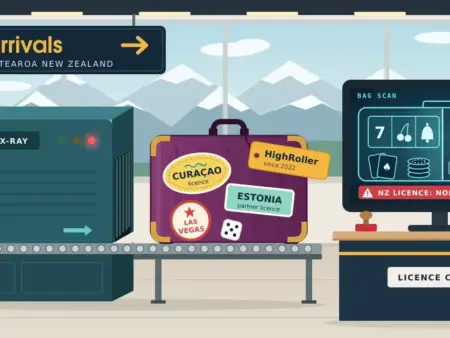
New Zealand’s online casino market is no longer a grey area. Online casino gambling is now governed by the Online Casino Gambling Act 2026, in force since 1 May 2026, with the detailed regulations following on 3 July 2026. This is settled law, not a bill before Parliament, and any page still describing New Zealand as unregulated is out of date.
The licensing process is deliberately narrow. Expressions of interest opened on 17 July 2026 with a non-refundable fee of NZ$19,000 plus GST, and applicants must demonstrate access to substantial capital (reported at around NZ$7.5 million). An ascending auction and full applications follow, for up to fifteen licences — one brand per licence, and no operator may hold more than three. Licensed operators also face a 16% online gambling duty plus problem-gambling and regulatory levies. From 1 December 2026, operators that have not entered the process must stop serving New Zealanders, with penalties of up to NZ$5 million.
The advertising and inducement rules reshape offers like the $1 deal directly. Where a customer must spend their own money, a bonus is capped at the lesser of NZ$100 or 200% of the deposit; where no spend is required, the cap is NZ$100. On a NZ$1 deposit, 200% is NZ$2 — so an entry offer of this shape simply cannot survive licensing in its present form. And on a thirty-plus brand network, at most three brands could follow the operator into a licensed New Zealand market.
Confirm that New Zealand registrations are still accepted before depositing. Sources conflict on this network’s current position, and several offshore groups have already closed to new New Zealand sign-ups while pursuing a domestic licence. Attempt registration and look at the cashier rather than relying on a page written months ago. Our New Zealand gambling laws guide sets out the full timetable.
Who this suits, and who it does not
Taken on its own terms, Zodiac suits a player who wants a cheap, low-stakes look at a progressive jackpot and treats the NZ$1 entry as the price of entertainment, not an investment. The native NZD support and the long trading history are genuine points in its favour, and eCOGRA testing is a real signal.
It suits far less anyone expecting to turn the welcome offer into a withdrawable balance — the 200x wagering and likely cashout cap make that implausible — or anyone who wants a broad spread of game studios, since the lobby is Microgaming only. And because the brand is offshore-licensed, the protections of the incoming domestic regime do not apply to it unless and until it is licensed here.
Getting help
Free, confidential support is available in New Zealand at any hour: the Gambling Helpline on 0800 654 655 or free text 8006, and PGF Services on 0800 664 262. You must be 18 or older to gamble online in New Zealand.
Our self-exclusion guide covers bank gambling blocks and device-blocking software — both of which cover every brand in a thirty-casino network at once, which is the practical answer to the self-exclusion-scope question above.
Disclaimer
This page is published for information. It is not financial, legal or gambling advice, and nothing on it is a recommendation to gamble or an endorsement of any operator. You must be 18 or older to gamble online in New Zealand.
The regulatory penalty described is a matter of public record. It is included because a reader is entitled to know an operator’s compliance history, not as a suggestion of current wrongdoing; the current position should be confirmed on the regulator’s own register.
Licensing, ownership, bonus terms, wagering multiples, withdrawal limits and country availability all change, sometimes within weeks. Sources conflict on whether this brand is currently accepting new New Zealand registrations, and this page does not resolve that — check before planning around it. Expected-cost figures are long-run averages, not predictions of any session, and no bet described here has a positive expected return. Gambling costs money over time by design; a one-dollar entry point changes only how cheaply the first session starts. Set a deposit limit before your first deposit rather than after a losing one.
Sources
- Kahnawake Gaming Commission — licensees and the player dispute process; where the licence number can be checked.
- Alcohol and Gaming Commission of Ontario — enforcement actions and monetary penalties, searchable by operator.
- eCOGRA — independent testing agency, certification and dispute resolution.
- Malta Gaming Authority — licence verification — for checking whether any Malta licence claim actually resolves.
- Zodiac Casino — operator and licence details — the Fresh Horizons Limited registration and the Kahnawake licence.
- Casinos Analyzer — Zodiac Casino bonus terms — the licence number, operating company and offer conditions.
- Wizard of Odds — Mega Moolah returns and odds — the base-game return behind the jackpot titles.
- DIA — online gambling licensing for providers — the multi-stage process and the 1 December 2026 cut-off.
- DIA — information for online casino customers — what the licensing change means for players.
- Senet — Online Casino Gambling Regulations 2026 — the inducement cap and harm-prevention requirements.
- Consumer NZ — POLi payments and your banking security — why sharing internet-banking credentials can breach your bank’s terms.
- BetBlocker — free device-blocking software run by a registered charity; covers every brand in a large group at once.
- Gambling Helpline Aotearoa New Zealand — free, confidential support, 24 hours a day.
Frequently Asked Questions
What is the wagering requirement on the $1 offer?
It is 200x the winnings from the 80 chances. Win NZ$50 and that is NZ$10,000 of turnover, at an expected cost near NZ$400 to release it — far above the 30x to 40x common elsewhere.
Is the offer worth taking?
As a dollar’s entertainment and a cheap jackpot ticket, it can be. As a route to a withdrawable balance it is not, because the arithmetic of a 200x requirement does not support it.
Are the 80 chances played on Mega Moolah?
No. They are played on a separate jackpot wheel game, not on Mega Moolah directly. That distinction is widely got wrong on other pages describing the same offer.
Who operates Zodiac Casino and who licenses it?
Fresh Horizons Limited is named in the terms, with Apollo Entertainment Limited as the operating entity, under a Kahnawake Gaming Commission licence. It is part of the Casino Rewards network, and the evidence points to Kahnawake rather than Malta, whatever some pages claim.
Can I legally play here from New Zealand in 2026?
Online casino play is now governed by the Online Casino Gambling Act 2026. Offshore operators that have not entered the licensing process must stop serving New Zealanders from 1 December 2026, so confirm the cashier still accepts New Zealand registrations before depositing.
Recent Gambling News