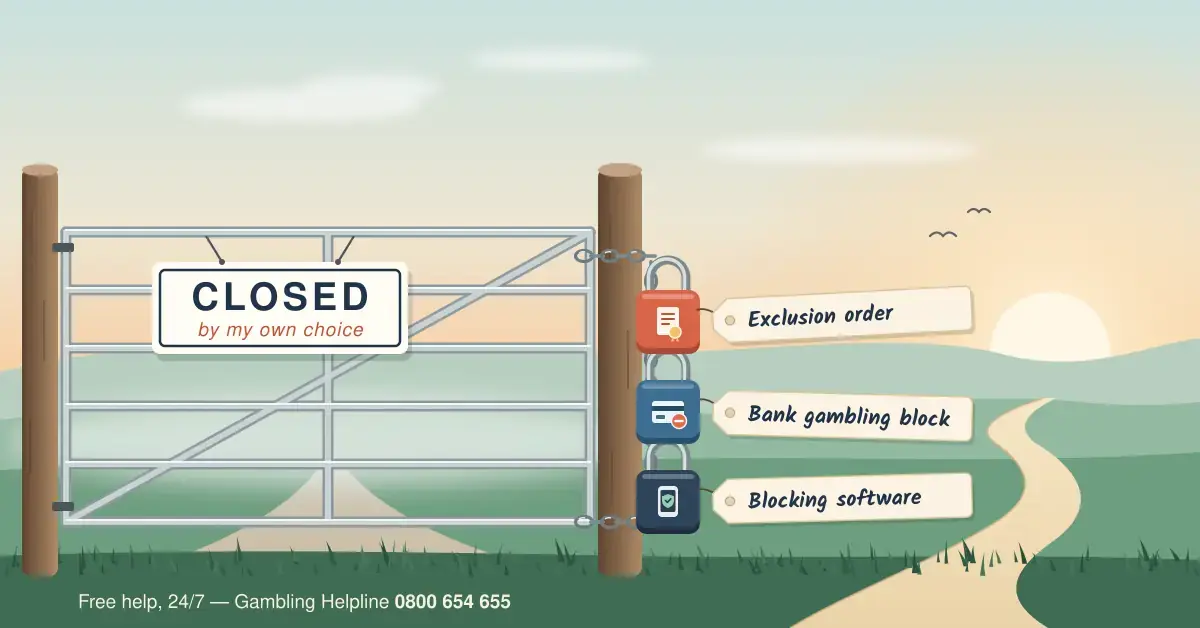
If you are reading this because gambling has stopped feeling like a choice, the useful part is short: the strongest tools available in New Zealand do not depend on any casino agreeing to anything. This page explains what each tool actually does, which ones carry legal force, and how to combine them. There are no casino recommendations here and no offers.
Free help in New Zealand
Gambling Helpline — 24 hours a day: call 0800 654 655 or free text 8006. Free from any New Zealand landline or mobile, and you do not have to give your name. Te reo Māori and Pacific-language support is available.
PGF Services — free counselling and financial mentoring: 0800 664 262. PGF delivers national gambling-harm services, with Māori, Pacific, Asian and youth-specific support — for the person gambling and for the people around them.
If things feel urgent: call or text 1737 any time to reach a trained counsellor, free. If someone is in immediate danger, call 111.
You do not need to have decided anything before you call. These services support family, partners and friends as well as the person gambling, and you can call on someone else’s behalf.
The tools differ a lot in how well they work, and the difference is not obvious from the outside. There are four, and it is worth seeing them ranked by strength before going through them one at a time.
The four tools, strongest first
The four tools compared
| Tool | What it covers | Needs an operator’s cooperation? | Strength |
|---|---|---|---|
| Bank gambling block | Card payments to gambling merchants, across every site at once. Free where offered, and usually held for a set period before it can be lifted. | No | Strongest |
| Device blocking software | Tens of thousands of gambling sites and apps across your phone, tablet and computer. Free from a registered charity. | No | Strong |
| Venue exclusion order | The gambling area of a New Zealand casino or pokie venue, for up to two years. Backed by the Gambling Act 2003, with a fine on a venue that breaches it. Multi-Venue Exclusion covers many venues through one process. | Yes, but legally enforceable | Strong where it applies |
| Online operator self-exclusion | One account at one website. Nothing stops a new account being opened elsewhere, and no scheme covers offshore casinos as a group. | Yes, and unenforceable here | Weakest |
That order is deliberate, and it is close to the reverse of how these tools are usually presented. Online self-exclusion at a casino gets talked about first because it is the one the casino controls. It is genuinely useful, and it is also the weakest of the four: it relies on the operator honouring it, applies to one account only, and covers nothing you might open tomorrow. The bank block and the device software are stronger for the opposite reason — neither needs anyone’s cooperation.
Bank gambling blocks
A block at your own bank stops card payments to gambling merchants across every site at once, and it does not care whether any casino agrees. It is the single most effective step most people can take in an afternoon.
Westpac NZ offers two versions. The original block, set up by phone or at a branch, applies to all your credit and debit cards, declines online transactions with gambling businesses, and stays in place for a minimum of three months before it can be removed. Since late 2025 Westpac has also offered gambling controls you can switch on yourself in the app or internet banking; those carry a shorter two-day stand-down before they can be turned off. Kiwibank offers a gambling-block option that stops its cards being used at known gambling merchants. As of 2026, ANZ, ASB and BNZ have not publicly confirmed an equivalent dedicated voluntary block, although all banks decline some overseas gambling merchants through ordinary fraud filters. Ask your own bank directly — this is changing, and their answer is better than anything written here.
What a card block does not catch
Two limits are worth understanding, because they decide what to pair the block with:
- Merchant category codes. Blocks work by reading the category code a merchant is registered under. A payment routed through an e-wallet, a prepaid voucher or a cryptocurrency exchange may be registered as something other than gambling, so it can slip through.
- Direct payments from your account. A card block does not cover money moved straight from your bank account — for example a bank transfer or direct debit — because that never touches the card network.
That is not a reason to skip the block. It is the reason to pair it with device blocking, which closes the same gap from the other direction.
Ask about the stand-down. The delay before a block can be lifted is the part doing the work. When you set one up, ask how long that removal period is and choose the longer option if you are offered a choice.
Device blocking software
BetBlocker is free software from a registered charity that blocks tens of thousands of gambling sites and apps. It installs on phones, tablets and computers, and once a restriction period is set it cannot be lifted early. Paid alternatives such as Gamban exist and work in a similar way, but BetBlocker being free and run by a charity makes it the natural starting point.
Install it on the phone as well as the computer. Mobile is the device most people actually gamble on, and the one most often left uncovered.
Venue exclusion orders: the part with legal teeth
This is the part of the New Zealand system that works properly, and it is stronger than most people assume. It applies to the gambling area of a New Zealand casino and to pubs and clubs with pokies, and it is backed by the Gambling Act 2003.
Self-exclusion you ask for (section 310)
If you tell a casino or a pokie venue that you are having difficulty with your gambling and ask to be excluded, the venue is required to issue an exclusion order. It is not discretionary. In practice you will normally be asked for identification and a photograph so staff can recognise you — New Zealand casinos run carded, ID-checked entry, as our SkyCity Auckland casino review describes — and the order can run for up to two years.
Venue-initiated and third-party exclusion (sections 309 and 309A)
Where staff have reasonable grounds to believe someone is experiencing harm, they must approach that person, offer information and advice, and may then issue an exclusion order of up to two years. Family members can also raise concerns with a venue operator, and bringing something concrete — such as bank statements — helps the venue act.
Why breaching an order is an offence (section 312)
Once an order is in place, it is an offence for the venue to admit you to the gambling area and an offence for you to enter. The maximum fine is NZ$5,000 for the venue manager or casino licence holder and NZ$500 for the excluded person. Failing to issue an order when properly asked also carries the NZ$5,000 penalty. Venues must keep records of every exclusion and produce them to the Secretary for Internal Affairs on request. That imbalance is deliberate: the larger consequence sits with the operator, which is what gives venues a real reason to enforce an order rather than wave it through.
Multi-Venue Exclusion: many venues, one process
Rather than visiting every venue individually, Multi-Venue Exclusion (MVE) lets you exclude yourself from multiple pokie venues through a single process. It has run in New Zealand since 2011, is nationally administered by the Salvation Army, and orders are managed through a shared database so venues receive them consistently. New Zealand’s casinos also operate their own multi-venue scheme between them.
In practice MVE is a short meeting, identification, a form and a photograph. Any gambling-harm service can help you arrange it: call the Gambling Helpline on 0800 654 655 or PGF Services on 0800 664 262, or contact the national MVE service directly through its website. A counsellor will walk you through it, and you can bring someone with you.
What online self-exclusion does and does not do
Online self-exclusion works at one operator only. Setting an exclusion at one site does nothing at any other site, and nothing stops a new account being opened elsewhere the same evening. There is no scheme in New Zealand that excludes you from offshore casinos as a group.
That is not a comment on anyone’s willpower. It is a structural gap, and it is the whole reason the bank-level and device-level tools matter more than they are usually given credit for. Two claims commonly made about online self-exclusion are not reliable:
- “Every reputable online casino offers self-exclusion.” No operator serving New Zealand is licensed here yet, so none is currently required to offer self-exclusion, honour it, or stop you opening a second account. Many do offer it; none is obliged to. The same uncertainty is why unlicensed offshore casinos are worth treating with caution generally.
- “You can’t reverse an online self-exclusion.” Some operators allow reversal, and some simply reopen accounts once a period expires without any check. Do not rely on a casino’s own exclusion as your only barrier.
Exclusion also does not cross between a venue and that brand’s website. Where a New Zealand casino company also runs an online casino, the two are usually separate businesses under separate regulators — the venue under New Zealand law, the website often under a Maltese licence. Excluding yourself at one does not automatically exclude you at the other. Our comparison of how a venue and its online arm differ and our SkyCity online casino guide explain that split. Ask both directly, in writing, and keep the replies.
What the Online Casino Gambling Act 2026 changes
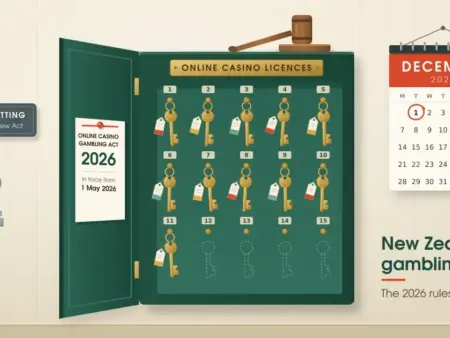
The legal picture is changing. The Online Casino Gambling Act 2026 came into force on 1 May 2026, with its regulations taking effect from 3 July 2026. Offshore operators that were already serving New Zealanders may continue only until 1 December 2026; from that date, up to 15 operators that succeed at auction may provide online casino gambling under a temporary exemption while the Department of Internal Affairs assesses their licence applications, and all others must exit the market. The regulator expects to begin issuing full licences from early 2027, and licensed sites will appear in a public register and display a unique registration icon.
Once licensed, operators will have to:
- Provide self-exclusion processed within 24 hours, for a fixed period or indefinitely
- Offer deposit, spend and session limits across daily, weekly and monthly periods
- Apply a 24-hour cooling-off period before any limit increase takes effect, with reductions applying immediately
- Verify age, with a minimum of 18
- Monitor player behaviour for indicators of harm
- Stop accepting credit cards and buy-now-pay-later as payment
- Limit customers to one account and one deposit method per platform
- Remove autoplay and prevent more than one pokie running at once
Until licensed sites actually launch, none of that is binding on the operators reachable from New Zealand today. Our New Zealand gambling laws guide sets out the timeline in full.
How to stack the tools
The tools are strongest together, and there is a sensible order to set them up in:
- Start with the two that need no one’s cooperation. Put a gambling block on your bank cards and install device-blocking software on your phone and computer the same day.
- Add a venue exclusion if pokie venues or a casino are part of the picture, and use Multi-Venue Exclusion to cover several at once.
- Use any online operator self-exclusion as a top-up, not a foundation. It is the easy extra, not the thing holding the line.
- Tell one person. A conversation with a free counsellor, or just someone close to you, makes the other steps far more likely to hold.
If you are wondering whether it is time
There is no threshold you have to cross before you are allowed to use any of this. People contact these services at every stage, including well before things become serious. Some things that commonly prompt a rethink:
- Gambling more than you planned to, more often than you meant to
- Trying to win back money you have lost
- Borrowing to gamble, or using credit
- Choosing payment methods partly because they keep it off a bank statement
- Not being straight with people about how much
- Feeling restless or on edge when you are not gambling
- It affecting work, sleep, relationships or health
None of these is a diagnosis and this is not a test. If more than one of them landed, that is worth a phone call — not because something is wrong with you, but because the call is free, confidential and easier than most people expect. Our responsible gambling page has further information.
A note about this site
We publish information about online casinos, so we should be direct about something. If you are on this page because gambling has stopped being enjoyable, the rest of this site is not what you need right now. Nothing here will help you find a safer casino or a better bonus, because those are not the problem being solved.
The numbers at the top of this page are the useful part; everything else is context. If you think something here is wrong or out of date, our contact page is the way to tell us.
Disclaimer
This page is published for information. It is not legal, financial, medical or clinical advice, and nothing on it is a diagnosis. It describes how the tools available in New Zealand work; it does not replace speaking to a counsellor, and the services listed here are free.
Bank policies, exclusion procedures and legislation change. Phone numbers and processes were checked when this page was last reviewed. If something here does not match what you are told by a bank, a venue or a support service, take their answer over ours.
If gambling is causing harm to you or someone close to you, free confidential support is available in New Zealand 24 hours a day on 0800 654 655, or by free text to 8006. If things feel urgent, call or text 1737. In an emergency, call 111.
Sources
- Gambling Helpline Aotearoa New Zealand — free, confidential support, 24 hours a day.
- PGF Services — free counselling for gambling harm, and for whānau and friends.
- Multi-Venue Exclusion — the national MVE service, administered by the Salvation Army.
- Gambling Act 2003, section 312 — offences and penalties for breaching an exclusion order.
- DIA — exclusion order guidelines — self-exclusion versus venue-initiated orders, and record-keeping duties.
- DIA — gambling harm prevention and minimisation guidelines — what venues are required to do.
- Westpac NZ — gambling block — how a New Zealand bank block works and how to request one.
- Kiwibank — gambling block option — card-level gambling block for customers.
- BetBlocker — free device-blocking software, run by a registered charity.
- Safer Gambling Aotearoa — Health New Zealand | Te Whatu Ora.
- DIA — information for online casino customers — the incoming licensing regime and the protections it will require.
Frequently Asked Questions
Does self-exclusion at one online casino cover the others?
No. It applies only to that operator. There is no scheme that excludes you from offshore casinos as a group, which is why a bank gambling block and device-blocking software matter more — both cover every site at once.
What is the strongest tool available to me right now?
A gambling block at your own bank, combined with blocking software on your devices. Neither depends on a casino honouring anything, and both cover every site at once rather than one at a time. Add a venue exclusion on top if pokie venues or a casino are part of the picture.
Which New Zealand banks offer a gambling block, and will it catch everything?
Westpac NZ offers one by phone or branch (held at least three months) and newer in-app gambling controls, and Kiwibank offers a card gambling-block option; ANZ, ASB and BNZ have not publicly confirmed an equivalent, so ask your own bank. A block will not catch everything: payments routed through an e-wallet, prepaid voucher or crypto exchange may slip through, and card blocks do not cover transfers made straight from your account. Pair it with device blocking.
How do I exclude myself from pokie venues, and does it get enforced?
Ask any venue with pokies, or a casino, and they are required to issue an exclusion order under section 310 of the Gambling Act 2003. To cover several venues at once, use Multi-Venue Exclusion — the Gambling Helpline (0800 654 655) or PGF Services (0800 664 262) can arrange it. It has legal force: once an order is in place, admitting or entering the gambling area is an offence, with a maximum fine of NZ$5,000 for the venue manager against NZ$500 for the excluded person.
If I exclude myself at a casino, am I excluded from its website?
Not automatically. The venue and the website are usually different companies under different regulators, so excluding yourself at one does not exclude you at the other. Ask both in writing and keep the replies.