Staying in control of gambling is far easier when you know which tools genuinely hold and which only look reassuring. This guide explains the practical controls available to people in New Zealand — bank blocks, device-blocking software, venue and multi-venue exclusion, player-set limits and online self-exclusion — ranked by how well each one actually works. It also sets out what the law now requires of operators, how common gambling harm is here, and where to find free, confidential help. For a step-by-step on excluding yourself from a casino, see our self-exclusion guide.
If you are reading this because something already feels wrong, you do not need a crisis or a firm decision before you reach out. Free, confidential support is available at any hour, and the phone numbers are listed in the disclaimer and the sources below.
The controls, ranked by how well they hold
Controls at a Glance
| Strength | Control | How well it holds |
|---|---|---|
| 1 — Strongest | Gambling block at your own bank | Covers every operator at once, needs no casino’s cooperation, and carries a stand-down period before it can be lifted. Westpac NZ holds one for at least three months; Kiwibank restricts a card category. |
| 2 — Very strong | Device-blocking software | Blocks thousands of gambling sites and apps across your devices and cannot be lifted early. BetBlocker is free (a registered charity); Gamban is paid. Install it on the phone too. |
| 3 — Enforceable | Venue and Multi-Venue Exclusion | Backed by the Gambling Act 2003, with a fine on any venue that breaches an order. A single request can cover many pokie venues. |
| 4 — Useful | Deposit, spend and session limits | Best set before the first deposit, at the lowest figure you would be comfortable losing. A first line of defence, not a last one. |
| 5 — Weakest | Self-exclusion at an online casino | Covers one account at one site, possibly not its sister brands. No operator serving New Zealand is licensed here, so none is required to offer or honour it. |
Set up one and two first. Online self-exclusion is usually discussed first because it is the control the casino owns — and the one that depends most on somebody else choosing to honour it.
That ordering is close to the reverse of how the gambling industry usually presents these tools, and the reason is simple: a casino talks first about the controls it owns. The controls that work best are the ones that do not depend on any single operator choosing to honour them.
A gambling block at your own bank is the strongest single step for most people. It covers every operator at once, needs no cooperation from any casino, and normally carries a stand-down period before it can be lifted — and that delay is the part doing the work. Westpac NZ offers a block on request, held for at least three months; Kiwibank operates a card-category restriction. Availability is changing, so ask your own bank what it provides.
Device-blocking software works from the other direction, closing the gap a card block cannot reach. It blocks thousands of gambling sites and apps across your devices and cannot be lifted early once a period is set. BetBlocker is free and run by a registered charity; Gamban is a paid alternative. Install it on your phone as well as your computer, because mobile is the device most often left uncovered.
Venue exclusion under the Gambling Act 2003 is the part of the New Zealand system with real force behind it: an order the venue must issue on request, with a fine on any venue that breaches it. Multi-Venue Exclusion lets you exclude yourself from many pokie venues through a single request, arranged through any gambling-harm service.
Deposit, spend and session limits are worth setting — and worth setting before the first deposit rather than after a losing session. Choose the lowest figure you would be comfortable losing, and check whether an increase takes effect immediately or only after a delay. Limits are a useful first line of defence, not a last one.
Online self-exclusion sits last. It covers one account at one website, possibly not that operator’s sister brands, and nothing stops a new account opening elsewhere. Because no online casino currently serving New Zealand is licensed here, none is obliged to offer self-exclusion, honour it, or check before reopening an account once a period expires. Treat it as a useful addition, never as your only barrier.
One point worth pressing. If you have set a limit before and passed it, the answer is a stronger control rather than a firmer intention. That is not a comment on willpower — it is exactly what the ranking above is for. Set up the bank block and the device software first; the casino-owned tools come after.
How common gambling harm is in New Zealand
Gambling Harm in New Zealand
| 186,000 | people in New Zealand are personally affected by gambling harm. |
| 61,000 | are gambling at moderate or more serious levels of harm — about the population of Rotorua. |
| 125,000 | more are likely experiencing at least some level of harm, and are at risk of more — about the population of Dunedin. |
| 1 in 5 | New Zealand adults will be affected at some point, by their own gambling or someone else’s. |
| 2× | Māori, Pacific and Asian peoples are each more than twice as likely to experience moderate to severe gambling harm than the European and other population. |
None of this predicts anything about any individual. It does mean that if this is happening to you, it is common, it is well understood, and there are free services built specifically for it — including kaupapa Māori, Pacific and Asian services. Figures published by Health New Zealand | Te Whatu Ora and the Department of Internal Affairs.
Harm falls unequally. Māori, Pacific and Asian peoples are each more than twice as likely to experience moderate to severe gambling harm than the European and other population, and people on lower incomes are disproportionately affected. Research also points to higher concentrations of pokie machines in lower-socioeconomic areas.
Free services exist specifically for this, including kaupapa Māori, Pacific, Asian and youth-focused support delivered through PGF Services and others. If any of this describes your situation, you are not an unusual case, and the people answering the phone will not be surprised. Our responsible gaming page carries further information and contacts.
Signs worth paying attention to
None of the following is a diagnosis, and this is not a test. It is simply a set of questions worth sitting with honestly.
- Are you gambling with money meant for bills, rent or food?
- Are you trying to win back what you have already lost?
- Are you being less than open with people about how much you gamble?
- Is it affecting your sleep, your work, or your relationships?
- Are you gambling to change how you feel, rather than for entertainment?
- Have you set a limit before and passed it?
If any of those land, that is worth a phone call — not because things have reached a crisis point, but because the services are free and talking to someone early is far easier than talking to them late.
What the law actually requires
Three things are often stated about the New Zealand position that are now out of date.
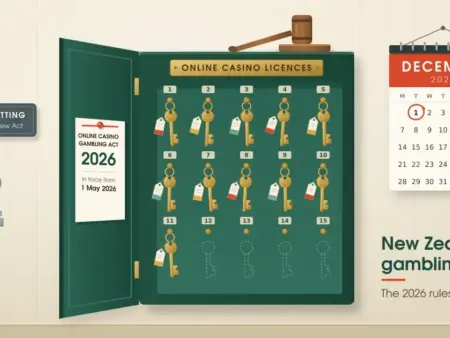
“Gambling here is governed only by the Gambling Act 2003.” Partly. The Gambling Act still governs land-based casinos, pokie venues and the exclusion regime. But online casino gambling is now governed by the Online Casino Gambling Act 2026, which received Royal Assent on 27 April 2026 and came into force on 1 May 2026, with detailed regulations in force from 3 July 2026. The Department of Internal Affairs will issue up to 15 licences through an auction, with licensing expected to begin in early 2027. Offshore operators that already served New Zealanders before 1 May 2026 may continue — without advertising — only until 1 December 2026, after which operators without a licence application must stop serving New Zealand. A public register of licensed casinos is planned. You can follow the detail in our New Zealand gambling laws guide and our overview of the New Zealand online casino market.
“Offshore play is fine as long as the operator holds a Malta, Curaçao or similar licence.” The Curaçao master-licence system was abolished when the island’s new gambling law (the LOK) came into force at the end of 2024, replacing resold “master” licences with direct government licensing — so any page still citing a Curaçao master-licence number as a current credential is describing a superseded system. More importantly, the jurisdiction named in a site’s footer tells you which rules apply to your account, and none of those regulators is a New Zealand authority.
“All responsibility for play falls on the user.” That is the industry’s framing rather than the legal position, and the 2026 Act moves in the opposite direction. Licensed New Zealand operators will be required to:
- Verify age, with a minimum of 18, using robust digital identity checks at sign-up rather than a self-declared tick-box
- Offer configurable deposit, spend and session limits
- Apply a 24-hour cooling-off period before any increase to a limit takes effect
- Provide breaks in play, time-outs and pop-up alerts after 60 minutes of continuous play
- Offer self-exclusion, with a 24-hour delay before a customer can return to play
- Identify and act on signs of harm, excluding customers identified as experiencing problem gambling
- Ban credit cards and credit-linked payment methods
- Prohibit autoplay and multi-slot play — more than one pokie running at once
- Operate under tight restrictions on advertising and inducements
Until the licensed market opens, none of that binds the operators available to you, because no online casino currently holds a New Zealand licence and no New Zealand authority can require anything of them.
Many offshore brands hold licences in several countries and run different terms in each. A wagering requirement, a bonus cap or a self-exclusion scheme that looks unusually generous may belong to a regulated market whose rules do not reach New Zealand — Britain’s limits on new-customer promotions, for example, apply to British customers of a British-licensed operator and to nobody else. Check the terms on the version of the site you can actually reach, and note which currency they are quoted in; comparison pages routinely mix jurisdictions up.
If someone you know is struggling
PGF Services and the Gambling Helpline both support whānau, partners and friends. You can call on your own behalf, about someone else, without them knowing and without having to persuade them of anything first.
Some things that help in practice:
- Keep your own finances separate, and do not cover losses. Paying off a debt removes the consequence without removing the cause.
- Say what you have noticed rather than what you have concluded, and avoid turning it into an ultimatum.
- Get help with the money side separately. PGF offers free financial mentoring, and it is often easier to start there than with the gambling itself.
- Look after yourself too. Support for affected family members is a service in its own right, not a lesser version of the real thing.
If you are concerned about someone at a pokie venue or a casino, you can raise it with the venue operator directly. Where staff have reasonable grounds to believe a person is experiencing harm they must approach them and offer information, and they may issue an exclusion order. Bringing something concrete, such as bank statements, helps.
Why this guide carries no operator links
This is a site about online casinos, which is a real conflict of interest on a page like this one. Naming it is better than pretending otherwise.
What that means in practice. No operator is recommended anywhere on this page, and no link on it goes to a gambling operator. The support services listed are publicly funded and independent of the industry. The controls above are ranked by how well they work, not by who provides them. Somebody reading a page about staying in control should not be handed a sign-up link at the end of it.
If you find yourself reading casino comparison pages while also reading this one, that is worth noticing. Our about page explains how we check things, and our contact page is the way to tell us if anything here is wrong or out of date.
Disclaimer
This page is published for information. It is not legal, financial, medical or clinical advice, and nothing on it is a diagnosis or a screening test. It describes the controls available in New Zealand and where to find help; it does not replace speaking to a counsellor, and the services listed here are free.
No gambling operator is recommended anywhere on this page, and no link on it goes to an operator. The support services named are publicly funded and independent of the gambling industry.
Bank policies, exclusion procedures, prevalence figures and legislation all change. Everything here was checked when the page was last reviewed. If something does not match what you are told by a bank, a venue or a support service, take their answer over ours.
If gambling is causing harm to you or someone close to you, free confidential support is available 24 hours a day on 0800 654 655, or by free text to 8006. If things feel urgent, call or text 1737. In an emergency, call 111.
Reference Sources
- Gambling Helpline Aotearoa New Zealand — 0800 654 655 or free text 8006, 24 hours a day.
- PGF Services — 0800 664 262, free counselling and financial mentoring, including for whānau.
- Salvation Army Oasis — 0800 53 00 00, free counselling and the national exclusion service.
- Need to Talk? 1737 — free national counselling, call or text at any time.
- Health New Zealand | Te Whatu Ora — minimising gambling harm — the source of the prevalence figures on this page.
- Safer Gambling Aotearoa — tools and information from Health New Zealand.
- DIA — understanding gambling in the community — the one-in-five figure and the ethnic-disparity data.
- Multi-Venue Exclusion — exclude yourself from multiple pokie venues with a single request.
- BetBlocker — free device-blocking software, run by a registered charity.
- Gamban — paid gambling-blocking software.
- Westpac NZ — gambling block — an example of how a New Zealand bank block works and how to request one.
- Ministry of Health — Strategy to Prevent and Minimise Gambling Harm — the current harm-minimisation strategy.
- DIA — information for online casino customers — the incoming licensing regime and the protections it will require. 0800 257 887.
Frequently Asked Questions
Where do I get help right now?
Call the Gambling Helpline on 0800 654 655 or free text 8006, at any hour. PGF Services is on 0800 664 262 for counselling and financial mentoring, and Salvation Army Oasis is on 0800 53 00 00. All are free, all are confidential, and all support whānau and friends as well as the person gambling.
What is the single strongest thing I can do?
Put a gambling block on your own bank account. It covers every operator at once, does not depend on any casino, and usually carries a stand-down period before it can be lifted. Westpac NZ and Kiwibank offer one; ask your own bank, because availability is changing.
Does self-exclusion at a casino block me from all gambling sites?
No. It covers that one operator, and possibly not its sister brands, and nothing stops you opening an account elsewhere. It is the weakest control on the list. To block every gambling site at once, use device-blocking software: BetBlocker is free and run by a registered charity, and Gamban is a paid alternative. Install it on your phone as well as your computer.
Is it true that all responsibility falls on the player?
No. That is the industry’s framing. The Online Casino Gambling Act 2026 places substantial obligations on licensed operators, including player-set limits, a 24-hour cooling-off before limit increases, pop-up alerts, a credit-card ban and self-exclusion tools. Those duties apply to the licensed New Zealand market expected to open from 2027, not to the unlicensed offshore sites available today.
Can I get help for someone else’s gambling?
Yes. Both the Gambling Helpline and PGF Services support whānau, partners and friends, and you can call without the person knowing. PGF also offers free financial mentoring, which is often an easier place to start than the gambling itself.