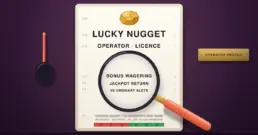

Lucky Nugget is one of the older names in online gambling, and it still turns up constantly in New Zealand listings, “best casino” round-ups and bonus comparisons. This page is a factual profile of the brand: who operates it, what it is licensed to do, how its bonus and game-return figures actually read once you check them against the operator’s own terms, and where New Zealand’s new licensing regime leaves it. It carries no rating, no offer and no link to any operator.
Two figures are worth putting first, because both are routinely reported wrongly: the wagering requirement attached to the welcome bonus, and the way the return on the site’s headline jackpot game compares with the ordinary slots listed beside it. Neither is a rounding difference, and getting either wrong changes the picture completely.
Who operates Lucky Nugget
Key facts
| Detail | Reported position |
|---|---|
| Brand | Lucky Nugget Casino |
| Type | Online casino — browser-based, no downloadable app |
| Launched | Widely reported as 1998 (over two decades of operation) |
| Operator | Digimedia Ltd (registered in Malta) |
| Licence | Malta Gaming Authority (MGA) — a European regulator, not a New Zealand one |
| Game software | Primarily Microgaming / Games Global; live tables and some titles from third-party studios |
| Mobile | Web browser on desktop and mobile; no dedicated app |
| Customer support | Live chat and email |
| Group | One of a family of long-running Microgaming-powered casinos that share operating terms |
| New Zealand status | Not licensed in New Zealand; no operator is yet licensed under the Online Casino Gambling Act 2026 |
Lucky Nugget is among the longer-running online casinos, widely reported as launched in 1998 and operating for more than two decades. The brand is run by Digimedia Ltd, a Malta-registered company, and holds a licence from the Malta Gaming Authority (MGA) — a European regulator, not a New Zealand one. Its game library is built predominantly on Microgaming and Games Global content, with live-dealer tables supplied by third-party studios and, in more recent listings, titles from other providers such as Pragmatic Play and Evolution.
There is no downloadable app; play is browser-based on desktop and mobile. Customer support runs through live chat and email rather than a phone line. To New Zealand visitors the site displays prices and jackpots in New Zealand dollars, which is a currency-display choice, not a sign of local licensing.
Longevity is worth stating accurately rather than treating as a seal of quality. A casino operating since 1998 has a long track record, which is useful information. It does not follow that the record is a good one, and sweeping claims such as “a long-standing reputation and commitment to security make it a trustworthy choice” rest on no evidence you can check. A licence tells you who an operator answers to; it does not tell you how a dispute will go.
It is also worth being clear about what the Malta licence does and does not mean for a New Zealand player. The MGA imposes standards on player-fund protection, game fairness and complaint handling, and it operates its own public licence register where a claimed authorisation can be checked — a worthwhile verification step with any operator, because licence claims are sometimes attached to the wrong corporate entity. What the MGA cannot do is act as a domestic regulator for New Zealanders: a complaint that cannot be resolved with the operator would be escalated through an overseas framework, in a currency and jurisdiction far removed from a New Zealand player. That distance is one of the central reasons New Zealand is building its own licensing regime.
How the welcome bonus terms actually read
The headline welcome package is built around a matched deposit bonus plus free spins across the first few deposits. The single most important figure is the wagering requirement — how many times you must stake the bonus before any winnings can be withdrawn. Listings commonly quote 50x and describe it as “typical for most online casinos.” The figure reported in the operator’s own terms is closer to 200x.
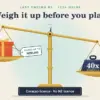
That gap is enormous. On a NZ$200 bonus, 50x would mean NZ$10,000 of turnover — demanding, but within an ordinary range. At 200x the same bonus requires NZ$40,000 of turnover before a single dollar of winnings becomes withdrawable. And 50x is itself toward the high end of “typical,” not the middle of it.
Several terms sit alongside the multiplier and are routinely left out of listings. They matter at least as much as the wagering figure:
- What the multiplier applies to. Reported as 35x on the bonus money only for the core match, rather than on deposit-plus-bonus — which is actually a better-than-average structure, yet it is often filed under “cons” without explanation. Elsewhere the far larger 200x figure appears. Which rule applies to which part of the offer is exactly the kind of detail that decides whether a bonus is worth claiming.
- Whether the bonus is “sticky.” A non-sticky bonus uses your own deposit first and lets you forfeit the bonus to release real funds; a sticky bonus locks everything together until wagering is met. The two behave very differently if you want to withdraw early.
- A maximum withdrawal from bonus winnings, which can cap what you keep no matter how much you win on the bonus.
- A maximum bet during bonus play, breaching which can void the bonus and its winnings.
- An expiry window — bonuses and free spins typically lapse after a set period (reported around two months, with spins dripped out in daily batches).
- Game weighting — slots usually count 100% toward wagering while table games count little or nothing, and progressive jackpot games are commonly excluded entirely.
The package is sometimes paired with a weekly cashback described in listings as “up to 20% with no wagering requirements.” The reported reality is close but not identical: cashback of roughly 10–20% on weekly losses, carrying a very low 1x wagering requirement rather than none at all. The difference between “no wagering” and “1x wagering” is small, but it is the difference between cash you can withdraw immediately and funds you must stake once first — and it is exactly the kind of detail that gets rounded off in a summary.
A “200 free spins” line is a good illustration of how a headline flatters. At NZ$0.10 per spin, 200 spins is NZ$20 of covered stakes in total, often released in daily batches rather than all at once. That is a modest trial of a game, not NZ$20 of free money. Our wagering requirements explained guide walks through how these terms interact, and our full Lucky Nugget Casino review covers the current promotions in more detail.
Reading the game-return figures
Return to player (RTP) is the share of all stakes a game pays back over a very long run; the remainder is the house edge, the built-in cost of playing. Listings often place several games and their RTP figures side by side with no commentary, which makes them look comparable. Read closely, they are not.
Game returns compared
| Game | Typical return to player | Approx. house edge | Cost per NZ$100 staked |
|---|---|---|---|
| Standard video slots on the site | around 96.2–96.9% | about 3.1–3.8% | about NZ$3.10–$3.80 |
| Mega Moolah progressive jackpot slot (base game) | 88.12% | about 11.9% | about NZ$11.90 |
| Mega Moolah including jackpot contribution (whole network) | around 93.4% | about 6.6% | about NZ$6.60 |
| European (single-zero) roulette | around 97.3% | 2.70% | about NZ$2.70 |
| American (double-zero) roulette | around 94.7% | 5.26% | about NZ$5.26 |
| Atlantic City blackjack (correct basic strategy) | around 99.5% | about 0.5% | about NZ$0.50 |
RTP and house edge are long-run averages across many thousands of rounds, not a guide to any single session. The figures for table games assume correct play; mistakes raise the real cost.
The standout is the headline progressive jackpot slot. Its base game returns about 88.12%, against roughly 96.7% for ordinary video slots on the same site. That is the difference between losing about NZ$3.20 and about NZ$11.90 per NZ$100 staked — roughly three and a half times as much.
The reason is legitimate and worth knowing: a slice of every stake on a progressive jackpot slot is diverted into the prize pool rather than returning through ordinary wins, which is what drags the base-game return down. Add the jackpot contribution back in and the figure rises to around 93.4%, describing what the game returns across the whole linked network rather than what it returns to you on the reels. A player who understands that trade-off — a far higher cost per spin in exchange for a tiny chance at a life-changing prize — is making a reasonable choice. A player shown 88.12% in an unannotated table beside 96% games is not choosing anything. Our pages on the best-paying pokies in New Zealand and how progressive jackpots on pokies work explain the mechanics in more depth.
Table games carry the lowest house edge
One thing listings note without drawing the obvious conclusion is that the lowest-cost games on the site are table games, not slots — and that similar names can hide very different odds.
The lobby offers American roulette alongside European roulette. They look almost identical, but the American wheel adds a double-zero pocket, which roughly doubles the house edge to about 5.26% against 2.70% for the single-zero European game. Choosing the wrong one costs nearly twice as much per spin for no extra entertainment.
The site also lists Atlantic City blackjack, reported at around 99.5% return with correct basic strategy — a house edge well under 1%, and the cheapest game in the building. A player choosing between the progressive jackpot slot at 88.12% and Atlantic City blackjack at roughly 99.5% is choosing between losing about NZ$11.90 and about NZ$0.50 per NZ$100 staked. Skill-based games reward strategy, so our guide to how to play blackjack is worth a look before you sit down at a table.
The group behind the brand, and the shared withdrawal cap
Lucky Nugget is one of a family of long-running Microgaming-powered casinos that have historically shared operating terms. The single term most likely to matter if you ever win a substantial amount is a group-wide withdrawal cap.
Published assessments of this group describe a weekly withdrawal limit of around €4,000 where a withdrawal is five times or more your total deposits, calculated across every brand in the group rather than per site. Progressive jackpot wins are reported as exempt from the limit. Two features make this worth understanding before you play:
- It is calculated collectively. Related brands market themselves as separate businesses with separate sites and sign-ups, but they share one cap. Holding accounts at several does not give you several caps.
- It bites precisely when things go well. The trigger is winning more than five times what you deposited — the outcome a player is hoping for. A large win is released in weekly instalments rather than paid in full, and published complaint records for casinos in this group describe amounts above the cap being returned to the playable balance, where they can be lost again before they are ever withdrawn.
The progressive jackpot exemption is the one genuine point in the player’s favour here, and the only context in which the site’s heavy promotion of progressive slots works for the player rather than the operator: a Mega Moolah-style jackpot win would sit outside the cap. Our guide to fast-payout casinos in New Zealand explains why capped funds returning to a gambling balance is a consumer-harm issue rather than a mere inconvenience.
Where New Zealand’s rules leave Lucky Nugget
New Zealand’s online casino market is being rebuilt. The Online Casino Gambling Act 2026 came into force on 1 May 2026. Operators that were already serving New Zealanders before that date fall within transitional arrangements and may continue only until 1 December 2026; from that point, only operators that have applied for one of a limited number of licences may keep going while their applications are assessed, and all others must leave the market.
A Malta licence is a European authorisation, not a New Zealand one, and it provides no domestic route of complaint for a New Zealand player. The Department of Internal Affairs has said it expects to begin issuing licences from early 2027 and will publish a public register of licensed online casinos. Until that register exists, no operator can accurately be described as licensed for online casino gambling in New Zealand — Lucky Nugget included.
The Regulations that sit under the Act also tighten what operators may offer. According to specialist compliance analysis of the rules, an inducement that a customer can claim without having to spend their own money cannot exceed NZ$100 in value, and advertising online casino gambling to New Zealanders remains restricted during the transition. The practical takeaway is simple: a large, heavily promoted overseas welcome package is a feature of the market that is being phased out, not a benchmark for what a future licensed New Zealand offer will look like. Our New Zealand gambling laws guide sets out the full timeline, and our responsible gambling page lists the support and self-exclusion tools available locally.
What to check before trusting any casino listing
The Lucky Nugget example shows how far a tidy-looking listing can drift from the terms it claims to summarise. Whatever brand you are reading about, these are the points to confirm in the operator’s own terms rather than in a third-party summary:
- The wagering multiplier, and exactly what it applies to — bonus only, or deposit plus bonus.
- Whether the bonus is sticky or non-sticky.
- The maximum withdrawal allowed from bonus winnings.
- The maximum bet permitted during bonus play.
- Which games count toward wagering, and which are excluded.
- The base-game RTP of any jackpot slot, separate from its network RTP.
- Whether any withdrawal cap is calculated per brand or across a whole group.
- Whether the operator holds — or has applied for — a New Zealand licence.
A figure that happens to flatter an operator deserves no more trust than one that does not. Content assembled without checking is unreliable in both directions.
Disclaimer
This page is published for information. It is not financial, legal or gambling advice, and nothing on it is a recommendation to gamble or an endorsement of any operator. You must be 18 or older to gamble in New Zealand.
No link on this page goes to an operator’s cashier, and none will. Licensing, ownership, bonus terms, withdrawal limits and country availability all change, sometimes within weeks, and this page covers a period in which the New Zealand market is being restructured. Confirm the current position in the operator’s own terms and on the regulator’s register before acting on anything here.
Free, confidential help is available in New Zealand from the Gambling Helpline on 0800 654 655, or by free text to 8006, 24 hours a day. PGF Services offers free counselling on 0800 664 262, and support is also available to whānau and friends.
Sources
Operator terms, independent assessments, legislation and public-health guidance used in this article. No link below goes to a gambling operator.
- Lucky Nugget Casino review, group membership and withdrawal terms — Casino Listings
- Mega Moolah: base-game return and the jackpot contribution — Bonus.com
- House edge of casino games compared — Wizard of Odds
- Assessment of a Microgaming casino group — Wizard of Odds
- Guide to casino games — Safer Gambling Aotearoa, Health New Zealand | Te Whatu Ora
- New Zealand’s Online Casino Gambling Regulations: what operators need to know — Senet Group
- Online Casino Gambling Regulations 2026 — New Zealand Legislation
- Online Casino Gambling Act 2026 — New Zealand Legislation
- Information for online casino customers — Department of Internal Affairs
- Unfair contract terms — Commerce Commission New Zealand
- Gambling Helpline Aotearoa New Zealand — free, confidential support service
Frequently asked questions
What is the wagering requirement on the Lucky Nugget welcome bonus?
Listings commonly quote 50x and call it “typical,” but the figure reported in the operator’s own terms is closer to 200x. On a NZ$200 bonus, 200x means about NZ$40,000 of required turnover before winnings can be withdrawn. Parts of the offer may use a lower 35x figure applied to the bonus only, so it is essential to check which rule applies to which part before claiming anything.
Why is the Mega Moolah return only 88.12%?
Because a slice of every stake funds the progressive jackpot pool rather than returning through ordinary wins, which lowers the base-game return. Figures nearer 93.4% describe the game including the jackpot contribution across the whole linked network, not what the base game returns to an individual player on the reels.
Is there a limit on how much I can withdraw?
Published assessments of this casino group describe a weekly cap of around €4,000 where a withdrawal is five times or more your total deposits, calculated across every brand in the group rather than per site. Progressive jackpot wins are reported as exempt. A large win is typically paid in weekly instalments rather than in a single payment.
Is Lucky Nugget licensed in New Zealand?
No — and at present no online casino is. Lucky Nugget holds a Malta Gaming Authority licence, which is a European authorisation rather than a New Zealand one and offers no local route of complaint. The Department of Internal Affairs expects to start issuing New Zealand licences from early 2027 and will publish a register of licensed operators.
Does this site recommend Lucky Nugget?
No. This page describes an operator; it does not recommend one. The site publishes no rankings, scores, offers or sign-up links on this profile, and this page does not link to any casino. If gambling is causing harm, the Gambling Helpline is free and available 24 hours a day on 0800 654 655, or by free text to 8006.