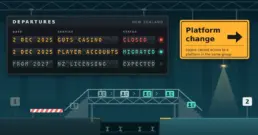

This is a factual record of a casino brand that no longer operates in New Zealand. It contains no offers and no link to any operator. If you are reading it because you once had an account, the short version is simple: the brand closed on 2 December 2025, and accounts were migrated to a different platform run by the same parent company. The rest of this page explains what happened, who owned the brand, and how the New Zealand rules have changed around it.
Quick Facts
| Status | Closed to New Zealand players |
|---|---|
| Closure date | 2 December 2025 |
| What happened to accounts | Migrated to a replacement platform in the same group (reported as SuperCasino, a Betsson Group brand); logins carried across |
| Launched | 2013, under MT SecureTrade Limited (Gaming Innovation Group) |
| Last owner | Betsson Group (acquired the brand in 2020) |
| Licensing | Offshore, under the Malta Gaming Authority; never licensed in New Zealand |
| New Zealand status | No operator holds a New Zealand online casino licence yet; the register is expected from 2027 |
Listings on other sites still describe Guts as a currently operating casino that accepts New Zealand players. Most of those pages were written years ago and were never updated after the brand shut, so they are no longer a reliable guide to anything.
The closure, and what it means for an account
On 2 December 2025 the Guts brand was retired for New Zealand customers. Rather than simply closing accounts, the operator migrated them to a sister platform in the same group — reporting at the time pointed to SuperCasino, a Betsson Group brand — with login details carried across so that customers could sign in using their existing credentials. Before the move, the operator advised players to withdraw any balance ahead of the switch, because withdrawals would be unavailable on the day of migration itself.
If you had a balance, it should have moved with the account rather than disappearing. If you cannot now sign in, or you cannot locate a balance, contact the parent group’s support directly and reference the December 2025 migration date. Keep any records you still have — screenshots of the balance, transaction history and any emails — because that is the evidence you will need if a transfer did not complete cleanly.
If you had self-excluded from Guts, that exclusion is supposed to follow you. A brand migration does not lift a self-exclusion, and group-wide exclusions are designed to apply across every brand a company runs. If you find you are able to register at the successor platform despite having excluded yourself, that is worth raising with the operator and, if it is not resolved, with the regulator named in that operator’s licence. Our guide to self-exclusion in New Zealand explains how the tools are meant to work and what to do when one fails.
How the brand got here
The useful part of this story is the ownership chain. Over roughly twelve years the brand passed through more than one corporate structure and withdrew from more than one market before it was finally retired. The timeline below is the short version.
| Year | What happened |
|---|---|
| 2013 | Guts launched under MT SecureTrade Limited as the flagship consumer brand of Gaming Innovation Group (GiG). It built its early reputation in Nordic markets, partly on wager-free free-spin promotions, which were unusual at the time and genuinely favourable to players. |
| 2020 | GiG sold its business-to-consumer brands — Guts, along with Rizk, Kaboo and Thrills — to the Betsson Group. In the same period the brand withdrew from the United Kingdom, where Betsson consolidated its British activity onto a single surviving brand. |
| 2020–2025 | The brand operated within the Betsson group under Malta Gaming Authority licensing, continuing to serve a number of markets including New Zealand from offshore. |
| 2 December 2025 | The brand was retired for New Zealand and accounts were migrated to a replacement platform within the same group. |
That history matters beyond this one casino. Review pages routinely cite an operator’s longevity as a reason for confidence — “over a decade of experience,” “trusted since 2013.” But the years accrue to the brand name, not to the company behind it. The business holding your money, the licence supervising it and the management setting the terms can all change several times without the name above the door changing at all. A brand is an asset that gets bought, sold, withdrawn from markets and eventually shut down.
What the New Zealand rules now say
Older write-ups described New Zealand as a “permissive” market, notable for allowing play at offshore casino sites because there were no locally licensed online casinos. That was a fair summary of the position a few years ago. It is now wrong in every important respect, and the framing was always questionable — an absence of regulation is a gap in player protection, not a feature to be marketed.
| When the old pages were written | The position now | |
|---|---|---|
| Licensing framework | None for online casino gambling | Online Casino Gambling Act 2026, in force from 1 May 2026 |
| Locally licensed operators | None | Up to 15 licences, awarded through an expressions-of-interest and auction process, with licensed sites expected from 2027 |
| Offshore operators | Served New Zealand without restriction | Must stop serving New Zealand from 1 December 2026 unless they have applied for a licence |
| Where the licence must be held | Not applicable | New Zealand, regardless of where the operator is incorporated |
| Advertising | Unrestricted | Restricted, with penalties that can reach the parties who publish it |
In plain terms: the Act took effect on 1 May 2026 and applies on an extraterritorial basis, so an operator anywhere in the world that targets New Zealanders is covered by it. Operators that were already serving the country may continue through a transition period, but from 1 December 2026 only those that have applied for a New Zealand licence can keep going; firms that have applied may continue a little longer while their applications are assessed. Until the Department of Internal Affairs publishes its register, no operator can honestly be described as “licensed for online casino gambling in New Zealand,” and the Department is direct that players using unlicensed platforms do not have the same protections. Our New Zealand gambling laws guide sets out the full framework and timeline.
What a gambling licence actually covers
This is the point most casino pages skip, and it is the single most useful habit to form. A licence covers a named territory — the residents the regulator has agreed to protect — not everyone who happens to be able to open the website.
Guts, like most Betsson-group brands, operated under a Malta Gaming Authority licence, and over its life it also held licences in markets such as the United Kingdom and Sweden. The wording attached to those licences is the part that matters: a UK licence is held “for customers who reside in Great Britain,” and a Swedish licence “for customers who reside in Sweden.” Read literally — which is how they are meant to be read — they describe exactly who is protected.
So when a UK Gambling Commission licence brings affordability checks, a mandated safer-gambling toolkit, membership of the national self-exclusion scheme and a formal dispute process, a resident of Great Britain receives all of it. A New Zealander on the same website, playing the same games, was covered by none of it, because the licence names the country it protects and New Zealand was not on the list. The habit worth forming is this: when a page says an operator is “licensed by the UKGC” as a general reassurance, check the footer for the qualifying phrase. It is almost always there, and it almost always names a country that is not your own. The guide to spotting scam and fake casino sites covers how to check an operating company against a regulator’s own public register rather than trusting a logo in a footer.
Game returns, and why the jackpot figure is different
One genuinely good thing about the old Guts material was that its published return figures were unusually honest. “Return to player,” or RTP, is the percentage of all money staked on a game that is paid back to players over the very long run; a 96% game returns, on average, NZ$96 for every NZ$100 wagered across millions of spins, with the house keeping the rest. It is a long-run average, not a promise about any single session.
- Most slots sat above 95% return.
- Progressive jackpot games ran considerably lower — sometimes as low as about 88% — because a slice of every stake is diverted into the prize pool instead of being returned through ordinary wins.
- Blackjack and some table games could exceed 99% when played with correct strategy.
The jackpot point is the one worth carrying away. A progressive jackpot slot can cost roughly three to four times as much per dollar staked as an ordinary slot, precisely because that slice is being skimmed to fund the headline prize. Elsewhere an 88% jackpot slot gets listed in a table next to 96% games with no comment at all, as though they were comparable. They are not. If you want to understand how much the specific version and settings of a game change its odds, our explainer on jackpot odds, cost and terms and the blackjack rules and strategy guide go into the detail.
Where things stand now
We do not recommend a replacement, publish rankings or carry sign-up links, and this page is no exception. If you are weighing up any operator during the current transition, the legal position is the same for all of them. Operators that were serving New Zealand before 1 May 2026 may continue only until 1 December 2026; after that, only those that have applied for a licence may carry on, and licensed sites are expected from 2027, at which point the Department of Internal Affairs will publish a register that players can check.
Until that register exists, treat any claim that a site is “licensed in New Zealand” with scepticism, and remember that an overseas licence protects the country it names rather than you. The casino reviews hub explains how to assess an operator yourself, including how to trace an operating company back to a regulator’s own records.
If a casino you use closes
Brands close, migrate and leave markets routinely, and the 1 December 2026 deadline is likely to produce more of it than usual. Four things are worth doing whenever it happens.
- Withdraw before you need to. A balance sitting in a gambling account is exposed to more than the temptation to play it. If an operator is winding down a market, funds are far simpler to retrieve before the deadline than after.
- Keep your own records. Screenshots of your balance, your transaction history and any correspondence. If an account migration goes wrong, that record is what you will have to fall back on.
- Check whether a self-exclusion carried across. Exclusions are meant to survive migrations and to apply across a group’s brands. If you can register at a successor brand after excluding yourself, raise it with the operator and its regulator.
- Know which regulator applies. It is the one named in the operator’s licence, not the one in your own country. If there is a dispute over a balance, that is where a complaint ultimately goes.
Key Points
- Guts has closed. The brand was retired for New Zealand on 2 December 2025 and accounts were migrated within the same group.
- A balance should have moved with your account. If you cannot find it, contact the parent group’s support and quote the migration date, and keep your own records.
- Longevity belongs to the brand, not the company. Ownership, licensing and terms can all change while the name stays the same.
- A licence protects a named country. An overseas licence covers that country’s residents — not, by default, New Zealanders on the same site.
- The law has changed. From 1 December 2026, offshore operators must have applied for a New Zealand licence to keep serving the country; a register is expected from 2027.
Whatever you decide, the free support services listed in our responsible gambling guide for New Zealand are available to anyone in the country, regardless of where an operator is based.
Disclaimer
This page is published for information. It is not financial, legal or gambling advice, and nothing on it is a recommendation to gamble or an endorsement of any operator. You must be 18 or older to gamble online in New Zealand.
No link on this page goes to an operator’s cashier, and none will. Licensing, ownership, bonus terms, withdrawal limits and country availability all change, sometimes within weeks, and this page covers a period in which the New Zealand market is being restructured. Confirm the current position in an operator’s own terms and on the relevant regulator’s register before acting on anything here.
Free, confidential help is available in New Zealand from the Gambling Helpline on 0800 654 655, or by free text to 8006, 24 hours a day. PGF Services offers free counselling on 0800 664 262, and support is available to whānau and friends as well as to players.
Sources
- Guts and Kaboo shut down as Betsson’s UK exit accelerates — EGR Intel
- Guts Casino: operating company and ownership record — Casino Listings
- Guts Casino: launch and acquisition history — GamblingCompass
- Malta Gaming Authority — licensee register and complaints route
- Online Casino Gambling Act 2026 — New Zealand Legislation
- Online Casino Gambling Regulations 2026 — New Zealand Legislation
- Information for online casino customers — Department of Internal Affairs
- Licence to operate: New Zealand’s Online Casino Gambling Act 2026 — MinterEllisonRuddWatts
- Return figures and paytable analysis — Wizard of Odds
- Gambling Helpline Aotearoa New Zealand — free, confidential support service
Frequently Asked Questions
Is Guts Casino still open?
No. The brand closed to New Zealand players on 2 December 2025 and migrated accounts to a replacement platform operated by the same parent group, reported at the time to be SuperCasino, a Betsson Group brand. Listings elsewhere that still describe Guts as operating are out of date.
What happened to my Guts account and balance?
Accounts were migrated rather than simply closed, with login details carried across to the successor platform, so an existing balance should have moved with the account. Players were advised to withdraw any balance before the switch. If you cannot sign in or locate a balance now, contact the parent group’s support and reference the December 2025 migration date.
Who owned Guts Casino?
It launched in 2013 under MT SecureTrade Limited as the flagship brand of Gaming Innovation Group. In 2020 that group sold Guts — along with Rizk, Kaboo and Thrills — to the Betsson Group, and the brand was operated within the Betsson group under Malta Gaming Authority licensing until it closed.
Was Guts Casino licensed in New Zealand?
No. It operated from offshore under Malta licensing, and over its life also held licences that named other markets such as the United Kingdom and Sweden. No operator holds a New Zealand online casino licence yet — the Department of Internal Affairs register is expected to open from 2027.
Can I still play at offshore casinos from New Zealand in 2026?
The position changed under the Online Casino Gambling Act 2026, which took effect on 1 May 2026. Operators that were serving New Zealand beforehand may continue only until 1 December 2026; after that, only those that have applied for a licence may carry on. The Act applies regardless of where an operator is incorporated, and players on unlicensed platforms do not have the same protections.