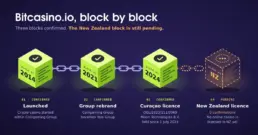

Bitcasino.io is one of the longest-running cryptocurrency casinos, launched in 2014 and aimed at players who want to deposit, wager and withdraw in digital currencies rather than traditional banking. This profile sets out who runs the brand, how it is licensed, what it offers and — importantly for a New Zealand audience — where it sits under the country’s new online casino law. It is an information page, not an endorsement or an advertisement: no online casino is currently licensed to operate in New Zealand.
Quick Facts
| Brand | Bitcasino.io |
| Launched | 2014 |
| Licensee | Moon Technologies B.V. (Curacao company no. 152185) |
| Group | Launched within Coingaming Group, rebranded Yolo Group (2021) |
| Licence | Curacao, OGL/2023/111/0069 (held since 1 July 2024) |
| Regulator | Curacao Gaming Authority / Gaming Control Board |
| Currencies | Crypto and stablecoins (BTC, ETH, LTC, DOGE, USDT and others); no NZD |
| Games | Thousands of slots, table and live-dealer titles from studios such as Pragmatic Play, Hacksaw Gaming, Play’n GO and Nolimit City |
| Mobile | Browser-based mobile site; no dedicated app |
| Support | 24/7 live chat and email |
| New Zealand status | Not licensed by the DIA; no NZ online casino is yet licensed (as of October 2026) |
Who owns Bitcasino and how is it licensed?
Bitcasino.io launched in 2014 as part of the Coingaming Group, a company founded in Tallinn, Estonia, that also built the Sportsbet.io brand. Coingaming rebranded to Yolo Group in September 2021 to reflect its wider range of businesses. Bitcasino is therefore not a small standalone site; it belongs to an established operator with more than a decade of history in the crypto gambling sector.
The gambling licence for bitcasino.io is held by Moon Technologies B.V., a company registered in Curacao (company number 152185). According to the Curacao regulator’s own certificate, Moon Technologies has been licensed since 1 July 2024 under licence number OGL/2023/111/0069, and the certificate lists bitcasino.io among its approved domains. The licensing body is the Curacao Gaming Authority, also referred to as the Curacao Gaming Control Board.
It is worth understanding what a Curacao licence does and does not mean. Curacao is a long-established licensing hub, and in 2024 it modernised its system so that each brand holds its own licence rather than relying on a shared master licence. Even so, Curacao oversight is generally lighter than that of stricter authorities such as the UK Gambling Commission (UKGC) or the Malta Gaming Authority (MGA). A Curacao licence shows the operator is regulated somewhere; it does not carry the same consumer-protection guarantees as those tier-one regulators, and it is not a New Zealand authorisation.
One further point on ownership: trade press reported during 2025 and early 2026 that Yolo Group was moving away from so-called grey markets and exploring the sale of its Bitcasino and Sportsbet brands. Reporting of that kind can change quickly, so anyone relying on ownership details should confirm them against the operator’s current terms before acting.
Bitcasino and New Zealand law
New Zealand’s rules changed significantly in 2026. The Online Casino Gambling Act 2026 came into force on 1 May 2026 and created, for the first time, a licensing regime for online casinos overseen by the Department of Internal Affairs (DIA). Up to 15 licences are being made available, with no single group permitted to hold more than three. The system is being rolled out in stages and, according to the DIA, is expected to be fully in place during 2027.
Several points matter for readers:
- No operator is licensed yet. At the time of writing (October 2026), the DIA has not granted any online casino licence. Winning the right to apply in the licensing auction does not guarantee a licence will follow.
- Advertising is prohibited. The DIA states plainly that “online casino gambling advertising is prohibited in New Zealand.” That is why this page describes Bitcasino factually rather than promoting it, carries no sign-up link and does not quote any offer as an inducement.
- Transitional window. Providers that were already operating may continue only under the Act’s transitional provisions. Providers that have not applied for a licence must cease operating in New Zealand from 1 December 2026, while those with an application under consideration may continue — without advertising — until a decision is made.
- Enforcement has teeth. The DIA can issue take-down notices and seek penalties of up to NZ$5 million for unlawful advertising, and that liability can extend to third parties who publish or arrange such advertising.
Bitcasino is an offshore, Curacao-licensed brand, so it is not part of the licensed New Zealand system. If you want the full picture of how the market is changing, our overview of the New Zealand online casino market and the explainer on what the law now allows set out the detail. The broader direction of travel is covered in our look at New Zealand’s online gambling trends.
Games and software
Bitcasino’s main draw is the size and variety of its games library. The lobby pulls titles from well-known studios, with slots the largest category and new releases added regularly. Providers seen on the site include Pragmatic Play, Hacksaw Gaming, Play’n GO and Nolimit City, among others, each named beneath its game tiles so players can sort by studio or popularity.
The catalogue is broad rather than niche:
- Slots (pokies): classic three-reel games through to high-volatility modern releases with bonus-buy features and large maximum multipliers.
- Table games: multiple versions of blackjack, roulette, baccarat and poker-style games.
- Live dealer: real tables streamed with human dealers, including game-show style formats, for players who want something closer to a venue experience.
- Specialty and crypto-native games: instant-win and “provably fair” titles, where a cryptographic method lets players verify that each result was not altered after the bet.
“Provably fair” is a transparency feature specific to crypto casinos; it is not the same as independent testing of a studio’s games, but it does give players a way to check individual outcomes. As with any casino, the long-run house edge still applies, and no feature, demo mode or strategy changes the built-in odds of a game.
One useful habit when sizing up a games library is to look past the headline count. A catalogue of “thousands of games” tells you little on its own; what matters more is the return-to-player (RTP) percentage listed in each title’s information panel, the volatility of the games you actually play, and whether the studios behind them are names with a track record. Bitcasino draws from mainstream providers, which is a reasonable sign, but players should still check the RTP and rules of individual games rather than assuming every title is generous.
Bonuses and promotions
Bitcasino runs welcome offers and ongoing promotions such as deposit matches, reload bonuses, cashback, slot challenges and a tiered loyalty programme with VIP perks. Because the cashier works in crypto and stablecoins, these offers are typically quoted in digital currency — for example, the welcome package observed on the site in September 2026 was advertised in USDT (a stablecoin pegged to the US dollar) across the first few deposits, rather than in New Zealand dollars.
Two things are worth keeping in mind. First, every bonus carries terms — most importantly a wagering requirement, which is the number of times a bonus (and sometimes the deposit) must be staked before any related winnings can be withdrawn. A headline figure means little until you read the playthrough, the game weightings and any maximum-bet or expiry rules. Second, New Zealand’s advertising prohibition means offers like these cannot lawfully be marketed to New Zealanders, which is another reason this page states the facts without presenting any promotion as an invitation to sign up.
Deposits, withdrawals and currencies
Bitcasino is a crypto-first operator. It does not process New Zealand dollars; instead, it works with a range of cryptocurrencies and stablecoins — commonly Bitcoin (BTC), Ethereum (ETH), Litecoin (LTC), Dogecoin (DOGE) and Tether (USDT), with other coins supported at times. To play, a user would already need to hold cryptocurrency or buy it from an exchange, then transfer it to the casino wallet.
Crypto deposits are usually credited quickly, and withdrawals are generally faster than card or bank payouts once any checks are complete, because they settle on the blockchain rather than through a bank. The trade-off is volatility: the value of a deposit, a balance or a win can rise or fall against the New Zealand dollar between the moment you fund the account and the moment you cash out. That currency risk sits on top of the normal risk of gambling itself. Stablecoins such as USDT are designed to track the US dollar and so reduce — but do not remove — this swing, which is one reason crypto casinos often quote balances and offers in a stablecoin.
There are also practical costs to factor in. Buying cryptocurrency from an exchange, transferring it to and from a casino wallet, and eventually converting any winnings back into spendable money can each involve fees and exchange spreads. Network (“gas”) fees vary with how busy a blockchain is at the time. None of this is unique to Bitcasino, but it means the real cost and speed of moving money are not quite as frictionless as “instant crypto payouts” can suggest, and they should be weighed before treating a crypto casino as a like-for-like replacement for an NZD-facing site.
Crypto casinos are sometimes promoted as “no-KYC” or needing little verification, but identity checks still apply in practice, particularly for larger withdrawals, and requirements change with the operator’s compliance obligations. If you are comparing how different funding methods behave, our guides to online casinos and New Zealand dollars and to casino withdrawal times explain the practical differences.
Mobile experience
Bitcasino does not offer a dedicated downloadable app. Instead it uses a mobile-optimised website that runs in a phone or tablet browser and mirrors the desktop layout, giving access to the full games library, the cashier and customer support. In practice this means there is nothing to install or update, though players who prefer a native app will not find one. Loading and performance depend on the device and the connection.
Customer support
Support is offered around the clock through live chat and email. Live chat is the quicker channel for account, deposit or gameplay questions, while email suits more detailed queries that need a written record. There is also a help centre with topic sections covering getting started, accounts, transactions, payment options and crypto basics. As always, the quality and speed of a reply can vary with demand, and complaints reported by third parties — for example about withdrawal checks — are a reminder to read the terms before depositing.
Security and responsible gambling
Bitcasino uses SSL encryption to protect data in transit and offers account protections such as two-factor authentication. Its “provably fair” games add a layer of result transparency. None of this removes the fundamental point that the operator is licensed in Curacao, which applies lighter oversight than tier-one regulators, so players carry more of the responsibility for checking terms and payout rules themselves. Our guide to spotting and avoiding fake casino sites explains the checks worth doing before trusting any platform.
Responsible-gambling tools commonly include deposit and loss limits, time-out periods and self-exclusion. Under New Zealand’s new regime, licensed operators will be required to provide player-set limits, self-exclusion options and a ban on credit-card payments — protections that an offshore site is not obliged to match. Setting your own limits before you play, and knowing how to step away, matters more, not less, when the funding is in volatile cryptocurrency.
Key Points
- Bitcasino is crypto-first: deposits and withdrawals are in digital currencies and stablecoins, not New Zealand dollars.
- Its licence is from Curacao, which applies lighter oversight than regulators such as the UKGC or MGA.
- No operator — Bitcasino included — currently holds a New Zealand online casino licence; the DIA regime is still being set up.
- Advertising online casinos to New Zealanders is prohibited, so this page is an information profile, not a promotion.
- Crypto prices move, so the value of a deposit or a win can change before you cash out.
- Set deposit and loss limits and know the self-exclusion and help options before you play.
Who Bitcasino may suit — and who it will not
On the facts, Bitcasino is built for a specific kind of player: someone who already holds and is comfortable managing cryptocurrency, who values fast crypto payouts and a very large games library, and who understands Curacao-level regulation. It is a poor fit for anyone who wants to deposit in New Zealand dollars, who prefers the stronger consumer protections of a UKGC or MGA licence, or who is uneasy with the price swings that come with crypto balances. For New Zealand readers specifically, the overriding fact is legal rather than feature-based: the DIA licensing system is still being built, and this page exists to inform, not to recommend any operator.
Responsible gambling and important notes
Gambling is restricted to adults aged 18 and over. This profile is provided for information only; it is not an advertisement, an endorsement or legal advice, and no online casino is currently licensed to operate in New Zealand. Gambling carries a risk of financial loss, and using cryptocurrency adds the separate risk that the value of your money can change before you withdraw.
If gambling is causing you or someone you know harm, free and confidential help is available 24/7 from the Gambling Helpline on 0800 654 655, or by free text to 8006. You can also read our guides to responsible gambling in New Zealand and self-exclusion for practical steps and support services.
Sources
- Department of Internal Affairs — Online casino gambling: information for providers
- Curacao Gaming Control Board — licence certificate (Moon Technologies B.V., OGL/2023/111/0069)
- Curacao Gaming Control Board (Gaming Authority)
- Russell McVeagh — DIA guidance on the Online Casino Gambling Act 2026
- SBC News — Coingaming rebrands to Yolo Group (2021)
- Gambling Helpline New Zealand
Frequently Asked Questions (FAQ)
Is Bitcasino legal to use in New Zealand?
No online casino, including Bitcasino, currently holds a New Zealand licence. The Online Casino Gambling Act 2026 came into force on 1 May 2026 and set up a Department of Internal Affairs licensing regime that is still being rolled out, with the full system expected during 2027. Advertising online casinos to New Zealanders is prohibited, and offshore operators that have not applied for a licence must stop serving New Zealand from 1 December 2026.
Who owns and licenses Bitcasino?
Bitcasino.io launched in 2014 within the Coingaming Group, which rebranded to Yolo Group in 2021. The gambling licence for the site is held by Moon Technologies B.V., a Curacao-registered company, under Curacao licence OGL/2023/111/0069, overseen by the Curacao Gaming Authority. Curacao applies lighter regulatory oversight than authorities such as the UKGC or MGA.
Can I deposit in New Zealand dollars at Bitcasino?
No. Bitcasino is crypto-first and does not process New Zealand dollars. It works with cryptocurrencies and stablecoins such as Bitcoin, Ethereum, Litecoin, Dogecoin and Tether. You would need to buy and hold crypto first, and the value of that balance can rise or fall against the New Zealand dollar before you cash out.
Does Bitcasino have a mobile app?
There is no dedicated downloadable app. Bitcasino runs as a mobile-optimised website in a phone or tablet browser, giving access to the full games library, the cashier and support without anything to install.
How can I tell whether an online casino is trustworthy?
Check who holds the licence and which regulator issued it, look for independent testing of the games, read the bonus terms and withdrawal rules carefully, and search for patterns in player complaints about payouts. A licence shows an operator is regulated somewhere, but the strength of that protection depends heavily on the regulator.