Discover the best online betting sites in NZ. Our expert guide covers top odds, legal NZD platforms, and how to bet safely. Start your winning journey today!

Online Betting in New Zealand: What the Law Now Allows

The single most important fact about online betting in New Zealand changed on 28 June 2025, yet much of the advice still circulating online was written as though it never did. This guide sets out what the law now allows, who may lawfully take a sports or racing bet, what to do if you still hold money with an offshore bookmaker, and which familiar rules of thumb — on odds, tax and bet types — still hold.
What the law changed on 28 June 2025
On 28 June 2025, amendments to the Racing Industry Act 2020 — passed with cross-party support as the Racing Industry Amendment Act 2025 — extended TAB NZ’s long-standing monopoly to cover online sports and racing betting as well. (“Offshore” here means a bookmaker licensed and based outside New Zealand; TAB NZ is the country’s sole domestic betting operator, run on behalf of the racing and sports codes.) In the words of the Department of Internal Affairs (DIA), the government body that regulates gambling, it is now illegal under New Zealand law for any person or organisation except TAB NZ to promote or take bets on racing or sporting events from a person located in New Zealand.
TAB NZ, and its associated betting brand, are the only lawful providers. The offshore bookmakers that once advertised here have been formally told to withdraw and may no longer take your bets — which is why offshore betting advertising has largely disappeared from New Zealand media.
Key Facts
- In force since: 28 June 2025, under the Racing Industry Amendment Act 2025.
- Only lawful provider: TAB NZ and its associated betting brand — no other operator may take or promote a sports or racing bet.
- Offshore bookmakers: prohibited from taking bets from anyone located in New Zealand, and instructed by the regulator to withdraw.
- Who the ban targets: operators, not individual bettors — placing a bet is not made an offence for the person placing it.
- Regulator: the Department of Internal Affairs (DIA).
- Tax on winnings: recreational betting winnings are not income and are not taxed in New Zealand.
- Minimum age: you must be 18 or older to bet online.
One detail matters more than it first appears: the prohibition is written against operators, not bettors. Placing a bet is not made a criminal offence for the individual who places it. That sounds reassuring, but it is a much weaker protection than it seems. An operator that still takes your bet is breaking New Zealand law and has already been instructed to leave. If it holds your money and stops paying out, you are dealing with a company that has ignored a direct instruction from the regulator — and no New Zealand authority can help you recover the balance.
Why the law changed
Somewhere between NZ$150 million and NZ$200 million a year was being wagered with offshore bookmakers, returning little or nothing to New Zealand racing or sport. The change is designed to redirect that money domestically. TAB NZ’s betting operations are run under a 25-year arrangement with Entain, the international betting group, entered into in 2023 — which is why TAB’s pricing and product moved closer to what offshore books offered at around the same time. In other words, part of the trade-off for closing the market was a domestic operator built to compete on quality.
Betting and casino moved in opposite directions
A common confusion is to read New Zealand’s new online casino law as proof that the country is opening up to competition, and then apply that reasoning to betting. It points the wrong way. Two separate statutes, with separate logic, took effect inside twelve months and moved in opposite directions.
Betting vs Online Casino
| Sports and racing betting | Online casino | |
|---|---|---|
| Governed by | Racing Industry Act 2020, amended 2025 | Online Casino Gambling Act 2026 |
| In force | 28 June 2025 | 1 May 2026 |
| Direction | Closed — monopoly extended online | Opened — competitive licensing |
| Who may serve New Zealand | TAB NZ only | Up to fifteen licensed operators |
| Offshore operators | Prohibited since 28 June 2025 | May apply; must cease from 1 December 2026 if they do not |
| Regulator | Department of Internal Affairs | Department of Internal Affairs |
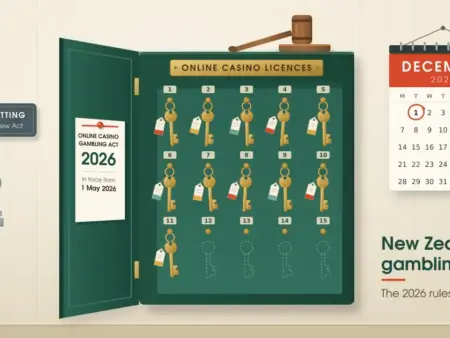
On the casino side, the Online Casino Gambling Act 2026 came into force on 1 May 2026, with regulations following on 3 July. Expressions of interest opened on 17 July at a fee of NZ$19,000, followed by a competitive auction and full applications, for up to fifteen licences — one brand each, and no operator may hold or influence more than three. From 1 December 2026, operators that have not entered the process must stop serving New Zealanders; those with pending applications may continue until a decision or mid-2027. Our New Zealand gambling laws guide sets out both timetables in full.
There is one consequence worth knowing. Several international betting companies shut out of the sports market are reported to be seeking online casino licences instead. A familiar bookmaker’s name reappearing here from 2027 will be a casino, not a sportsbook — and a betting account with that brand will still not be lawful. Our reviews of Betway and BetVictor cover two brands in exactly that position.
If you still hold an offshore betting account
Operators told to leave a market do not always close accounts gracefully. The usual pattern is that new registrations stop first, then deposits, then withdrawals — and balances left behind become progressively harder to reach. If a balance is stranded at an operator already instructed to withdraw from New Zealand, no domestic authority can recover it for you. If you have money with an offshore bookmaker, the priority is simple: get it out, and start sooner than feels necessary. The sensible order is:
- Complete identity verification if you have not. An unverified account cannot withdraw, and this is the delay that catches people out.
- Screenshot everything before you start — the balance, any open bets, and the terms as they read today.
- Let open bets settle first where you can, since a closing account may void them rather than pay them.
- Withdraw the full balance, not part of it. Note any weekly withdrawal limit — a large balance may take several cycles to clear.
- Remove your card details once the money is out, and close the account properly rather than abandoning it.
If a withdrawal is refused or ignored, complain to the operator in writing first and keep the reply. Then escalate to the regulator named in the site’s own footer — a Maltese or other foreign authority — and to a free complaints-mediation service. If money left your account without your authorisation, tell your bank immediately: that is fraud and speed matters. A chargeback (your bank reversing a card payment) is appropriate for fraud, but it is not the right tool for a dispute about a bet that has already been settled.
And if closing the account is the hard part, a market shutting down is an awkward moment for anyone whose betting had become difficult to stop. Free, confidential help is available on 0800 654 655 or by free text to 8006 at any hour, and from PGF Services on 0800 664 262, which also offers free financial mentoring. A bank gambling block is free, covers every operator at once including offshore ones, and usually carries a built-in delay before it can be lifted — it is the single most effective step available, and it does not depend on any operator’s cooperation. Our self-exclusion guide explains both.
What no longer applies
Guidance on how to choose an offshore sportsbook — selection criteria, which overseas licence to prefer, comparing odds against the TAB, ranking betting apps — now describes something that cannot lawfully be offered to you. There is no useful version of “how to pick an offshore bookmaker” when offshore bookmakers may not take your bets. Two claims in particular are worth retiring:
“Offshore sportsbooks offer better odds than the TAB.” Whether or not that was ever true, it is no longer a choice available to you, so it is not a reason to do anything.
“New Zealanders can use offshore platforms with no legal risk.” Because the prohibition targets operators rather than bettors, an individual placing a bet does not commit an offence. But the operator does, and it has been told to leave — which means no domestic recourse if your money does not come back. “No legal risk” and “no protection” are different statements, and only the second one is useful to you.
What still stands
Tax. Recreational betting winnings are not income and are not taxed in New Zealand. That is unchanged. Our gambling tax guide covers the narrow exceptions, including interest earned on winnings held in a bank account.
Decimal odds. New Zealand prices bets in decimals: odds of 3.50 return $3.50 for every dollar staked, and that figure already includes your stake back. So a $20 bet at 3.50 returns $70, which is $50 of profit.
The bet types. Head-to-head, handicaps, over/under lines and multis all work as they always did. A multi (combining several selections into one bet) is entertainment rather than a reliable income strategy — the more legs you add, the more the bookmaker’s margin compounds against you. That is worth remembering wherever you bet.
Identity verification. Complete it when you open an account, not when you want paying. It remains the single most useful practical step a bettor can take.
The warning signs. Betting more than you can afford, chasing losses, lying about how much you bet, neglecting work or relationships, and feeling anxious when you are not betting are all drawn from recognised screening criteria and are worth taking seriously.
Where that leaves you
TAB NZ, together with its associated betting brand, is the lawful option for online sports and racing betting. Fewer operators means less price competition, and that is a real consequence of the change rather than something to paper over. The flip side is that the amendments also give the Government power to make harm-minimisation regulations — limiting bets, restricting communications to bettors and requiring consumer-protection processes — and they constrain TAB NZ’s previously unfettered ability to refuse a bet without reason. Deposit limits, time limits and self-exclusion are available and are best set at registration, not after a bad run.
Getting help
Free, confidential support is available in New Zealand at any hour. The Gambling Helpline is on 0800 654 655 or by free text to 8006. PGF Services on 0800 664 262 offers counselling and free financial mentoring, and MoneyTalks on 0800 345 123 helps with the financial side at no cost. Bank gambling blocks and device-blocking software cover offshore operators as well as domestic ones — which matters more than usual in a market where the offshore operators have been told to leave. Our responsible gaming page has more. You must be 18 or older to bet online in New Zealand.
Disclaimer
This page is published for information. It is not financial, legal, tax or gambling advice, and nothing on it is a recommendation to gamble. You must be 18 or older to bet online in New Zealand. Since 28 June 2025, only TAB NZ may lawfully promote or accept sports or racing bets from a person located in New Zealand; nothing here promotes, endorses or facilitates betting with any other operator, and no offshore bookmaker is named or linked. The prohibition is set out because a reader is entitled to know it applies and because anyone holding a balance offshore needs to act on it. That the prohibition targets operators rather than bettors is a description of where the statute falls, not advice that placing a bet is safe or advisable — it is neither, because no New Zealand authority can assist if the money is not returned. Legislation, regulation and the licensing timetable continue to change; confirm the current position on the Department of Internal Affairs’ own pages. Betting costs money over time by design, and a monopoly provider is no more profitable to bet with than a competitive one. Free, confidential support is available 24 hours a day on 0800 654 655, or by free text to 8006.
Sources
- DIA — law changes for online racing and sports betting — the Department’s announcement of the 28 June 2025 prohibition and the notice to offshore operators.
- Racing Industry Act 2020 — New Zealand Legislation, as amended in 2025.
- Simpson Grierson — New Zealand bans offshore betting — legal analysis of the Amendment Act, the regulation-making powers and the constraints placed on TAB NZ.
- DIA — gambling regulation — the regulator’s overview, including racing and sports betting.
- Online Casino Gambling Act 2026 — New Zealand Legislation, the separate casino regime.
- DIA — online gambling licensing for providers — the casino licensing process, the fifteen-licence cap and the deadlines.
- DIA — information for online casino customers — and where the licence register will be published from 2027.
- Inland Revenue — Te Tari Taake — on the tax treatment of recreational winnings and of interest earned on them.
- Netsafe — report an online scam — free and confidential, for a site that has taken money and stopped responding.
- Safer Gambling Aotearoa — blocking gambling — bank blocks and blocking software, and how the delay on lifting them works.
- BetBlocker — free device-blocking software run by a registered charity; covers offshore operators as well as domestic ones.
- MoneyTalks — free, confidential financial helpline, 0800 345 123.
- PGF Services — free counselling and financial mentoring, including for whānau and friends.
- Gambling Helpline Aotearoa New Zealand — free, confidential support, 24 hours a day.
Frequently Asked Questions
Can I legally bet with an offshore bookmaker in New Zealand?
No offshore operator may lawfully take or promote your bet. Since 28 June 2025, only TAB NZ and its associated betting brand may do so.
Am I breaking the law by placing a bet myself?
The prohibition is written against operators, not bettors, so placing a bet is not made an offence for the individual. But the operator is breaking the law and has been told to leave, and no New Zealand authority can help if your money does not come back.
Doesn’t the 2026 online casino law open things up?
For online casino gambling, yes. For sports and racing betting, the opposite happened. They are two different laws that moved in opposite directions within the same year.
I have money in an offshore betting account — what should I do?
Verify your identity, screenshot everything, let any open bets settle, then withdraw the full balance. Start earlier than feels necessary if a weekly withdrawal limit applies, and remove your card details once the money is out.
Do I pay tax on betting winnings?
Not as a recreational bettor. Winnings are treated as a windfall rather than income, so they are not taxed in New Zealand.
Recent Gambling News