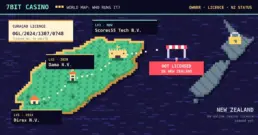

7Bit Casino is a long-running, crypto-friendly online casino that launched in 2014 and operates from Curaçao. It runs a very large games lobby, quotes everything in euros and US dollars, and applies a per-transaction cap on withdrawals. This profile sets out who actually operates it, the licence to verify, how the bonus and banking work, and — importantly for anyone reading from here — exactly where it sits under New Zealand’s new online casino rules. It is published for information only; CasinoChecking.nz does not link to any operator’s cashier and does not recommend gambling.
Key facts
| Brand launched | 2014 |
| Operating company (per site terms, Sep 2026) | ScoresS5 Tech B.V., Willemstad, Curaçao (reg. No. 162990) |
| Earlier operators | Direx N.V. (from 2014); Dama N.V. (from 2020) |
| Licensing | Curaçao Gaming Authority — licence OGL/2024/1307/0748 |
| New Zealand status | Not licensed in New Zealand; no NZ online casino licence has yet been issued |
| Games | Several thousand (operator advertises ~7,000–10,000) from studios incl. Pragmatic Play, Evolution, Betsoft, BGaming, Yggdrasil |
| Welcome offer | Four-deposit package plus no-deposit spins; wagering not shown on the offer (third-party reviews cite ~35x) |
| Minimum deposit | About €/$10 |
| Minimum withdrawal | About €/$20 |
| Maximum withdrawal | About €/$4,000 per transaction |
| Currencies | Euros and US dollars; NZD not listed |
| Support | 24/7 live chat and email; no phone line |
The licence, and how to verify it
Licensing is the single claim a casino profile exists to check, so start there. Many summary tables for casinos of this type carry a row headed “Licence” with the value “Curaçao Government” as a clickable link. Those links very often do not go to any government. They tend to land on commercial firms that sell help obtaining gambling licences, and they frequently arrive carrying advertising tracking codes — a paid-search marker, a campaign name and a unique click identifier. In plain terms, someone searched for the regulator, clicked a paid advertisement above the real result, and pasted that address in as a “source”. A licence claim dressed up that way tells you nothing.
A real licence has a number. Curaçao replaced its old master-licence and sub-licence model with the LOK (its reformed Games of Chance ordinance), which took effect in 2025 and created the Curaçao Gaming Authority (CGA). Operators now hold licences directly from the CGA, each with a reference that can be looked up on the regulator’s own register. 7Bit’s footer and terms, captured in September 2026, show the licence reference OGL/2024/1307/0748. The way to verify any casino is to find that number in the site’s footer or terms and check it at the source — not to trust a logo or a link someone has pasted in. If a “licence” has no number behind it, treat it as marketing. The same scepticism is worth applying to every other figure a casino publishes about itself, and it is the main thing that separates a genuine operator from the fake sites covered in our guide to scam casinos in New Zealand.
One point matters more than the Curaçao number itself: an overseas licence is not a New Zealand authorisation. Until the Department of Internal Affairs begins publishing its own register, no online casino — 7Bit included — can be described as licensed for online casino gambling in New Zealand.
Who runs 7Bit Casino
7Bit has changed operating companies more than once, which matters because the company named in the terms is the one a player would actually be contracting with. In its early years the site was run by Direx N.V. From 2020 it sat in the portfolio operated by Dama N.V., the name most third-party reviews still print. The site’s current terms, captured in September 2026, name a different entity again: ScoresS5 Tech B.V., a Curaçao company registered as No. 162990 in Willemstad, holding the CGA licence above. Whatever an older review says, the entity in the site’s own terms is the one that counts — so read it before depositing, not after.
7Bit also belongs to a large multi-brand group. It has long been linked to the same operating network as sister brands such as BitStarz, which we cover separately in our BitStarz review. Under the Curaçao reform, which moved operators onto direct per-brand licences, each brand now shows its own B.V. in its terms, so two sites that share a cashier, a withdrawal cap and near-identical bonus rules may no longer list an identical company name. The practical consequence still holds: a complaint pattern, a slow-payout habit or a strict bonus interpretation tends to follow the operator group rather than the individual brand. It also means a bonus term limiting you to “one offer per group” can quietly cover far more sites than you expect, including ones that look like competitors. To check for yourself, search the operating-company name from the footer rather than the casino’s brand name; that is what surfaces the other sites it runs.
The welcome bonus and what is not published
7Bit advertises a multi-part welcome package spread across four deposits, plus a no-deposit spins offer, weekly reloads and a ten-tier loyalty scheme. Third-party reviews describe the headline as a percentage match up to a large crypto-denominated ceiling with a few hundred free spins, and commonly cite a wagering requirement of around 35 times. The problem is what the operator’s own offer page leaves out. The claiming instructions run to several steps, one of which is simply “meet wagering requirements” — without the multiple printed beside it, without a maximum bet while wagering, without an expiry window, and without a cap on what a no-deposit offer can pay out.
Those four terms decide whether any bonus is worth taking, and they belong in the operator’s own terms, not in a review’s summary. A high playthrough figure, a low max-bet cap or a short expiry can turn an attractive-looking match into something almost impossible to clear. A worked example makes the point: a NZ$100 bonus at 35x wagering requires NZ$3,500 of turnover before any of it can be withdrawn, and if the maximum stake while a bonus is active is capped at a few dollars per spin, clearing that turnover can take a very long time — during which a single oversized bet can void the whole balance. If you are weighing it up, get the actual numbers from the terms page first and read how a playthrough multiple is calculated in our guide to wagering requirements.
The same caution applies to the no-deposit spins and the weekly reloads. A no-deposit offer almost always carries its own wagering requirement and a cap on how much it can ever pay out, so a “win” from free spins is frequently worth far less than it first appears. Reload bonuses and the ten-tier loyalty scheme are ordinary retention tools: loyalty points accrue as you wager and convert into perks or bonus credit at rates the operator sets and can change, so they are a reason to play more rather than a measure of value. Note too that under New Zealand’s incoming rules a licensed operator’s welcome bonus is expected to be capped (reported at NZ$100 or 200% of the deposit, whichever is lower), so an offshore offer on this scale is not a preview of what a future NZ-licensed site will be allowed to advertise.
Key points
- Verify the licence number, not a logo. Find the CGA reference in the footer or terms and look it up on the regulator’s register; ignore a “Curaçao Government” label with no number.
- Read the company named in the terms. The current entity is ScoresS5 Tech B.V.; search the operating-company name to see the other sites in its group and any complaint pattern.
- Pin down the bonus rules before depositing. Get the wagering multiple, maximum bet while wagering, expiry window and no-deposit payout cap from the operator’s own terms.
- Be wary of “app” downloads. Casinos here are browser-based and the app stores do not carry real-money gambling apps for New Zealand; use the mobile browser.
- Check currency and country eligibility. Everything is priced in euros or US dollars, and two listed rails (Interac, Zimpler) do not work from New Zealand.
- Mind the €/$4,000 per-transaction cap. A large win is paid in instalments, so do not let a balance build up — especially before the 1 December 2026 transition deadline.
Apps, country list and New Zealand eligibility
7Bit advertises dedicated apps for Windows, Android and iOS. Treat that with care. Casinos of this type are browser-based, and the mainstream mobile app stores do not carry real-money gambling apps for New Zealand. The safe way to play on a phone is the mobile browser. If a site offers you a file to install instead, that is a reason to stop rather than proceed: installing it usually means switching off a phone’s protection against unvetted software, on the same device you bank with.
On eligibility, the operator’s terms name some excluded countries (Finland, for example) but do not address New Zealand either way, and the no-deposit offer is described as available “for select regions” without naming them. Country restrictions and promotion eligibility are both worth confirming before you register, not after a deposit. A tell-tale sign of who a lobby was really built for is its payment list: 7Bit’s includes rails that only work from specific markets, which brings us to banking.
Banking and withdrawals
The published banking figures are the most useful numbers on the whole site. The minimum deposit is around €/$10, the minimum withdrawal around €/$20, and the maximum withdrawal is about €/$4,000 per transaction — the figure that decides how a real win reaches you. A large balance does not come out at once; it comes out in instalments across several transactions, which is a practical reason not to let a balance build up. Crypto and e-wallet payouts typically complete within about 24 hours, while cards and bank transfers usually take three to five days, and withdrawals return to the method used for the deposit.
Watch the currency. Everything is quoted in euros or US dollars, with no mention of New Zealand dollars. If NZD is not supported, that means currency conversion at both ends — commonly up to around 3.99% through an e-wallet, applied on the way in and again on the way out. Two of the listed payment methods also do not work from here at all: Interac requires a Canadian bank account and Canadian dollars, and Zimpler is a Swedish service. For which deposit and withdrawal routes genuinely work from New Zealand, see our casino deposit methods page.
On cryptocurrency specifically, Inland Revenue treats cryptoassets as property rather than currency, so disposing of them can be a taxable event in its own right, separate from any question about gambling winnings. And a blunt safety point: sending crypto on a network that does not match the receiving address is the single most common way people lose it permanently, because there is no reversal.
The games
The lobby is genuinely large. The operator advertises figures in the region of 7,000 to 10,000 titles across pokies (slots), table games, crash games and live dealer, from studios including Pragmatic Play, Evolution, Betsoft, BGaming, Belatra and Yggdrasil. That is a credible provider list for a platform of this type, and the breadth is one of the brand’s real selling points.
The mix is the usual spread for a crypto-era casino: thousands of video pokies alongside classic three-reel titles, a table-games section covering blackjack, roulette and baccarat variants, a growing set of “crash” and instant games, and a live-dealer studio powered largely by Evolution, where real dealers are streamed in real time. One practical point about a lobby this size is that return-to-player percentages are set by the game and sometimes by the specific version an operator loads, not by the casino as a whole — so the number that matters is the one in each game’s own information panel, not a site-wide average.
Headline jackpot titles deserve a closer look, though. Mega Moolah, for instance, is widely published with a standard return to player of about 93.42%, but its base-game return — what you are actually playing most of the time — is around 88.12%, well below the roughly 96% typical of a modern pokie. The gap exists because around 5.3% of every wager is diverted to fund the progressive jackpot pools rather than ordinary wins. That is the trade-off on any progressive jackpot game: a life-changing top prize paid for by a lower everyday return, and odds of hitting the top pool that run into the tens of millions to one. We set out how those odds and that cost actually work in our guide to winning a jackpot on pokies in NZ.
Support
Customer support runs 24/7 by live chat and by email, with no telephone line. Live chat is the faster channel for routine questions. Email is slower, but it is the one to use whenever you want a written record — of a withdrawal request, a bonus query, or anything support tells you about your account. Keeping that paper trail matters more at an offshore site than at a locally licensed one, because your recourse if something goes wrong is more limited.
One place that record becomes important is identity verification. Like most licensed casinos, 7Bit applies know-your-customer (KYC) checks, and these are usually triggered at the point of withdrawal rather than at sign-up. In practice that means you can deposit and play quickly, but a first payout may be held until you supply proof of identity, address and payment ownership. It is worth completing verification early and keeping your account details consistent, because a mismatch — a different name on a card, or an unverified crypto wallet — is a common reason a withdrawal stalls. None of this is unusual, but it is another reason to read the terms before a win rather than after one.
Where New Zealand’s rules are heading
No online casino currently holds a New Zealand licence, and none can yet be described as NZ-licensed. Under the Online Casino Gambling Act 2026, the Department of Internal Affairs ran a competitive auction on 29 September 2026 for the right to apply for a licence, with up to 15 operators able to proceed; successful bidders can submit full applications from October 2026. Overseas casinos that served New Zealanders before 1 May 2026 may continue during the transition but are not permitted to advertise to New Zealanders, and from 1 December 2026 any operator that did not succeed at auction or did not take part must stop serving New Zealand customers. The first licences are expected from early 2027, at which point the DIA will publish a public register of approved brands — replacing guesswork about country restrictions with a list anyone can check, and a registration icon licensed sites will display.
The practical takeaway for anyone with a balance at an offshore site: withdraw it well before December, and remember the €/$4,000 per-transaction cap means a larger balance takes several separate withdrawals to clear. Our New Zealand gambling laws guide sets out the full timeline and what each date means for players.
Who this profile is for
7Bit will appeal most to players who specifically want a crypto-first casino with a very large lobby and fast crypto payouts, and who are comfortable reading offshore terms carefully. It is a weaker fit for anyone who wants New Zealand dollars, local dispute protection, or the certainty of a locally licensed operator — none of which it currently offers. Whatever your preference, the sensible order is the same: verify the licence number, read the entity named in the terms, pin down the bonus and withdrawal rules, and treat the New Zealand timeline above as the binding context rather than the operator’s own marketing.
Disclaimer
This page is published for information. It is not financial, legal or gambling advice, and nothing on it is a recommendation to gamble or an endorsement of any operator. You must be 18 or older to gamble online in New Zealand. No link on this page goes to an operator’s cashier. Licensing, ownership, bonus terms, withdrawal limits and country availability all change — sometimes within weeks — and this page covers a period in which the New Zealand market is being restructured, so confirm the current position in the operator’s own terms and on the regulator’s own register before acting on anything here. Free, confidential help is available in New Zealand from the Gambling Helpline on 0800 654 655, or by free text to 8006, 24 hours a day.
Sources
- Curaçao Gaming Authority — the licensing body since the 2025 reform, where a licence number can be verified
- Online Casino Gambling Act 2026 — New Zealand Legislation
- Online casino gambling: information for players — Department of Internal Affairs, and where the licence register will be published
- Cryptoassets and tax — Inland Revenue, Te Tari Taake
- Crypto-Asset Reporting Framework — Inland Revenue, on international reporting from 2027
- Keeping your devices secure — Own Your Online, CERT NZ
- Real-money gambling apps: policy and approved countries — Google Play
- Fair Trading Act — Consumer Protection, New Zealand Government
- Gambling Helpline Aotearoa New Zealand — free, confidential support, 24 hours a day
Frequently Asked Questions (FAQ)
Who operates 7Bit Casino?
The company named in 7Bit’s current terms (captured September 2026) is ScoresS5 Tech B.V., a Curaçao company registered as No. 162990, holding Curaçao Gaming Authority licence OGL/2024/1307/0748. Older reviews still name Dama N.V., which operated the brand from 2020, and Direx N.V. before that; the brand sits within a large multi-brand group. Always read the entity printed in the site’s own terms, because that is who you would be contracting with.
Is there a withdrawal limit?
Yes. The maximum withdrawal is about €/$4,000 per transaction, so a large win is paid out in instalments across several transactions rather than all at once. The minimum withdrawal is around €/$20, and crypto or e-wallet payouts are typically faster than cards or bank transfers.
What is the wagering requirement on the bonus?
The operator’s offer page does not print the multiple beside the bonus, even though its claiming steps include “meet wagering requirements”. Third-party reviews commonly cite around 35 times, but you should confirm the exact figure, plus any maximum bet while wagering, expiry window and no-deposit payout cap, in the operator’s own terms before depositing.
Can New Zealanders use 7Bit Casino legally?
7Bit holds a Curaçao licence, not a New Zealand one, and no online casino is yet licensed in New Zealand. Overseas sites that served New Zealanders before 1 May 2026 may continue only during a transition, cannot advertise here, and must stop serving New Zealand customers from 1 December 2026 unless they succeed at the licensing auction. The first NZ-licensed operators are expected from early 2027 on a public DIA register.
Where can I get help if gambling is causing problems?
Free, confidential help is available in New Zealand 24 hours a day from the Gambling Helpline on 0800 654 655, or by free text to 8006. PGF Services offers free counselling on 0800 664 262. You can also set up bank gambling blocks and blocking software, and arrange self-exclusion, as explained in our self-exclusion guide.