
BitStarz is one of the longest-running casinos to take both cryptocurrency and ordinary money, live since 2014 and operated by Dama N.V. under a Curaçao licence. It is best known for a very large game library — around 6,500 titles from more than 80 studios — and for crypto withdrawals usually measured in minutes rather than days. This page is an information profile, not a recommendation. It sets out who runs BitStarz, which currencies it actually holds, how the bonus and withdrawal terms work in practice, and — importantly for anyone reading from Aotearoa — where it sits against New Zealand’s new online-casino rules.
Quick facts
| Operator | Dama N.V. (registered in Curaçao) |
|---|---|
| Established | 2014 |
| Licensing | Curaçao — Curaçao Gaming Authority (CGA) framework since the 2024 reform; not licensed in New Zealand |
| Games | Around 6,500 titles |
| Software providers | More than 80 studios |
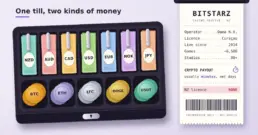
| Account currencies | NZD, AUD, CAD, USD, EUR, NOK, JPY and others |
| Cryptocurrencies accepted | Bitcoin, Ethereum, Litecoin, Tether and more |
| Welcome offer | Multi-deposit match plus 180 free spins (figures marketed in EUR/BTC; confirm current terms) |
| Wagering requirement | 40×, applied to each part of the package |
| Crypto withdrawal speed | Usually within the hour, after identity verification |
| Native app | None — mobile browser or home-screen shortcut |
| New Zealand status | Offshore operator; no New Zealand licence |
Who runs BitStarz, and under what licence
BitStarz is operated by Dama N.V., a company registered in Curaçao. The brand launched in 2014 and has changed hands and licensing arrangements over the years, so you may see older records referencing a different operator or an Antillephone sub-licence number (8048/JAZ2020-013). What matters today is the current position: the casino operates under a Curaçao licence.
Curaçao overhauled its gambling framework in 2024. Licensing moved from the old system of master-licence holders issuing sub-licences to direct licences granted by the Curaçao Gaming Authority (CGA) under the island’s National Ordinance on Games of Chance. In plain terms, a Curaçao licence now comes from a single regulator rather than a reseller. That is an improvement on the old model, but it is still a lighter-touch regime than the Malta Gaming Authority (MGA) or the UK Gambling Commission (UKGC) — a point BitStarz itself discloses. You can check a current Curaçao licence number against the CGA register rather than taking a logo at face value.
The licensing detail that counts for a reader in New Zealand is simpler: an overseas licence is not a New Zealand authorisation. No online casino currently holds a New Zealand licence, so BitStarz is an offshore operator as far as New Zealand law is concerned. More on what that means, and the dates involved, further down.
Does BitStarz support New Zealand dollars?
Yes. This is worth stating clearly, because it is often reported the wrong way round. BitStarz lets you hold your account balance in New Zealand dollars, and NZD sits alongside Australian dollars, Canadian dollars, US dollars, euros, Norwegian kroner and Japanese yen on its list of supported account currencies, plus a range of cryptocurrencies. Being able to register and bank in NZD puts BitStarz in the minority of crypto-first casinos that do not force you into euros, US dollars or Bitcoin.
There are still a few practical points worth understanding before you read too much into that:
- Your balance stays in the currency you choose at sign-up. BitStarz is a casino, not a currency exchange, and it does not convert between currencies inside your account. If you want to avoid conversion, select NZD when you register and fund from an NZD source.
- Marketing figures are frequently quoted in euros, US dollars or Bitcoin. Deposit minimums, withdrawal minimums and bonus ceilings are often shown in EUR or BTC, so convert them mentally into NZD before judging whether an offer is as large as it looks.
- Funding in a foreign currency or crypto means you convert twice. If you deposit in anything other than your account currency, your bank, card issuer or wallet applies a rate on the way in and again on the way out, and cards commonly add a foreign-transaction fee while e-wallets can charge up to around 3.99% for conversion.
- Individual games can restrict certain currencies. Eligibility is sometimes set game by game — a slot may be labelled as open to fiat currencies except, say, JPY and RUB — so a specific title being unavailable in your currency is a game rule, not a sign that the currency is unsupported.
If banking in your own currency is a priority, it is worth comparing operators side by side; our guide to casinos that let you bank in New Zealand dollars explains what to look for.
Paying in cryptocurrency: what it does and does not do
BitStarz accepts major cryptocurrencies — Bitcoin, Ethereum, Litecoin, Tether and others — and crypto is the route behind its fast-payout reputation. Three claims commonly attached to crypto play are worth correcting, because they shape decisions that can cost money.
Key points
- Crypto is pseudonymous, not anonymous. The ledger is public and permanent, the exchange verifies your identity, and the casino verifies it before paying out.
- Disposing of cryptoassets can be taxable. Inland Revenue treats them as property, so selling, swapping or spending them can trigger tax separately from any gambling win; OECD reporting begins in 2027.
- Do not use a VPN to reach a blocked casino. It breaches the operator’s terms and the usual result is account closure and forfeited funds, found out when you try to withdraw.
- Match the network to the address. Sending crypto on the wrong network is the most common permanent loss — there is no reversal or chargeback.
- NZD is supported, but balances do not auto-convert. Choose NZD at sign-up and fund from an NZD source to avoid paying a spread at both ends.
It is not anonymous. “Anonymity” is routinely listed as a benefit of paying in cryptocurrency, often in the same breath as the statement that identity verification is required before you can withdraw. Those two things cannot both be true. Cryptocurrency is pseudonymous, not anonymous: the blockchain ledger is public and permanent, the exchange you buy coins from verifies your identity, and the casino verifies your identity before paying out. Nothing in that chain is private.
There is a tax question worth raising. Inland Revenue treats cryptoassets as property rather than currency. Disposing of them — selling, swapping or spending them — can be a taxable event at your marginal rate, whether or not you ever convert back to New Zealand dollars. That is a separate question from whether a gambling win itself is taxable, and both deserve thought. New Zealand is also part of the OECD Crypto-Asset Reporting Framework, under which exchanges begin reporting account information from 2027.
Do not use a VPN to reach a blocked casino. When a site appears unavailable, a common suggestion is that access may be restricted locally and that a VPN “may or may not be legal depending on your jurisdiction.” Set the legal hedging aside; the practical consequence comes first. Masking your location to reach a casino that has excluded your country breaches its own terms, and the standard outcome is account closure and forfeiture of the whole balance — discovered at the moment you try to withdraw and identity verification reveals where you actually are.
One mechanical risk sits underneath all of this: sending cryptocurrency on a network that does not match the receiving address is the most common way people lose it for good. There is no chargeback, no reversal and no support ticket that recovers it, so check the network as carefully as the address. If a bonus is what draws you to crypto in the first place, read our explainer on crypto casino bonuses in New Zealand before depositing.
The welcome bonus, in proportion
BitStarz headlines a multi-part welcome package: a 100% match plus 180 free spins on the first deposit, followed by further matched deposits. The top-line figure is marketed in Bitcoin terms — commonly advertised as up to around 5 BTC (roughly the equivalent of several hundred euros in cash) across the first four deposits — but the exact cash, crypto and free-spin figures vary by region and currency, so treat the number on the promotions page as the one that counts and confirm it on the day.
Two things put any figure like that into scale:
- A 40× wagering requirement applies, and to each part of the package. On a first deposit of NZ$100 matched at 100%, a 40× requirement implies turnover in the region of NZ$8,000 before you can withdraw — at an expected cost near NZ$320 on a game returning about 96%. The headline number and the playthrough are two halves of the same offer.
- Some payment methods are excluded from claiming a bonus. Deposits made with Skrill or Neteller are commonly ineligible for welcome offers, which matches how those wallets are treated across the industry generally.
None of that makes the offer bad; it makes it an offer with conditions, like every other. If the mechanics are unfamiliar, our guide to how wagering requirements work walks through the four terms that actually decide an offer’s value.
The games library
Around 6,500 titles from more than 80 providers is a genuinely large catalogue — one of the biggest covered on this site. It spans pokies, table games, live dealer studios and a set of in-house “Originals” such as Plinko, Crash, Mines and Dice. Two notes keep the scale honest:
- Headline jackpots carry a lower base return. Mega Moolah, a progressive jackpot pokie, is often named as an attraction. Its base-game return to player is about 88% — well below the roughly 96% typical of a modern pokie — because a slice of every wager funds the jackpot pools rather than ordinary wins. Our online pokies guide explains why a big-jackpot game and a high base RTP rarely come together.
- “Provably fair” applies to selected crypto games only. It is a real mechanism that lets you verify an individual result cryptographically, but it covers a subset of titles — mainly the in-house crypto games — not the whole lobby. Treat it as a feature of some games, not a description of the library.
Payouts, limits and verification
BitStarz built its name on fast crypto payouts, and the timings it publishes are reasonably frank. Stripped of the “10-minute payout” marketing, the realistic picture is:
- Cryptocurrency: usually processed within the hour, often within minutes once any pending review and blockchain confirmations clear.
- E-wallets (such as Skrill or Neteller): typically from near-instant up to around 24 hours.
- Cards and bank transfer: several business days, often in the 1–5 day range depending on your bank.
Every withdrawal is subject to identity verification (KYC), and strict checks can delay a large payout — which is exactly when people least expect it. On limits, the position is best confirmed in the cashier rather than taken from a review: limits are set per method and per currency, card transactions are often capped around a few thousand euros per transaction, and crypto withdrawals are effectively uncapped, which is the practical reason a crypto-first casino attracts larger winners. If payout speed is your deciding factor, verify the method you will actually use; our overview of fast-paying operators is a useful starting point.
What BitStarz discloses — and where its own copy slips
A good deal about this casino is disclosed rather than buried, which deserves saying. The 40× wagering requirement is stated up front. The lighter Curaçao oversight compared with MGA or UKGC is acknowledged. The possibility that strict identity checks delay large payouts is flagged, and the realistic payout timings are given instead of the marketing version. The operator and its licence are named precisely. That is more transparency than many brands at this tier manage.
Where the published material slips is mostly in its own help pages and FAQs:
- The app is described inconsistently. You may be told to “download the BitStarz app,” that there is no Play Store app, and that “in some regions a downloadable APK may be available.” In practice there is no native app and a home-screen shortcut is the right answer (see below).
- Withdrawal minimums are restated in several places and not always identically. Take the figure from the cashier on the day you withdraw.
- The FAQs run long and repetitive — several near-identical “is it legitimate?” entries are not several answers — and “similar casinos” prompts point mostly at other offshore crypto brands. At least one entry still refers to a promo code for a year that has passed, a reminder that any code or figure needs checking against the live site.
Apps and mobile access
There is no native BitStarz app for Android or iOS. The site is a responsive web app, so the right approach on a phone is to open it in your mobile browser and, if you want an icon, add a home-screen shortcut. Do not sideload an APK. Installing an APK from outside an official store means switching off Android’s protection against unvetted software — on a device you also bank on — and that setting stays switched on afterwards, widening your exposure well beyond the casino itself.
Safety, fairness and how BitStarz compares
On the measurable basics, BitStarz is a long-established brand with a large multi-studio library, a named operator, a verifiable Curaçao licence, mandatory KYC and transparent payout timings. Those are the things to check on any operator, and BitStarz discloses most of them. The honest caveats are the ones that apply to the whole offshore crypto category: Curaçao oversight is lighter than MGA or UKGC; dispute resolution, if it ever comes to that, runs through an overseas framework; and bonus playthrough is high. A crypto-led casino tends to suit players who already hold cryptocurrency, understand that it is pseudonymous and taxable, and value speed of withdrawal. It suits a cautious first-timer far less well than a lower-wagering, NZD-native operator would. Whatever the brand, the warning signs of an unsafe site — no verifiable licence, vanishing terms, blocked withdrawals — are the same, and it is worth knowing how to read them.
Where New Zealand’s rules are heading
New Zealand is in the middle of regulating online casino gambling for the first time, and the dates matter.
- The Online Casino Gambling Act 2026 came into force on 1 May 2026, and from that date advertising online casino gambling to New Zealanders has been barred for operators without a licence.
- Fifteen licences were offered, each covering a single brand for an initial three-year term (renewable), with no operator permitted more than three. An ascending-clock auction run by the Department of Internal Affairs (DIA) was held in September 2026, and in mid-October 2026 the DIA confirmed that eleven companies won the right to apply, at a reported price of about NZ$15 million per slot. Winning the right to apply is not the same as holding a licence; applicants are still assessed on harm-minimisation, consumer protection and advertising plans.
- From 1 December 2026, operators that do not hold a licence or a pending application must stop providing online casino gambling to New Zealanders. Unlicensed operation or advertising after that date can attract substantial penalties.
- A fully licensed and regulated regime is expected to be operational in 2027, at which point the DIA is the body to check for which operators are actually authorised.
For players, the confirmed consumer protections are as important as the licensing. Credit cards and buy-now-pay-later facilities are banned as funding methods for online casino gambling, a quarterly levy funds harm-reduction work, and licensed operators face limits on inducements and features such as autoplay, plus deposit-limit prompts. If you currently hold a balance at an offshore casino such as BitStarz, the sensible step is to withdraw it in good time ahead of December rather than close to the deadline. Our New Zealand gambling laws guide keeps the full timeline up to date.
Getting help in New Zealand
Free, confidential help is available in New Zealand at any time. The Gambling Helpline can be reached on 0800 654 655 or by free text to 8006, 24 hours a day, and PGF Services offers free counselling on 0800 664 262. If you want to put practical barriers in place, our guide to self-exclusion tools covers bank gambling blocks and device-level blocking software.
Responsible gambling and disclaimer
This page is published for information. It is not financial, legal or gambling advice, and nothing on it is a recommendation to gamble or an endorsement of any operator. You must be 18 or older to gamble online in New Zealand.
No link on this page goes to an operator’s cashier, and none will. Licensing, ownership, bonus terms, currency support, withdrawal limits and country availability all change — sometimes within weeks — and this page covers a period in which the New Zealand market is being restructured. Confirm the current position in the operator’s own terms and on the regulator’s register before acting on anything here. If gambling is causing harm, free and confidential support is available 24 hours a day on the Gambling Helpline, 0800 654 655, or by free text to 8006.
Reference sources
- Online Casino Gambling Act 2026 — New Zealand Legislation, including the advertising restrictions
- Online Casino Gambling Regulations 2026 — New Zealand Legislation
- Information for online casino customers — Department of Internal Affairs, where licensed operators will be listed
- Cryptoassets and tax — Inland Revenue, Te Tari Taake
- Crypto-Asset Reporting Framework — Inland Revenue, on international reporting from 2027
- Curaçao Gaming Authority — the licensing body since the 2024 reform, where licence numbers can be checked
- Fair Trading Act — Consumer Protection, New Zealand Government
- How to spot a scam website — Own Your Online, CERT NZ
- Gambling Helpline Aotearoa New Zealand — free, confidential support, 24 hours a day
Frequently Asked Questions
Does BitStarz support New Zealand dollars?
Yes. BitStarz lets you hold your balance in New Zealand dollars, alongside currencies such as AUD, CAD, USD, EUR, NOK and JPY and a range of cryptocurrencies. Your balance stays in the currency you choose at sign-up, and the casino does not convert between currencies in-account, so pick NZD and fund from an NZD source if you want to avoid conversion costs.
Who operates BitStarz, and is it licensed in New Zealand?
BitStarz is operated by Dama N.V. under a Curaçao licence. It is not licensed in New Zealand; no online casino currently holds a New Zealand licence, so BitStarz is an offshore operator and a Curaçao licence is not a New Zealand authorisation.
What is the wagering requirement on the BitStarz bonus?
It is 40×, and it applies to each part of the multi-deposit welcome package. Some payment methods, including Skrill and Neteller, are commonly excluded from claiming a bonus. Always read the current promotion terms, as the cash, crypto and free-spin figures vary by region.
How fast are BitStarz withdrawals?
Cryptocurrency withdrawals are usually processed within the hour, e-wallets from near-instant up to about 24 hours, and cards or bank transfers over several business days. Every withdrawal is subject to identity verification, which can add time to a large payout.
Can I still use BitStarz from New Zealand after 1 December 2026?
Under the Online Casino Gambling Act 2026, operators without a New Zealand licence or a pending application must stop serving New Zealanders from 1 December 2026. If you hold a balance at an offshore casino, withdraw it in good time rather than close to the deadline, and check the Department of Internal Affairs for which operators become licensed in 2027.