Holding your online casino balance in New Zealand dollars is a genuine convenience, and a small one. It avoids a currency-conversion cost each time money moves in and out, it makes bonus figures easier to read at a glance, and it makes a budget easier to track. All true, and all worth a few dollars.
This page sets out what NZD support does not do, what costs far more than currency ever will, and the licensing change now reshaping which sites New Zealanders can use at all. It is information, not advice, and not a recommendation to gamble.
What paying in NZD actually saves you
When your bank account and your casino account are both in New Zealand dollars, no conversion happens, so you avoid the spread a provider adds on top of the mid-market exchange rate. That spread typically runs somewhere around 2% to 4% each way. The digital wallet Skrill, for example, publishes a foreign-exchange fee of about 3.99% on its standard tier, charged only when a conversion is actually needed. On a NZ$100 deposit, that is a few dollars.
Set that next to a wagering requirement — the amount you must bet before bonus money (and often the deposit tied to it) can be withdrawn. At 30× deposit-plus-bonus, clearing a NZ$100 deposit with a matched NZ$100 bonus means putting NZ$6,000 through the games, at an expected cost of roughly NZ$240 on a pokie that returns 96%. At 200×, the same deposit demands NZ$40,000 of turnover, at an expected cost near NZ$1,600.
Currency is a rounding error next to that. Any page presenting NZD support as a deciding factor has the proportions wrong. Our guide to wagering requirements works through the maths in full.
One correction worth making. Holding your account in New Zealand dollars saves a conversion cost. It does not save time. Conversion is effectively instantaneous and adds nothing to a payout timeline. If a withdrawal is slow, currency is not the reason.
Which payment routes genuinely hold NZD
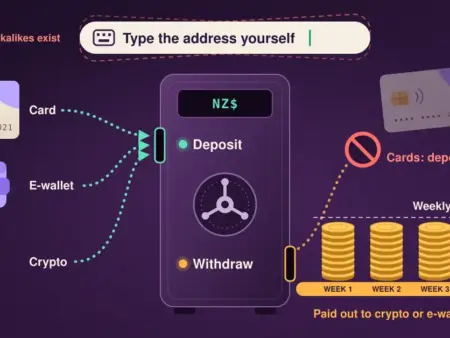
Skrill and Neteller both support New Zealand dollar accounts. Choose New Zealand and NZD when you register, and the wallet holds your balance in NZD, so no conversion occurs on the way through. Some older guides claim these wallets settle only in euros or US dollars; that is out of date.
POLi is a deposit method only. You cannot withdraw to it, so you need a separate payout route arranged in advance. POLi also works by having you enter your internet-banking username and password into a third party’s interface. Consumer NZ has warned that this probably breaches your bank’s terms and conditions, and the major New Zealand banks tell customers not to share their login details. Regulated open banking went live in New Zealand on 1 December 2025 and lets you authorise a payment from inside your own bank’s app without handing credentials to anyone.
Cards and crypto each carry a caveat. Visa and Mastercard debit cards are widely accepted, but credit-card gambling deposits are being prohibited for licensed New Zealand operators, so a credit card is not a route to rely on. If you fund an account with cryptocurrency, remember that Inland Revenue treats crypto as property, and disposals can have tax consequences regardless of how the money is later used.
A site displaying NZD is not necessarily holding NZD. Some operators show New Zealand dollars in the interface while settling in another currency and converting at their own rate. If the conversion happens at the operator’s rate rather than your bank’s, the saving you thought you were making has simply moved. Check the cashier and the terms rather than the marketing. Our casino deposit methods page covers the routes that work from New Zealand and what each costs.
What to check instead
The checklists on most NZD pages ask whether a site shows balances in New Zealand dollars, takes local payment methods, has clear terms, offers round-the-clock support and has good reviews. Four of those five are about convenience. Ordered by what actually costs you money, currency comes last.
Key checks before you deposit
Work down this list before you deposit. Currency belongs near the bottom, not the top.
- The wagering requirement, and what it applies to. Deposit, bonus, or both — the difference doubles the number. Roughly 30× to 40× is the normal market range; above 60× is steep; at 200× a bonus is promotional rather than realistically winnable.
- Any maximum bet while wagering. Breaching it usually voids the bonus and the winnings with it, and players tend to find out only at withdrawal. The limit is often a percentage of the bonus rather than a fixed figure.
- Withdrawal caps, weekly or monthly. Check whether they aggregate across sister brands — several groups apply one limit across every casino they own.
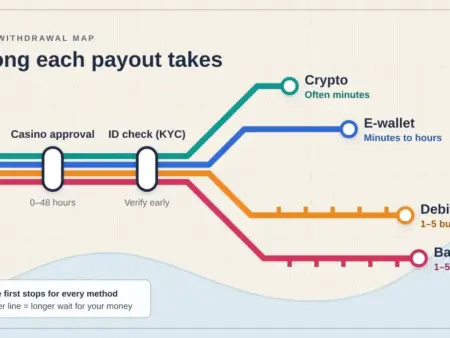
- The minimum withdrawal and the pending period. Minimums are commonly NZ$50 and sometimes higher for bank transfer, which quietly strands small balances. Many operators hold a request for 24 to 48 hours before processing, during which it can often be reversed back into play. If that reversal can be switched off in your settings, switch it off.
- Whether the licence is real and verifiable. A named authority and a number you can check on that authority’s own register. “Licensed and regulated” with no authority named is not a credential, and a licence for one market does not necessarily govern your account.
- Only then: currency, payment methods and support hours. Real conveniences, worth having — and worth a fraction of the five items above.
Withdrawal caps deserve special attention, because this is the term that catches people hardest. Payout speed is measured in hours; a withdrawal cap is measured in weeks. Win NZ$20,000 at an operator that advertises 24-hour withdrawals but applies a weekly cap of around NZ$7,000, and the first instalment arrives the next day while the rest takes the better part of a month — with the unpaid balance sitting in your casino account as playable money the whole time. That is the structure, not an accident.
Caps also frequently aggregate across sister brands. Several large groups apply one weekly limit across every casino they own, so three accounts in the same family share a single cap rather than three. Sister brands are rarely signposted: two casinos with different names, themes and welcome offers can run on one operator, one cashier and one limit. Our fast-payout casinos page covers what genuinely speeds up a withdrawal — verifying your identity at registration rather than at cash-out is the single largest factor.
The change that matters more than currency
Choosing an offshore casino is no longer the settled question most guides assume. New Zealand is part-way through licensing the market for the first time, and the timetable is specific and already biting.
Licensing timeline
New Zealand’s first online casino licensing regime, staged by the Department of Internal Affairs.
| Date | What happens |
|---|---|
| 1 May 2026 | Online Casino Gambling Act 2026 commences; advertising to New Zealanders is prohibited for unlicensed operators. |
| 3 July 2026 | Online Casino Gambling Regulations 2026 take effect. |
| 17 Jul – 14 Aug 2026 | Expression-of-interest stage. |
| 29 Sep – 12 Oct 2026 | Competitive auction: 32 bidders over 10 rounds at NZ$15 million per application right. Eleven entities win the right to apply for up to fifteen licences — one brand each, no operator holding more than three. |
| From Oct 2026 | Full licence applications submitted and assessed. |
| 1 December 2026 | Operators that did not enter the process must stop serving New Zealanders; civil penalties up to NZ$5 million for a company. |
| Early 2027 | First three-year licences expected to be granted; a public DIA register and an on-site registration mark. Licensed operators must offer mandatory deposit and session limits, verify age at 18, bar credit-card deposits, and follow restrictions on inducements and game design, including an autoplay ban. |
| 1 June 2027 | Transitional exemption ends: applicants still awaiting a decision must stop by this date. |
In short: the Online Casino Gambling Act 2026 commenced on 1 May 2026, with regulations taking effect on 3 July 2026. After an expression-of-interest stage and a competitive auction that ran into October 2026, eleven entities secured the right to apply for up to fifteen licences — one brand each, with no operator permitted to hold more than three. Winning an auction slot is only a right to apply; the applications are now being assessed, and the first three-year licences are expected to be granted in early 2027. SkyCity, the operator behind New Zealand’s land-based venues, is among the applicants; you can read more in our SkyCity Auckland casino review.
This is already happening. From 1 December 2026, operators that did not enter the licensing process must stop serving New Zealanders, with civil penalties of up to NZ$5 million for a company. Operators that applied may keep trading — but not advertise here — until their application is decided or the transitional exemption ends on 1 June 2027, whichever comes first. In practice, new sign-ups tend to close before existing accounts do, and some operators had already stopped accepting new New Zealand registrations before the Act even commenced. A comparison page written months ago cannot tell you whether an account is open to you today.
Before you deposit anywhere, attempt registration and look at the cashier. And if you already hold a balance, take it out well before December rather than after. Where an operator caps weekly withdrawals, a large balance takes weeks to release, and the deadline does not wait for it. Our New Zealand gambling laws guide sets out the framework in full.
Is NZD support a safety signal?
No, and it is worth being clear about this because it is often implied. Accepting New Zealand dollars, using New Zealand-focused wording, or offering POLi tells you only that an operator has chosen to market here. It says nothing about licensing, solvency or conduct. The Fair Trading Act applies to misleading claims made to New Zealand consumers, but enforcing it against an offshore company is a very different matter from having a domestic regulator to call.
An offshore licence tells you an operator is supervised somewhere, which is better than nothing and considerably less than it sounds. It does not mean a New Zealand authority can help you, that a New Zealand court has easy jurisdiction, or that the operator will still be trading next year. Two further points are worth knowing:
- Check which licence governs your account. Multi-market operators often hold several. A UK or Ontario licence carries real obligations for customers in those markets and none for a New Zealander, whose account usually sits under a different entity and a different regulator. The footer of the version of the site you can actually reach is the only reliable place to look.
- A Curaçao “master licence” number is not a current credential. Curaçao has wound down its old master-and-sublicence model and now issues direct licences through its gaming authority. The former master licences have expired, so a sublicence number quoted under one of them no longer offers the recourse it once implied.
From 2027 there will be a public Department of Internal Affairs register to check against, and a registration mark displayed on licensed platforms. Until then, the honest position is that you are relying on a foreign regulator and the operator’s own conduct.
Getting help
Free, confidential support is available in New Zealand at any hour through the Gambling Helpline on 0800 654 655, or by free text to 8006. Support is for anyone affected by gambling, including family and friends, and it is independent of any operator.
Practical tools work regardless of which casino you use. Many banks will block gambling transactions on request, device-level blocking software covers your phone as well as your computer, and formal self-exclusion removes access across participating services. Our self-exclusion guide explains the options. You must be 18 or older to gamble online in New Zealand.
Disclaimer
This page is published for information only. It is not financial, legal or gambling advice, and nothing on it is a recommendation to gamble or an endorsement of any operator. You must be 18 or older to gamble online in New Zealand.
Country availability, licensing, bonus terms and withdrawal limits change quickly, and this page covers a period in which the New Zealand market is being restructured. Anything stated here reflects the position when the page was last reviewed; confirm the current position on the regulator’s own register and in the operator’s own terms before you deposit. Where a figure could not be verified from a primary source, this page says so rather than filling the gap.
Expected-loss figures are long-run averages calculated from stated return percentages. They describe the cost of generating turnover, not the outcome of any session, and no bet described here has a positive expected return. Gambling costs money over time by design; no bonus, currency or payment method changes that. Set a deposit limit before your first deposit rather than after a losing session. Free, confidential support is available 24 hours a day on 0800 654 655, or by free text to 8006.
Sources
Legislation, regulator guidance, consumer information and support services. No link below goes to a gambling operator.
- DIA — online gambling licensing for providers — the staged process, the fifteen-licence cap, the auction outcome and the 1 December 2026 cut-off.
- DIA — information for online casino customers — what the change means for players and where the register will be published.
- Simpson Grierson — New Zealand’s new online casino regime — staged commencement dates and the harm-prevention measures for licensed operators.
- Senet — Online Casino Gambling Regulations 2026 — the inducement limits, advertising restrictions and game-design rules.
- Kahnawake Gaming Commission — licensee register, for verifying a claimed Kahnawake licence.
- Curaçao licence status — background on the wind-down of the old master-licence model.
- Consumer NZ — POLi payments and your banking security — why sharing internet-banking credentials can breach your bank’s terms.
- MBIE — open banking regulations now in force — the 1 December 2025 commencement and the phased bank timetable.
- Inland Revenue — cryptoassets and tax — relevant if you fund an account with cryptocurrency.
- Consumer Protection — Fair Trading Act — the New Zealand law on misleading claims about a service.
- Gambling Helpline Aotearoa New Zealand — free, confidential support, 24 hours a day.
Frequently Asked Questions
Does depositing in NZD save me money?
A little, where your bank account is also in New Zealand dollars — you avoid a conversion spread of roughly 2% to 4% each way, worth a few dollars on a typical deposit. That is small next to wagering requirements and withdrawal caps, which is why currency should not drive your choice of site.
Does NZD support make withdrawals faster?
No. Conversion is effectively instant and adds nothing to a payout timeline. If a withdrawal is slow, the cause is the pending period, identity verification, a withdrawal cap or outstanding wagering — not the currency your balance is held in.
Do Skrill and Neteller support NZD accounts?
Yes. Both offer New Zealand dollar accounts — select New Zealand and NZD at registration and no conversion occurs on the way through. Skrill applies a foreign-exchange fee of about 3.99% on its standard tier only when a conversion is actually needed.
Does a casino accepting NZD mean it is licensed or safe in New Zealand?
No. Accepting New Zealand dollars means only that the operator has decided to market to New Zealanders. New Zealand’s first online casino licences are not expected to be granted until early 2027, and a foreign licence gives no New Zealand authority a role in a dispute. Check which regulator actually governs your account.
What is happening to offshore casinos serving New Zealand?
Following an auction that concluded in October 2026, eleven entities won the right to apply for up to fifteen licences. From 1 December 2026, operators that did not enter the process must stop serving New Zealanders, with penalties up to NZ$5 million. Those that applied may continue, without advertising, until their application is decided or 1 June 2027. Some operators have already closed to new New Zealand sign-ups, so check that an account is open to you before depositing.