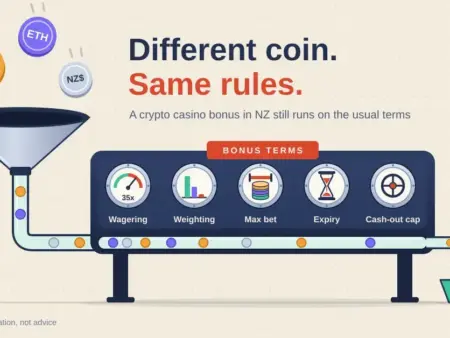
The wagering requirement is the single number that decides whether a casino bonus is worth taking — and it is also the number most often quoted without the context that gives it meaning. A multiple of 10× sounds generous and 40× sounds steep, but neither figure tells you anything until you know what it is multiplied against, what it caps your winnings at, and how long you have to meet it.
This page does not list operators or offers. Instead it sets out what each multiple actually costs you in turnover and in dollars, what is usually traded away in exchange for a low one, and a short method for checking any offer yourself in about a minute. The reason there is deliberately no list is explained further down.
The arithmetic behind a wagering requirement
A wagering requirement — also called playthrough or turnover — is a target for how much you must stake before bonus funds, and anything won with them, can be withdrawn. It is not an amount you must lose. A NZ$100 bonus at 30× means you have to place NZ$3,000 in bets, win or lose, before a withdrawal becomes possible. At NZ$1 a spin, that is 3,000 spins. Our guide to wagering requirements walks through the same calculation step by step.
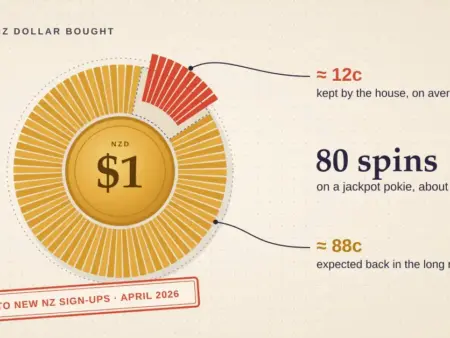
The turnover itself carries a cost, because every bet is exposed to the house edge — the built-in margin that makes the game profitable for the operator over time. On a pokie that returns 96% to players (a return-to-player, or RTP, of 96%), the house keeps about 4% of everything staked. Generating NZ$3,000 of turnover therefore has an expected cost of roughly NZ$120. Push the multiple to 200× and the same NZ$100 bonus now demands NZ$20,000 of turnover at an expected cost near NZ$800 — which is why very high multiples turn a “bonus” into an advertisement rather than something you can realistically clear.
The detail that changes everything is what the multiple applies to. Is it the bonus only, or the deposit plus the bonus? A NZ$100 deposit matched by a NZ$100 bonus, with 40× applied to both, is NZ$8,000 of turnover — not NZ$4,000. That means 20× on deposit-plus-bonus is actually more work than 30× on the bonus alone. A headline multiple tells you almost nothing until you know its basis.
As a rule of thumb, anything below 20× is considered low and 10× or less is excellent — but those labels only hold once you know what is being multiplied, and on which funds.
What gets traded for a low multiple
Operators do not lower a wagering requirement out of generosity. They lower one number and tighten another, and working out which lever moved tells you what an offer is really worth. The table below sets out the six terms that most often move in the opposite direction to the headline multiple.
The trade-offs
| What is tightened | What it means for you |
|---|---|
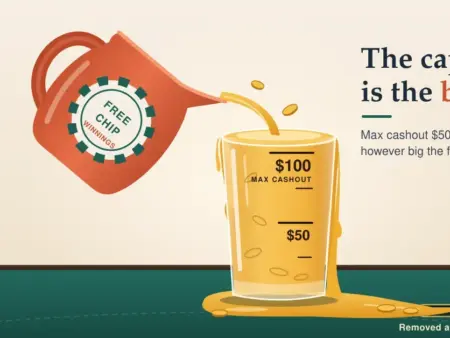
| Maximum cashout | The most common trade, and the one that matters most on wager-free offers. A NZ$50 wager-free bonus capped at a NZ$100 maximum win is a different product from one capped at NZ$1,000. |
| A smaller bonus | Low-wagering offers are usually smaller in headline terms. That is a fair exchange rather than a catch — a small bonus you can actually clear beats a large one you cannot. |
| A low maximum bet | Often only a few dollars, and sometimes a percentage of the bonus rather than a fixed figure. Breaching it even once usually voids the bonus and everything won with it, and it is normally discovered at withdrawal. |
| A restricted game list | Pokies typically count 100% toward the requirement; table games often count 10% or nothing, and some terms void the bonus if you play them at all. A low multiple on a narrow list of eligible titles is not as generous as it looks. |
| A shorter window | Sometimes 24 to 72 hours. A short expiry can make a low multiple harder to complete than a high one spread over a month. |
| The basis it is calculated on | The quietest trade of all. A headline of 20× applied to deposit plus bonus is 40× on the bonus in real terms — the detail most listings leave out. |
The maximum cashout is the single most important one, particularly on wager-free offers. An operator giving money away with no playthrough still needs a limit on its exposure, and this is normally where it sits. A NZ$50 wager-free bonus capped at a NZ$100 maximum win is a fundamentally different product from one capped at NZ$1,000, and listings routinely quote the first figure while omitting the second.
The maximum bet during wagering is the term that most often costs people a win. It is frequently only a few dollars, is sometimes expressed as a percentage of the bonus rather than a fixed figure, and breaching it even once typically voids the bonus and everything won with it. There is rarely a warning at the moment you do it — you find out at withdrawal.
Game contribution matters more than most guides suggest. Pokies usually count 100% toward the requirement, while table games often count 10% or nothing, and some terms void the bonus entirely if you play them. Our online pokies guide explains what those return percentages look like in practice.
The one-minute check
Before you claim any offer, run five questions in the order that matters. The first two decide whether the offer is even worth reading any further; a listing that cannot answer them has given you advertising rather than information.
The one-minute check
- What is the multiple, and what does it apply to? Bonus only, or bonus plus deposit? Those differ by a factor of two before anything else is considered. Search the terms for “wagering”, “playthrough” and “turnover”.
- What is the maximum cashout? On a wager-free offer this is where the value is capped, and it is frequently the only limit that matters. Search for “maximum win”, “max cashout” and “winnings cap”.
- What is the maximum bet while wagering? Often a few dollars, sometimes a percentage of the bonus. Breaching it usually voids everything, and there is rarely a warning at the point you do it.
- What counts toward the requirement? Pokies typically 100%, table games often 10% or zero, and some terms void the bonus if you play them at all. Look for the game-contribution table rather than assuming.
- How long do you have? A short window can make a low multiple harder than a high one spread over a month. Check whether the clock starts at registration, at deposit, or when the bonus is credited.
If an offer gives you a multiple but not its basis and not the maximum cashout, it is not a comparable figure. A great many published comparison tables give nothing beyond the multiple, and some get even that wrong by lifting it from a different market or a different stage of a multi-deposit package.
Wager-free and no-deposit offers
A wager-free bonus has no playthrough at all: any winnings are yours to withdraw immediately. These do exist and are usually the fairer deal, but the value is almost always capped by a low maximum cashout, so the first thing to find is that cap rather than the headline amount. Our no-wagering bonus guide covers how these offers are structured.
No-deposit and free-spin offers follow the same logic from the opposite direction: the amount is small, the maximum cashout is low, and the maximum bet is tightly restricted. Multi-deposit welcome packages add another wrinkle — the multiple can differ between the first, second and third deposits, so a single quoted figure can be misleading. Our welcome bonus guide breaks down how those stages work.
Why this page does not list casinos
Bonus terms move constantly, and any list published here would be stale within weeks. There is a stronger reason as well: the comparison figures circulating in this category are unreliable in one consistent direction — they flatter the offer.
A multiple quoted as 10× can belong to a different market than the reader is in, to a different stage of a multi-deposit package, or simply be wrong. Multi-market operators run different terms in different jurisdictions, and a figure lifted from a regulated market whose rules do not reach New Zealand is a common source of error. Two checks catch most of it: read the terms on the version of the site that actually loads for you, in the currency they are quoted in; and check whether the operator still accepts New Zealand registrations at all, because several groups have already closed to new New Zealand sign-ups ahead of the licensing deadline, and comparison pages have been slow to catch up.
What this page keeps instead is the method, which does not go out of date.
What changes under New Zealand’s new online casino rules
This page is about bonus terms, and from 2026 those terms are being capped by law. Under the Online Casino Gambling Regulations 2026, which took effect on 3 July 2026, a licensed New Zealand operator may not offer an inducement worth more than NZ$100 where the customer does not have to spend their own money. Where a deposit or bet is required, the value is capped at the lesser of NZ$100 or 200% of that deposit or bet. Sign-up inducements may only be published on the operator’s own platform — not through social media, television, radio, billboards, affiliate websites or other online advertising — and any conditions attached to a bonus must be set out in clear, plain language.
Licensed operators also face a set of player-protection rules. The minimum age is 18, with identity and age verified before an account is activated. Credit cards and linked credit products are banned as deposit methods, autoplay is prohibited, and a result equal to or below the amount staked may not be presented as a win with celebratory sounds or animations. Players must be given tools to set deposit, spend and time limits, along with breaks in play, time-outs and pop-up alerts for time and losses. A customer may hold only one deposit method per platform and cannot change it within 24 hours of selecting it, and an operator must exclude a customer across all of its platforms for up to two years where it has reasonable grounds to believe they are showing signs of problem gambling. Our New Zealand gambling laws guide sets out the full framework.
On the licensing side, advertising offshore online casinos to New Zealanders is already prohibited, and from 1 December 2026 any operator that has not applied for a licence must stop serving New Zealanders; those with a pending application may continue temporarily, without advertising, until a decision is made. The Department of Internal Affairs ran an expressions-of-interest round from July to August 2026 and an auction that concluded in October 2026, with up to 15 licences available. Full applications opened in October 2026, the licensed regime is expected to be operational in 2027, and approved brands will be listed on a public DIA register once their licences are granted.
One correction on licensing claims you may still see: a Curacao master licence number is no longer a current credential. Curacao’s new National Ordinance on Games of Chance took effect in late 2024, replacing the old master-and-sublicence model with direct licensing by the Curacao Gaming Authority, and the old master licences have since expired. A sublicence quoted under one of those master numbers is not evidence of current regulation.
Before you claim anything
Verify your account at registration, not at withdrawal. It is the same identity documents either way, and doing it up front removes the delay behind most payout complaints.
Read the terms on a computer rather than a phone. Multiples, maximum bets and cashout caps tend to sit behind links and inside collapsed panels on a small screen, which is exactly where they are hardest to find.
Check the licence number on the regulator’s own register. A named authority with a verifiable number is a credential; a logo is not, and neither is a licence issued for a market you are not in. Our casino deposit methods guide covers the payment routes that work from New Zealand once you have checked an operator out.
A note on chasing offers
Working systematically through bonus offers means opening verified accounts at many operators, each of which then markets to you and each of which is designed to convert a bonus into further deposits. A low wagering requirement makes an individual offer fairer; it does not change that pattern, and the accounts outlast the offers.
Gambling costs money over time by design, and no bonus — however low the wagering — changes that. If you want to step back, our self-exclusion guide covers bank gambling blocks and device-level blocking software, both of which work regardless of any single operator. Free, confidential support is available in New Zealand at any hour on the Gambling Helpline, 0800 654 655 or free text 8006, and from PGF Services on 0800 664 262. Both also support whanau and friends. You must be 18 or older to gamble online in New Zealand.
Disclaimer
This page is published for information only. It is not financial, legal or gambling advice, and nothing on it is a recommendation to gamble or an endorsement of any operator. The expected-cost figures are long-run averages calculated from a stated return percentage; they describe the average cost of generating turnover, not the outcome of any session, and no bet described here has a positive expected return. Licensing, bonus terms and country availability all change — confirm the current position in an operator’s own terms, and on the regulator’s register, before you deposit.
Reference sources
- Department of Internal Affairs — online casino licensing for providers — the licensing timetable, the 1 December 2026 deadline and the public register of licensed brands.
- Department of Internal Affairs — information for online casino customers — what the new rules mean for players.
- Senet Group — New Zealand’s Online Casino Gambling Regulations explained — inducement caps, advertising limits and the player-protection rules.
- iGaming Business — New Zealand introduces online gambling regulations — the regulations and the shape of the licensing process.
- Curacao licensing — the master-licence system and its replacement — why sublicences under the old master numbers are expired.
- Own Your Online (CERT NZ) — how to spot a scam website — New Zealand government guidance on checking a site’s credentials.
- Safer Gambling Aotearoa — blocking gambling — bank gambling blocks and blocking software.
- PGF Services — free counselling and financial mentoring, including for whanau and friends.
- Gambling Helpline Aotearoa New Zealand — free, confidential support, 24 hours a day.
Frequently Asked Questions
What counts as a low wagering requirement?
Below 20× is generally considered low and 10× or less is excellent. But the multiple alone is not enough: ask what it applies to, because 20× on deposit plus bonus is more turnover than 30× on the bonus alone.
What does a 40× wagering requirement mean in dollars?
On a NZ$100 bonus applied to the bonus only, it is NZ$4,000 of turnover, at an expected cost of around NZ$160 on a 96% pokie. On a NZ$100 deposit plus a NZ$100 bonus with the requirement applied to both, it is NZ$8,000 of turnover and roughly NZ$320.
Do wager-free bonuses really exist?
Yes, and they are usually paired with a low maximum cashout. An operator giving money away with no playthrough still needs a limit on its exposure, and that is normally where it sits. Find the cashout cap before you judge the offer.
What is the most common way people lose a bonus?
Exceeding the maximum bet while wagering. It is often a small figure, sometimes a percentage of the bonus rather than a fixed sum, and breaching it typically voids the bonus and the winnings together — usually discovered at withdrawal.
Will low-wagering bonuses still exist under New Zealand’s new rules?
Bonuses from licensed New Zealand operators are capped at NZ$100, or the lesser of NZ$100 and 200% of the deposit or bet, and sign-up inducements may only be published on the operator’s own site. Terms will matter more than headline size — which is what this page has always argued.