Claim the best exclusive casino bonus codes nz in NZ — terms, wagering, and how to maximise your value.

Exclusive Casino Bonus Codes in New Zealand: How They Work and What the Law Says

An exclusive casino bonus code is a short string of letters and numbers that links a specific promotion to your account when you register or make a deposit at an online casino. The word “exclusive” simply means the offer was arranged for one particular audience or channel rather than shown to the whole public — it says nothing about whether the deal is actually better. This guide explains, in plain terms, what these codes do, how to read the conditions attached to them, and — crucially for anyone in New Zealand — how the country’s new online casino law reshapes the picture in 2026. The short version: the fine print now matters far more than the headline number.
Key points
- A code attaches a pre-set offer to your account; it never changes that offer’s terms.
- “Exclusive” means a private channel, not automatically a bigger or fairer deal.
- Compare offers by wagering multiple, maximum cash-out and game weighting — not the headline percentage.
- Most codes must be entered at sign-up or before you deposit; entering one afterwards usually fails.
- In New Zealand, advertising online casino gambling to residents is prohibited during the 2026 transition, and no operator is licensed yet.
What an “exclusive” code actually is
Think of a bonus code as a voucher. When you type it into the sign-up form or the cashier, the casino’s system recognises it and attaches a pre-set promotion to your account — a deposit match, a batch of free spins, or occasionally a small no-deposit credit. The code is only the key. The promotion it unlocks already exists on the operator’s side with fixed terms, so entering a different code never changes those terms; it either opens the matching offer or it does nothing.
The label “exclusive” is a marketing term. It usually means the offer was built for a single channel — a particular email list, loyalty tier or comparison site — instead of appearing on the operator’s public promotions page. Sometimes that genuinely buys you something: a lower wagering multiple, a higher value cap, or a few extra spins. Just as often it is the same public offer behind different packaging. The only reliable way to tell the two apart is to compare the written conditions side by side.
- What “exclusive” can mean: a better wagering multiple, a larger cap on winnings, extra spins, or a lower qualifying deposit than the standard offer.
- What it often means instead: an identical promotion with a different name and a tracking code attached, so the channel that referred you can be credited.
How a bonus code works, step by step
The mechanics are much the same across most online casinos, and the order of steps is what trips people up most often.
- Find the exact code and its terms. Copy it precisely — many codes are case-sensitive, so a stray capital letter can invalidate the claim.
- Enter it at the right moment. That is normally during registration or in the cashier at the point of deposit, before any money is committed.
- Meet the qualifying condition. A deposit-based offer needs a qualifying deposit, often with a minimum amount; a no-deposit offer triggers on its own.
- Check the bonus has credited. Look in the “active bonuses” area to confirm the spins or bonus balance have landed and to see the wagering progress bar.
- Play within the rules and the clock. Stay under any maximum bet, stick to eligible games, and finish before the offer expires.
Depositing first and entering the code afterwards is the single most common reason an offer fails, because very few systems let a code be applied to an account that has already been funded.
Where this stands under New Zealand’s 2026 law
Before you act on any offer, it helps to understand where online casino bonuses sit legally for people in New Zealand, because the ground shifted in 2026. The Online Casino Gambling Act came into force on 1 May 2026 and, for the first time, sets up a licensed market for online casinos that serve New Zealanders. While that market is still being built, the Department of Internal Affairs (DIA) is explicit that advertising online casino gambling to New Zealand customers is currently prohibited — and promotional bonus offers aimed at Kiwis fall within that restriction. You can read more in our overview of New Zealand’s gambling laws.
The key facts from the DIA, as the transition runs through late 2026, are:
- No online casino is licensed yet. The DIA expects to begin issuing licences from early 2027, with the regime fully operational during 2027.
- There will be up to 15 licences, each covering a single brand. They were allocated through an auction that concluded in October 2026; eleven entities won the right to apply, at NZ$15 million per licence.
- From 1 December 2026, only operators that hold or have applied for one of those licences may offer online casino gambling to New Zealand customers. Every other site must leave the market.
- Licensed casinos must display an official registration icon on their platform and in any advertising, and the DIA will publish a public register of licensed operators.
- Overseas sites that served New Zealanders before 1 May 2026 may keep operating during the transition, but they must not advertise here.
The practical takeaway is straightforward. Any “exclusive NZ bonus code” promoted to you right now is being advertised in a space the regulator restricts, and the site behind it is not yet licensed in New Zealand. The DIA warns that if you choose to use an unlicensed platform, you will not have the same player protections that licensed operators will be required to provide, such as independent complaint handling. Unlawful advertising can be reported to the DIA at [email protected]. For full details, the official guidance is on the DIA’s online gambling page for players. Note that online racing and sports betting sits under separate rules: since 28 June 2025 it may only be offered in New Zealand by TAB NZ.
The main types of offer a code unlocks
Most bonus codes map to one of a handful of promotion types. They differ less in their marketing and more in the conditions attached, so it is worth knowing what each one typically asks of you before you decide it is worthwhile. The site’s wider guide to casino bonuses covers each in more depth.
Bonus types compared
| Bonus type | What the code unlocks | Typical catch | Good to know |
|---|---|---|---|
| No-deposit bonus | Small credit or spins with no payment | Strict maximum cash-out | Good for testing a site; rarely a big payout |
| Deposit match | A percentage of your deposit as bonus funds, up to a cap | Wagering requirement on bonus (and sometimes deposit) | Most common offer; value depends on the multiple |
| Free spins | A set number of pokie spins | Winnings usually become a bonus balance to clear | Often tied to one or two specific games |
| Wager-free spins | Spins whose winnings pay as withdrawable cash | Rare; usually few in number | The most player-friendly form when available |
| Reload / weekend bonus | A match on a later top-up for existing players | Lower match and shorter window than a welcome offer | Aimed at retention rather than sign-up |
A deposit match is the most common form: the casino adds a percentage of your deposit as bonus funds, up to a cap. A no-deposit offer gives a small credit or set of spins with no payment required, which is why it almost always carries the strictest caps on what you can withdraw. The rarest and most player-friendly form is wager-free spins, where any winnings are paid as cash you can withdraw immediately rather than as a bonus balance you have to clear first.
How to read the terms — the part that decides value
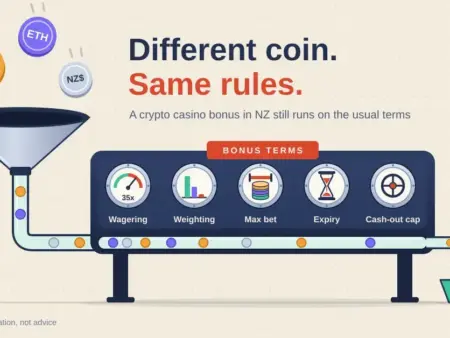
The headline number on a banner tells you almost nothing. The conditions below it decide whether an offer is worth your time. A few terms do most of the work:
- Wagering requirement. A multiple — say “35x” — of how much you must stake before bonus winnings can be withdrawn. A lower multiple is easier to clear. Our explainer on wagering requirements works through the maths with examples.
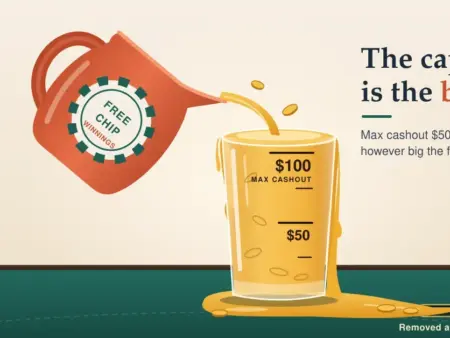
- Maximum cash-out. A cap on how much you can withdraw from bonus play, most common on no-deposit offers. A generous-looking bonus with a low cap may not be generous at all.
- Game weighting. How much each game contributes to the wagering target. Pokies usually count 100%, while table games such as blackjack and roulette often count far less, or nothing.
- Maximum bet. A per-spin or per-hand cap that applies while a bonus is active. Breaching it is a frequent reason winnings are voided.
- Expiry. The window in which you must meet the conditions. Short windows paired with high wagering are rarely realistic to clear.
- Sticky or non-sticky. A “sticky” bonus cannot itself be withdrawn — only winnings above it can — whereas a non-sticky bonus lets you withdraw your own deposit before touching the bonus.
Reading these together, rather than reacting to the percentage, is the single habit that protects your money.
Why codes fail, and other common mistakes
When a code does not work, the cause is usually mundane rather than technical. Knowing the usual culprits saves a lot of frustration.
- It was entered too late — after a deposit had already been made.
- It had expired, or was limited to new accounts only.
- It was single-use per person, household or IP address.
- A typo or wrong case stopped the system recognising it.
- A region restriction meant it was never valid for players accessing from New Zealand.
Beyond entry errors, the bigger mistakes are strategic: chasing a large match you cannot realistically clear, ignoring the maximum-bet rule, or treating bonus funds as “free money” rather than credit with strings attached.
Safety and the real cost of a “free” bonus
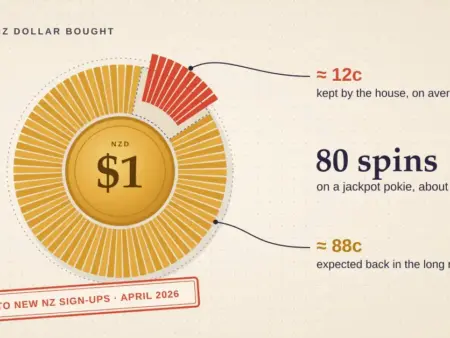
A bonus code costs nothing to enter, but the offer it unlocks is rarely free in a meaningful sense. A deposit match requires you to risk your own money first, and even a no-deposit credit asks you to meet wagering before anything becomes withdrawable. The house edge still applies to every spin you make while clearing a bonus, so the expected cost of that play is a real, if hidden, price.
On the safety side, the clearest signal in New Zealand from late 2026 onward will be whether an operator appears on the DIA’s public register and displays the official registration icon. Until the licensed market is live, standard precautions still matter: look for transparent terms, a clear complaints process, and sensible deposit and session limits you can set yourself. Treating a code as a way to extend play you were going to do anyway — never as a reason to deposit more — keeps the decision in proportion.
Who these offers actually suit
Used carefully, a bonus code suits a player who already intended to play, understands the conditions, and treats the extra funds or spins as a modest top-up rather than a strategy. It suits almost no one as a way to “win” money: wagering requirements, caps and the house edge mean bonuses are, on average, a marketing cost to the operator, not a transfer of value to the player. If an offer only looks attractive because of the headline percentage, that is usually a sign to read the terms again — or to walk away.
Responsible gambling
Gambling is entertainment, not a way to make money, and no bonus, code or “strategy” changes the underlying odds, which always favour the house over time. Set a budget and a time limit before you start, never gamble money you cannot afford to lose, and never chase losses. In New Zealand the Gambling Helpline offers free, confidential, 24-hour support on 0800 654 655 (or text 8006), including dedicated Māori, Pasifika, Youth and Debt lines. Online casino gambling in New Zealand is restricted to adults, and you can learn how to limit or stop your play through our guide to responsible gambling. This article is general information about how bonus codes work; it is not gambling advice or encouragement to gamble.
Sources
Frequently asked questions (FAQ)
What makes a casino bonus code “exclusive”?
It is an offer an operator has agreed to provide through one particular channel rather than on its public promotions page. That can genuinely mean a lower wagering multiple, a higher cap or extra spins, but it can equally be the same public offer with different branding and a tracking code attached. Comparing the written terms side by side is the only way to tell which it is.
Are exclusive casino bonus codes legal in New Zealand right now?
The Online Casino Gambling Act came into force on 1 May 2026, and while the licensed market is being set up the Department of Internal Affairs says advertising online casino gambling to New Zealand customers is prohibited. No operator is licensed yet, and from 1 December 2026 only operators that hold or have applied for one of the 15 licences may serve New Zealand customers. Any exclusive code promoted to Kiwis today is being advertised in a restricted space, and the site behind it is not yet licensed here.
Where and when do I enter a bonus code?
Usually on the registration form or in the cashier at the moment of deposit, depending on the operator. Very few systems let a code be applied to an account that has already been funded, so entering it after you deposit normally means the offer is lost.
Can winnings from a no-deposit bonus be withdrawn?
Generally yes, but only after you meet the wagering requirement and stay within the maximum cash-out limit, which is often low for no-deposit offers. In practice that cap, rather than your winnings, is what determines how much you can actually take out.
Why did my bonus code not work?
The usual causes are a code that has expired, is limited to new accounts, is single-use per person or household, or was entered after a deposit was already made. A typo or the wrong letter case will also stop the system from recognising it, as will a region restriction that makes the code invalid for play from New Zealand.
Recent Gambling News