
This is a factual profile of the SpinAway online casino brand as it is presented to New Zealand visitors. It carries no rating, no offer and no link to the operator. Its purpose is to set out what can actually be verified about who runs the site, which authority is said to license it, and how its terms sit against New Zealand’s new rules for online casino gambling.
Most published material about this casino shares one weakness: it rarely names the authority that licenses the operator, and the licence that is shown on the site’s own pages does not match itself. Those gaps matter more than any bonus headline, so they come first.
Quick facts
| Brand | SpinAway (online casino) |
| Operating company | NGame N.V. (listed address Willemstad, Curaçao; registration number 151672) |
| Stated licences | Curaçao sub-licence (cited in the terms) and Kahnawake Gaming Commission (cited in the footer); AGCO / iGaming Ontario in Canada (OPIG1242639) |
| New Zealand licence | None — no online casino holds one yet; the DIA register is expected from early 2027 |
| Platform | Browser-based on desktop and mobile; no downloadable app |
| Games | Aggregated from third-party studios, including a live-dealer lobby from external providers |
| Support | Live chat and email; no telephone line stated |
| Advertised welcome offer | Varies by source, roughly NZ$1,000–NZ$1,500 plus 100 free spins |
| NZ bonus cap (licensed market) | Lower of NZ$100 or 200% of the deposit or bet |
Who operates SpinAway
On SpinAway’s own pages the operating company is given as NGame N.V., a company registered in Curaçao (registration number 151672, listed address in Willemstad). A related company, NGame Services Ltd, registered in Cyprus, is described as handling payments and support. The same operator also runs a Canadian-facing version of the brand that is licensed in Ontario by the Alcohol and Gaming Commission of Ontario (AGCO) and listed with iGaming Ontario under registration OPIG1242639, in place since around November 2022.
That Ontario footprint is useful because conduct in a regulated market becomes a matter of public record, whereas conduct in an unregulated one does not. It also means the brand operates across more than one jurisdiction at once, which is exactly why its licensing statements need reading carefully rather than taken at face value.
The licence contradicts itself
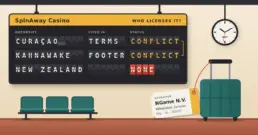
SpinAway’s own site makes two different licensing claims in two different places:
- The website footer states that the site is operated by NGame N.V. and licensed by the Kahnawake Gaming Commission — a regulator based on Kahnawake Mohawk territory in Canada — under a licence number.
- Section 1 of the terms and conditions instead cites a Curaçao licence, quoted as a 365/JAZ sub-licence.
A sub-licence is an authorisation granted by a company that itself holds a larger “master” licence, rather than directly by the regulator. Two separate licensing claims — one Kahnawake, one Curaçao — on the same operator’s own pages is a contradiction a reader should resolve before trusting either. At minimum it tells you the paperwork has not been kept tidy.
A further source of confusion is worth clearing up. Some third-party listings describe SpinAway as “Malta licensed” or tie it to Green Feather Online Limited. Green Feather is a separate Malta-licensed operator that runs other brands — including bCasino — and is not the company shown on SpinAway’s own site. If you have read that SpinAway is a Maltese operation, that detail almost certainly belongs to a different group. Our bCasino review covers the Green Feather side separately.
Why a Curacao licence needs checking in 2026
Even if you accept the Curaçao claim, a Curaçao licence is no longer the settled thing it once was. Curaçao’s National Ordinance on Games of Chance (known by its Dutch initials, LOK) came into force on 24 December 2024 and overhauled the island’s licensing regime. The old model — in which a handful of “master” licence holders issued “sub-licences” to operators like the one quoted in SpinAway’s terms — has been wound down. Operators are now expected to hold a direct licence from the Curaçao Gaming Authority (CGA) rather than a sub-licence from a private master holder.
The practical consequence for a reader is simple:
- A sub-licence number quoted in an operator’s terms may describe an arrangement that the new regime is phasing out.
- The Curaçao Gaming Authority maintains a public register and has advised the public to verify licences through it, not through claims on a casino’s own site.
- To check SpinAway, you look up the operating entity named in the footer — NGame N.V., the company, not the “SpinAway” brand name — and confirm it appears with a current, valid licence.
A licence number printed on a website records that an authorisation existed at some past moment. It says nothing about today. Curaçao licences have been revoked in the past, in at least one documented case within months of being issued, over an operator’s financial problems. That is why “they display a licence number” is not the same as “they are currently licensed”.
Key points
- SpinAway’s own pages name NGame N.V. (Curaçao, registration 151672) as the operator.
- The footer cites a Kahnawake licence while the terms cite a Curaçao sub-licence — two different claims to reconcile before trusting either.
- “Malta” or “Green Feather” references in some listings point to a different operator group (which runs bCasino and others), not SpinAway.
- Curaçao’s licensing regime changed with the LOK reform of 24 December 2024, so any sub-licence claim should be checked against the Curaçao Gaming Authority register.
- No operator is licensed for online casino gambling in New Zealand yet; the DIA register is expected from early 2027.
- Independent reviews report recurring complaints about withdrawals, account verification and support.
- Advertised welcome offers (around NZ$1,000–NZ$1,500 plus 100 spins) far exceed the NZ$100 / 200% cap that will apply to licensed operators.
- “Staged payouts” in the terms function as a withdrawal cap.
What the public record shows
Because SpinAway operates in Ontario under a provincial licence, independent reviews of that market give a sense of how the brand behaves where a regulator is watching. Two patterns recur across independent sources.
Consumer review scores run low. An Ontario review citing Trustpilot data recorded that, at the time of writing, 84% of reviews sat at one star. The problems most often cited were difficulty withdrawing funds, delays after a withdrawal request, and trouble completing account verification.
Complaint categories cluster around getting money out. Independent review and complaint platforms list recurring issues: withdrawals that are hard to complete, account-verification hold-ups, games freezing mid-play, and live chat that is reported as not always available or not always helpful. Complaint volumes naturally rise with player numbers, and any large brand accumulates disputes, so a single complaint proves little. What is more telling is the pattern: the heaviest clustering is around withdrawals and verification — that is, getting money back out — rather than games failing to load.
A note on geo-blocking
You will sometimes read about casinos being penalised for “geo-blocking” (also written geo-locking) failures. Geo-blocking is the technical control that stops an operator accepting players from a territory it is not licensed for. In a regulated market, a failure of that control is a compliance breach that can carry a fine. In an unregulated market, there is no boundary to breach and no regulator to notice — which is precisely the position a New Zealand player is in while the local market is being rebuilt. The Department of Internal Affairs is direct that players on unlicensed platforms will not have the same protections. Our guide to spotting unsafe and scam casinos explains the warning signs in more detail.
Bonuses and wagering
The advertised welcome offer is one of the least consistent facts about this brand. Different sources quote figures in the region of NZ$1,000 to NZ$1,500 plus 100 free spins, while some body descriptions give no figure at all — only “a matched deposit bonus and a bundle of free spins” with wagering “often around 35x”. Two things can be said regardless of the exact number.
A wagering requirement multiplies the amount you must stake before a bonus can be withdrawn. A “35x” requirement on a bonus means you must wager 35 times its value first. But the headline multiple is only half the story. Most bonus terms add that “some games contribute less toward wagering” — this is called game weighting. If a game counts at only 10% toward the requirement, a 35x figure becomes an effective 350x in turnover on that game. Our wagering requirements guide and our casino bonuses page explain how the mechanics work.
No offer of this size will be lawful in New Zealand’s licensed market. Under the Online Casino Gambling Regulations 2026, an inducement (a bonus or free-spin offer) from a licensed operator will be capped at the lower of NZ$100 or 200% of the deposit or bet, with a flat NZ$100 ceiling where the player does not have to spend their own money. A NZ$1,000-plus welcome package has no lawful equivalent under those rules.
Deposits and withdrawals
Stated payment methods vary considerably from one listing to another. Across the brand’s pages and third-party summaries you will see Visa, Mastercard, Interac, bank transfer, and e-wallets such as Skrill, MuchBetter, ecoPayz, Jeton and Paysafecard named in different combinations — and the site’s own structured records do not always agree with the marketing copy sitting above them. The honest summary is that the exact menu is not fixed and should be confirmed in the cashier before depositing.
For a New Zealand reader the more important gap is what is not reliably present. Several of the methods that appear — Jeton, MuchBetter — are e-wallets used more heavily in European markets than here, and local routes such as POLi, a Prezzy card or a direct New Zealand bank option do not appear consistently. Note that POLi has itself drawn warnings from consumer bodies over how it accesses online banking. Our casino deposit methods page sets out which routes actually work from New Zealand, and our NZD casino guide covers playing in local currency.
On withdrawals, the stated position is internal processing of up to around 48 hours, then a further day or two for e-wallets or roughly two to five working days for cards and bank transfers, with a minimum around NZ$20 and identity verification (the “know your customer”, or KYC, check) required before a first payout. One clause is worth pulling out of the small print:
“Large withdrawals may be subject to additional verification or staged payouts.”
A staged payout is a withdrawal cap by another name: rather than paying a large win in full, the operator releases it in instalments across successive periods. Buried in a single sentence, it is the term most likely to affect anyone who wins a substantial amount — and capped funds sitting in a gambling balance are a harm issue, not just an inconvenience. Our fast payout casinos page explains why.
Games and platform
SpinAway’s game library is aggregated from third-party studios rather than built in-house, with a live-dealer lobby (real tables streamed by a human dealer) supplied by external providers. Game counts quoted in listings vary from “hundreds of slots” to “1,500+”, another figure that is not pinned down. There is no downloadable app; play is browser-based on desktop and mobile. Customer support runs through live chat and email, with no telephone line stated.
Where New Zealand’s rules leave this
New Zealand has moved from an unregulated position to a licensed regime, and the timeline matters for how any offshore casino should now be described:
- Online casinos that served New Zealanders before 1 May 2026 may continue operating until 1 December 2026, but must not advertise to people in New Zealand during that window.
- From 1 December 2026, only up to 15 operators that win the right at auction may continue, running under an exemption while their licence applications are assessed. Every other online casino must leave the New Zealand market.
- The Department of Internal Affairs expects to begin issuing licences from early 2027, publish a public register of licensed operators, and require each licensed casino to display a unique registration icon on its site and in its advertising.
Against that framework, any claim that “SpinAway operates legally for New Zealand players” describes the pre-2026 past, not a settled present. The list of operators that have entered the process has not been published, and there is no indication this brand is among them. Until the DIA register opens, no operator can accurately be described as licensed for online casino gambling in New Zealand. Our New Zealand gambling laws guide sets out the full timeline.
What to check before trusting any offshore casino
Whether you are looking at SpinAway or any other brand, the same short checklist does most of the work:
- The operating company and registration number in the footer — the company, not the brand name.
- Whether that company appears on the relevant regulator’s public register with a current, valid licence, rather than an expired or master-held sub-licence.
- Whether the licence shown in the footer matches the one in the terms and conditions.
- The full withdrawal terms, including any staged payout, cap or reverse-withdrawal clause that lets a pending payout slide back into a playable balance.
- Whether the advertised bonus is even lawful in your market.
Our casino reviews hub applies the same checklist across the brands this site tracks.
Disclaimer
This page is published for information. It is not financial, legal or gambling advice, and nothing on it is a recommendation to gamble or an endorsement of any operator. No link on this page goes to an operator’s cashier.
You must be 18 or older to gamble online in New Zealand. Licensing, ownership, bonus terms, withdrawal limits and country availability all change, sometimes within weeks, and this page covers a period in which the New Zealand market is being restructured. Confirm the current position in the operator’s own terms and on the regulator’s own register before acting on anything here.
If gambling is causing harm, free and confidential help is available in New Zealand from the Gambling Helpline on 0800 654 655, or by free text to 8006, 24 hours a day. PGF Services offers free counselling on 0800 664 262, and support is available to whānau and friends as well as to players. See our responsible gambling page for more.
Reference sources
- SpinAway Casino review, complaint records and terms analysis — Casino Guru
- SpinAway Ontario review: licensing and consumer review data — Online-Casinos.ca
- Curaçao as an iGaming jurisdiction: the LOK reform explained — Latest Casino Bonuses
- Curaçao iGaming licence 2026: reform, transition and enforcement — Zitadelle AG
- Green Feather Online Limited authorisation notice — Malta Gaming Authority
- Online Casino Gambling Act 2026 — New Zealand Legislation
- Online Casino Gambling Regulations 2026 — New Zealand Legislation
- Online Casino Gambling Regulations 2026: what operators need to know — Senet Group
- Information for online casino customers — Department of Internal Affairs
- POLi payments and your banking security — Consumer NZ
- Gambling Helpline Aotearoa New Zealand — free, confidential support service
Frequently asked questions
Who licenses SpinAway?
SpinAway’s own pages make two different claims. The footer names the Kahnawake Gaming Commission, while the terms and conditions cite a Curaçao sub-licence, both tied to the operating company NGame N.V. Any Curaçao claim needs checking against the Curaçao Gaming Authority’s public register, because the island’s master and sub-licence model has been wound down since the LOK reform took effect on 24 December 2024.
Is SpinAway licensed in New Zealand?
No, and nor is any other online casino yet. Operators that served New Zealanders before 1 May 2026 may continue until 1 December 2026, after which only up to 15 auction winners may remain under an exemption. The Department of Internal Affairs expects to issue licences from early 2027 and will publish a register of licensed operators then.
What do independent reviews and complaints show?
Independent review and complaint platforms report recurring issues with withdrawals, account verification and customer support. An Ontario review citing Trustpilot data recorded 84% of reviews at one star at the time of writing. Complaint volumes rise with player numbers, so the useful signal is the pattern — most of it concerns getting money out rather than games failing to load.
What is a staged payout?
It is a withdrawal cap by another name. Instead of paying a large win in full, the operator releases it in instalments over successive periods. It usually appears as a single clause in the terms with no explanation, and it is the term most likely to affect anyone who wins a large amount.
What is the welcome bonus, and would it be legal in New Zealand?
The advertised figure is inconsistent across sources, generally quoted at around NZ$1,000 to NZ$1,500 plus 100 free spins. Under New Zealand’s Online Casino Gambling Regulations 2026, a licensed operator’s bonus will be capped at the lower of NZ$100 or 200% of the deposit or bet, so an offer of that size has no lawful equivalent in the licensed market.
SpinAway Casino Profile: Owner, Licence and NZ Status Details