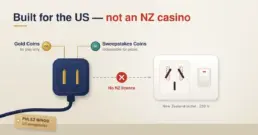

This is a factual profile of Pulsz Bingo, a platform that appears on sweepstakes-casino listings aimed at players around the world. It carries no offer, no score and no link to the operator. The aim is to set out plainly what the product is, how its two-currency model works, what regulators have said about that model, and what the position is for a reader in New Zealand.
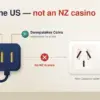
The short version is simple and it comes from the operator’s own pages: Pulsz Bingo is a United States–facing sweepstakes platform, and it is not a real-money casino. You do not deposit New Zealand dollars and bet them on it, and it holds no New Zealand licence — because no online casino operator is licensed in New Zealand yet.
What Pulsz Bingo actually is
Pulsz Bingo is a free-to-play bingo and slots site that runs a sweepstakes structure — a promotional model, common in the United States, in which players receive a redeemable virtual currency as a giveaway rather than buying the right to gamble. It is the bingo-focused sister brand to Pulsz Social Casino, and industry sources name the operator as Yellow Social Interactive Limited, a Gibraltar-registered company whose details appear in the site’s own footer. The brand is generally reported to have launched around 2022.
Two words in that description do the heavy lifting. Sweepstakes means the platform is built around a legal mechanism specific to United States promotions law, not around a gambling licence. Free-to-play means there is a no-cost route to the games — which is accurate, but, as the sections below explain, does not mean no money can leave your account. Registration asks the user to confirm they are located in an eligible United States state, and the site’s geolocation checks are described as enforcing US state regulations. That is the operator’s own account of who the product is for.
It is worth being clear about what Pulsz Bingo is not. It is not a casino in the sense the rest of the regulated market uses the word: there is no cashier where you deposit a balance in dollars and wager it at fixed odds. Treating a sweepstakes platform as if it were an ordinary online casino — scoring it on bonus value or payout speed as though those terms meant the same thing — mixes up two products that sit under different rules.
Key facts
| What it is | A United States–facing, free-to-play sweepstakes bingo and slots platform — not a real-money casino. |
| Operator | Reported as Yellow Social Interactive Limited, a Gibraltar-registered company (details shown in the site’s own footer); also runs Pulsz Social Casino. |
| Launched | Reported around 2022. |
| Currencies | Gold Coins (play only, no cash value) and Sweeps Coins (promotional; redeemable under conditions). |
| Who it is for | Registration requires being located in an eligible United States state; geolocation enforces US state rules. |
| New Zealand status | No New Zealand licence. No online casino operator is licensed in New Zealand yet; the regulated market opens on 1 December 2026. |
| Age and help | 18+. Gambling Helpline: 0800 654 655, or free text 8006. |
How the sweepstakes model works
The two-currency structure is not a design preference; it is a legal mechanism, and understanding what it is built to do explains almost everything else about how these sites behave. Pulsz Bingo, like other sweepstakes platforms, runs on a pair of virtual currencies with very different purposes.
Gold Coins are play-money tokens. They have no monetary value, they can be bought in bundles, and nothing you win with them can be cashed out. Sweeps Coins are the promotional currency: they are handed out free (often alongside a Gold Coin purchase, on daily logins or by a postal request route), and, after identity verification and once a minimum threshold is reached, they may be redeemed for prizes. You cannot buy Sweeps Coins directly — that is the point of the whole arrangement.
Gold Coins vs Sweeps Coins
| Gold Coins | Sweeps Coins | |
|---|---|---|
| What they are | Virtual tokens for entertainment | Promotional sweepstakes entries |
| Monetary value | None | Redeemable, subject to conditions |
| Can you buy them? | Yes, in bundles | No — not directly; they arrive free, often bundled with a Gold Coin purchase |
| Redeemable for prizes? | No | Yes, after identity verification and once a minimum threshold is met |
| Role in the model | The product you may pay for | The free element that keeps the model outside the US gambling definition |
Under United States law, an activity is generally treated as gambling only when three elements are present together: a prize, an element of chance, and consideration — that is, payment to enter. Remove any one of the three and the activity usually falls outside the gambling definition. Sweepstakes platforms remove consideration by making the redeemable currency available for free, which is exactly why the words “no purchase necessary” appear on every one of them.
Why “no purchase necessary” exists
“No purchase necessary” is a legal requirement, not a gesture of generosity. The free-entry route is the load-bearing part of the structure: remove payment and you remove consideration, and removing consideration is what is meant to keep the activity outside the United States gambling definition. If the free route disappeared, the legal basis of the model would disappear with it.
You can still spend a great deal of money. Gold Coin bundles are genuine purchases, and Sweeps Coins commonly arrive attached to those purchases. The distinction the law draws — between buying entertainment tokens that happen to come with free entries, and buying the entries themselves — is clear on paper and very easy to lose from inside a session. There is no deposit-limit framework of the kind licensed operators are required to provide, so the only brake on spending is the player’s own.
That the model was engineered to sit outside one country’s definition of gambling does not mean it sits outside another’s. Other jurisdictions define gambling differently, and some do not recognise the three-element test at all.
What regulators have said
The model is not universally accepted even within the market it was designed for. Through 2025 and 2026 a growing number of United States states moved against it. By 2026 a cluster of states had passed outright bans, others had blocked it under existing law, and more again had seen regulators or attorneys general take enforcement action; counts differ because sources tally bans, enforcement and operator self-exclusions separately. The practical lesson is that the legal footing of the model is contested and shifting, not settled.
The clearest single action came in New York. In 2025 the New York Attorney General, working with the State Gaming Commission, secured the withdrawal of 26 sweepstakes gaming platforms from the state. The reasoning is the part worth sitting with: under New York law, betting cash-redeemable virtual coins on games of chance was treated as gambling regardless of how the operator characterises the way players obtain those coins. That is a regulator declining to accept the “no purchase necessary” mechanism at face value.
The same office also made a consumer-protection point: sweepstakes platforms are not subject to the audits and oversight applied to licensed operators, which leaves players without an independent way to know whether games are fair, whether the operator can cover a large win, or whether standard protections apply. Separately, a New York legislator described these games as a potential on-ramp to problem gambling, particularly for younger players — a concern that rests on how closely the games resemble real-money products rather than on the money changing hands.
Bonuses and redemption: what to check
Because Sweeps Coins are a promotional currency rather than a cash balance, “bonus” terms on a sweepstakes platform do not work the way a real-money casino welcome offer does, and figures quoted on third-party listings should be treated with caution. The terms that actually govern whether you ever see a prize are the redemption conditions, and they are set out in the operator’s own rules rather than on any review page.
The points worth confirming for yourself, directly in the site’s terms, are these:
- Playthrough on Sweeps Coins. Free Sweeps Coins typically have to be played through a set number of times before any balance can be redeemed. For Pulsz brands this is commonly reported as a low multiple (often 1×), but confirm the current figure rather than assuming it.
- Minimum redemption threshold. A minimum Sweeps Coins balance is usually required before you can request a prize or cash redemption at all.
- Identity verification. Redemption is conditional on verifying your identity, usually with government-issued ID and proof of address.
- Expiry and eligibility. Promotional balances can expire, and the whole process is only open to users located in an eligible United States state.
- No guarantee. The platform’s own promotional material concedes there is “no guarantee of receiving rewards.”
If any of this reminds you of a casino bonus, that is deliberate — the mechanics are borrowed from real-money products. If you want a plain-English primer on how playthrough conditions work in the licensed market, our guide to how wagering requirements work on NZ casino bonuses covers the same mechanics in a regulated context.
Where this leaves a New Zealand reader
New Zealand has no licensed category for sweepstakes casinos. Gambling here is governed by the Gambling Act 2003, administered by the Department of Internal Affairs, and — for online casino gambling specifically — by the Online Casino Gambling Act 2026. Neither uses the three-element structure the sweepstakes model is built around, so the reasoning that places these platforms outside United States gambling law does not transfer automatically to New Zealand.
It is also worth being precise about licensing. As at late 2026, no online casino operator is licensed to serve New Zealand. The Online Casino Gambling Act 2026 set up a new regime, licences are being awarded through a staged process during 2026, and the regulated market is due to open on 1 December 2026. An overseas registration — a Gibraltar company number, for instance — is not a New Zealand authorisation. Our New Zealand gambling laws guide sets out how the domestic framework works, and the New Zealand online casino market overview tracks how the new rules are being rolled out.
What can be said without qualification is that Pulsz Bingo’s own registration process asks users to confirm they are located in an eligible United States state. That is the operator telling you, in its own terms, who the product is for.
Free-to-play is not the same as no-risk
This deserves its own section, because “you can’t lose money” is the intuition these platforms trade on, and it is only partly true.
Money does leave your account. Gold Coin bundles are real purchases. The absence of a formal wager does not mean the absence of spending, and — unlike a licensed operator — a sweepstakes site is not required to offer deposit limits, reality checks or self-exclusion tools.
The games are built the same way. The reels, the near-miss patterns, the sound design and the reward schedules are drawn straight from real-money products. The regulatory concern that these games can act as an on-ramp to gambling, especially for younger players, rests on that similarity rather than on the amount of money involved.
Redemption is conditional. As set out above, Sweeps Coins can only be redeemed after verification and a minimum threshold, and even then there is no guarantee. If you or someone close to you is affected by gambling, our responsible gambling in New Zealand page lists the free support services available, including the Gambling Helpline.
What to check for yourself
If you come across Pulsz Bingo — or any platform of this kind — on a listing page, a few checks will tell you far more than a star rating:
- The eligible-territory list in the operator’s own terms, not a third-party summary. If it names United States states, it is a United States product.
- Whether it is a real-money product or a virtual-currency one, because those are different things governed by different rules.
- What a purchase actually buys, and exactly what the redemption conditions are.
- Whether the site recommending it has told you which of the two it is — and has disclosed any commercial relationship.
A listing that scores a free-to-play sweepstakes site above 9 out of 10 and ranks it among real-money casinos has not done that work. For a wider view of the warning signs on untrustworthy sites, see our guide to spotting and avoiding scam casino sites, and our casino reviews hub for how we describe operators that serve New Zealand.
Disclaimer. This page is published for information. It is not financial, legal or gambling advice, and nothing on it is a recommendation to gamble or an endorsement of any operator.
You must be 18 or older to gamble online in New Zealand.
No link on this page goes to an operator’s cashier, and none will.
Licensing, ownership, currency rules, promotional terms, redemption limits and country availability all change, sometimes within weeks, and this page covers a period in which the New Zealand market is being restructured. Confirm the current position in the operator’s own terms and on the regulator’s own register before acting on anything here.
Free, confidential help is available in New Zealand from the Gambling Helpline on 0800 654 655, or by free text to 8006.
Reference sources
- Attorney General James stops illegal online sweepstakes casinos — New York State Office of the Attorney General
- Prohibited gambling and gambling classes under the Gambling Act 2003 — Department of Internal Affairs
- Information for online casino customers — Department of Internal Affairs
- Online Casino Gambling Act 2026 — New Zealand Legislation
- Gambling: rules and regulations — New Zealand Police
- Gambling and young people — Safer Gambling Aotearoa, Health New Zealand | Te Whatu Ora
- Sweeps Coins explained: the dual-currency model and its legal basis — Lines.com
- Gambling Helpline Aotearoa New Zealand — free, confidential support service
Frequently Asked Questions
Is Pulsz Bingo available in New Zealand?
Not as a New Zealand product. Its own registration process asks users to confirm they are located in an eligible United States state, and its geolocation systems are described as enforcing US state regulations. It holds no New Zealand licence, and no online casino operator is licensed to serve New Zealand yet.
Is Pulsz Bingo a real-money casino?
No. It is a free-to-play sweepstakes platform that uses virtual currencies. You do not deposit and bet cash on it. Where it appears on listings alongside real-money casinos with a high score attached, those two things are being treated as the same when they are not.
What is the difference between Gold Coins and Sweeps Coins?
Gold Coins are entertainment tokens with no monetary value and cannot be redeemed. Sweeps Coins are promotional entries that may be redeemed for prizes after identity verification and once a minimum threshold is met. Sweeps Coins cannot be bought directly; they arrive free, often bundled with a Gold Coin purchase.
Why do sweepstakes sites say “no purchase necessary”?
Because it is the mechanism the model depends on. United States gambling law requires prize, chance and consideration together. Providing a free route to the redeemable currency removes consideration, which is meant to place the activity outside the gambling definition in most states. It is a legal requirement, not generosity.
Where can I get help with gambling harm in New Zealand?
Free, confidential support is available from the Gambling Helpline on 0800 654 655, or by free text to 8006. The Problem Gambling Foundation (PGF Services) offers free counselling on 0800 664 262. Support is available to the person gambling and to whanau and friends affected by it.