
Mr Vegas is a large international online casino brand that appears on dozens of English-language review sites, usually with glowing figures attached. For a reader in New Zealand, two plainer questions come first: can you actually use it, and is what has been written about it even describing the version of the site you would see? On both counts the honest answer is “check carefully first” — because most of the material in circulation was written for other countries and then given a New Zealand heading.
Key Points
- No online casino holds a New Zealand licence yet, so Mr Vegas cannot currently be an NZ-licensed option.
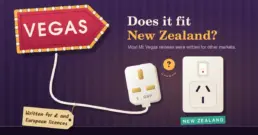
- Most English-language listings quote Mr Vegas in pounds sterling and cite European licences — material written for other markets with a New Zealand heading placed on top.
- Reliable sources disagree on who actually operates the brand (White Hat Gaming, ProgressPlay and Videoslots have all been named), which makes “operated by” claims hard to rely on.
- White Hat Gaming — one company repeatedly tied to the brand — paid a GBP 1.3m UK settlement in 2021 over anti-money-laundering and player-protection failings that covered four other brands.
- Bonus wagering terms and exact game counts are rarely stated consistently; verify both in the operator’s own terms, not in a review.
- Free, confidential help in New Zealand: Gambling Helpline 0800 654 655 or free text 8006. 18+.
Is it even available in New Zealand?
Start with the fact that overrides everything else: no online casino currently holds a New Zealand licence. New Zealand only began licensing online casinos in 2026, and no operator has yet been granted one. So Mr Vegas cannot be an NZ-licensed casino today, whatever a listing implies.
The next clue is the currency. Nearly every set of figures published for Mr Vegas is quoted in pounds sterling — a minimum deposit of GBP 10, a minimum withdrawal of GBP 10, a maximum cash-out in the tens of thousands of pounds, and a welcome offer framed as “100% up to GBP 200”. A handful of pages drop an NZ$10 into an introduction while the table underneath still reads in pounds, which only underlines the point. When the amounts on a page are quoted in a currency you do not use, the page was written for somebody else.
The licences cited point the same way. Mr Vegas listings typically quote United Kingdom, Maltese, Swedish and Danish licences — four European regulated markets. Casinos that genuinely set out to serve New Zealanders from offshore have usually held a Curacao or Kahnawake licence instead. And at least one widely copied payment list includes Interac, which is a Canada-only banking network that requires a Canadian bank account and Canadian dollars; a New Zealander cannot use it at all. Sterling amounts, European licences and a Canadian payment rail in a single “NZ” listing describe a page assembled for other markets.
None of that makes the brand a scam. It means the specific claims in most Mr Vegas reviews — bonus sizes, limits, payment methods — should not be assumed to apply to you. Before treating it as an option, attempt to register and look at the cashier’s currency list. If New Zealand dollars are not offered you convert at both ends, which quietly eats into every deposit and withdrawal; our guide to paying an online casino in New Zealand dollars explains what that actually costs. And if the site declines your registration on location, that is your answer.
Quick Facts
| Brand | Mr Vegas Casino |
|---|---|
| Operator named in listings | White Hat Gaming / ProgressPlay / Videoslots (sources disagree) |
| Licences cited | UK (Gambling Commission), Malta (MGA), Sweden (Spelinspektionen), Denmark (Spillemyndigheden) |
| New Zealand licence | None — no online casino is NZ-licensed as of October 2026 |
| Currency in most listings | Pounds sterling (GBP) |
| Cryptocurrency | Not supported |
| Games cited | Around 3,600 slots plus live-dealer tables (counts vary by source) |
| Verify before use | The cashier’s currency list and the operator’s own terms and conditions |
Who actually runs Mr Vegas?
This is where listings become unreliable, and it matters more than the bonus. Reviews commonly say Mr Vegas is “operated by White Hat Gaming” and leave it there. In reality, reputable trade and industry sources do not agree on who operates the brand: White Hat Gaming, ProgressPlay Limited and an in-house Videoslots platform have all been named at different times, alongside older references to Curacao, Maltese and Swedish licensing. When the published sources cannot settle who runs a casino, that uncertainty is itself a reason for caution — and a reason to verify ownership yourself rather than trust a review’s single-line claim.
It also helps to understand why “operated by” is a slippery phrase. Many casino brands run on a white-label platform — a model in which one licensed technology company supplies the software, the cashier, identity checks and regulatory compliance for dozens of separate-looking brands. In that arrangement:
- The platform company holds the gambling licence, runs the systems and is legally answerable to the regulator for how customers are treated.
- The brand owner owns the name, the design and the marketing, chooses the promotions, and is often a much smaller company that is not named anywhere on the site.
So “operated by” does not mean “owned by”, and the distinction cuts both ways. In your favour, the compliance and payment systems may be those of a substantial licensed company rather than whoever owns the branding. Against you, casinos that look like independent competitors can share one operator, one cashier and one compliance team — so switching to a “rival” after a bad experience may change nothing but the colour scheme, and a self-exclusion or account closure may or may not carry across. That is worth asking about directly.
To check for yourself, read the footer rather than the review. A licensed casino names the company that holds the licence and the licence number in small print at the bottom of the page. Search that company name — not the brand name — and you will learn which other casinos share the platform and whether any regulator has had something to say about it. Our guide to checking a licence properly walks through how to confirm a registration on the regulator’s own register rather than a logo copied onto a web page.
The regulatory record attached to one named operator
Because White Hat Gaming is the company most often linked to Mr Vegas, its regulatory history is worth knowing — with one important caveat stated up front. White Hat Gaming is a Malta-headquartered platform provider, founded in 2012, that supplies white-label and player-account services to a portfolio of brands. In January 2021 it agreed a GBP 1.3 million settlement with the UK Gambling Commission, paid in lieu of a financial penalty, over inadequate anti-money-laundering and social-responsibility procedures.
The findings came from an investigation into seven customer accounts and covered the period October 2016 to March 2019. The Commission identified breaches of two licence conditions and a provision of the social-responsibility code. Among the individual findings reported by the trade press:
- A customer lost around GBP 70,000 over roughly two years without the company establishing where the money came from.
- Another lost GBP 50,000 in six hours, with safer-gambling interaction the regulator described as ineffective.
- A third lost about GBP 85,000 in just over an hour.
The company accepted the failings, said publicising them helps the wider industry, and agreed a remediation programme — more safer-gambling interaction, deeper source-of-funds checks, and backstop limits that halt further spending until checks are complete. A regulator forcing an operator to overhaul its approach is a better outcome than the failures alone suggest.
Now the caveats. First, that settlement covered four other brands — grandivy.com, 21casino.com, hellocasino.com and dreamvegas.com — not Mr Vegas, so it bears on Mr Vegas only if White Hat Gaming is in fact the operator, which (as above) the public sources do not firmly establish. Second, those protections were agreed to satisfy a British regulator. The UK Gambling Commission acts for people gambling in Britain; a New Zealander has no access to its complaints process, and New Zealand’s own regulator for licensed online casinos is only now being stood up.
What the listings tend to get right
Not everything in a typical Mr Vegas write-up is market-mismatched. A few points are consistent and credible:
- The licences cited are demanding ones. The UK Gambling Commission, the Malta Gaming Authority, Sweden’s Spelinspektionen and Denmark’s Spillemyndigheden are among the stricter regulators in the industry, and the 2021 settlement is proof that scrutiny there is real rather than cosmetic.
- The game library is large. Figures around 3,600 slots plus a few hundred live-dealer tables from established studios describe a serious catalogue, even if exact counts vary by source.
- Cryptocurrency is not supported. That is stated plainly and is consistent with a regulated-market operator.
- Identity checks at sign-up are normal. Any licensed casino will verify your identity before paying out; a review that warns you to expect this is being accurate.
Where the published figures don’t add up
Alongside the solid points, Mr Vegas listings routinely contain internal contradictions that are worth spotting in any review, not just this one:
- The game count contradicts itself. One section may say “over 3,000 games” in total while another claims 3,600+ slots alone plus hundreds of live tables. Both cannot be true, so treat lobby counts as marketing rather than measurement.
- No wagering requirement is given. A “100% up to GBP 200” welcome offer appears with no playthrough multiple, no maximum bet and no expiry — the very terms that decide whether an offer is worth taking. Our explainer on how a wagering requirement is calculated shows why a headline figure means little on its own.
- Self-exclusion is described as a “temporary suspension”. That conflates two different tools: a time-out is a short, reversible break, while self-exclusion is a longer commitment that usually cannot be lifted on request. Blurring them on a harm-reduction page is a genuine error — see the difference between a time-out and self-exclusion.
- Headline jackpot games can carry low base returns. A progressive such as Mega Moolah is often listed without noting that its base game pays back about 88.12%, well under the roughly 96% of a typical modern pokie, because a slice of every stake funds the jackpot. Our guide to reading return-to-player percentages covers why that matters.
- There is often no criticism at all. “Exceptional”, “highly commendable”, a rating of 8.8/10 — on a page with no wagering figure, no complaint data and (until now) no regulatory history. A review with no drawbacks section is selling, not assessing.
Where New Zealand’s rules are heading
New Zealand is building its online-casino regime from scratch under the Online Casino Gambling Act 2026 (Public Act 2026 No 14), which received the royal assent on 28 April 2026 and came into force on 1 May 2026. The Act creates a licensing system, bans unlicensed operation and bans advertising of unlicensed online casino gambling — with penalties of up to NZ$5 million for unlawful advertising.
The licensing process has now largely played out:
- Licences are capped at 15, each tied to a single brand, running up to three years with a possible five-year renewal, and no operator may hold more than three.
- An expression-of-interest stage closed on 14 August 2026, and an ascending-clock auction ran from 29 September to 12 October 2026 — 32 bidders over 10 rounds, closing at NZ$15 million per licence.
- On 13 October 2026 the Department of Internal Affairs confirmed that 11 entities had won the right to apply for licences. Winning the auction is not the same as holding a licence; the winners must still apply and be approved.
- From 1 December 2026, any offshore operator that has not applied for a licence must stop offering online casino gambling to New Zealanders. The full licensed regime is expected to be operational in 2027.
The supporting Online Casino Gambling Regulations 2026 also cap promotional inducements: a sign-up offer is limited to NZ$100 where a customer need not spend their own money, and where a deposit or bet is required the cap is the lesser of NZ$100 or 200% of that deposit. In other words, the headline “100% up to GBP 200” welcome deal from Mr Vegas listings could not legally be offered in that form to a New Zealander by a licensed operator. For the current state of the market and the auction outcome, see our overview of where New Zealand’s licensing process now stands. Until a licence actually exists, the cashier — not any review, including this one — is the only reliable test of availability.
A five-point test for any casino listing
The problems on Mr Vegas pages are not unique to this brand; they recur across the genre. Five quick checks will tell you, in a minute or two, whether a review was written for you or recycled from somewhere else:
- Read the currency. If the deposit, withdrawal and bonus figures are in a currency you do not use, the page was written for another market. Conversion costs apply at both ends and the stated limits may not match what your account actually sees.
- Name the licensed company, not the brand. Find the operator and licence number in the site’s footer and look them up on the regulator’s own register. A logo copied onto a review proves nothing; an entry on the register does.
- Look for the terms behind the bonus. A match percentage with no wagering multiple, maximum bet or expiry is a headline, not an offer. If those terms are missing, assume the offer is worth far less than it looks.
- Check the payment list for impossible methods. Rails tied to a single country — such as Interac for Canada — are a sign the list was copied from material aimed elsewhere.
- Distrust a review with no drawbacks. Every real casino has trade-offs. A page that is all praise and a round number out of ten is marketing, and a high score sitting next to missing wagering terms and no complaint data tells you what the score is worth.
Applied to Mr Vegas, that test flags sterling pricing, an unresolved operator name, missing bonus terms and a Canada-only payment method — four reasons to treat the headline claims with care rather than four reasons to sign up.
Getting help in New Zealand
If gambling is causing harm, free and confidential support is available at any hour. The Gambling Helpline is on 0800 654 655, or free text 8006, 24 hours a day. PGF Services (the Problem Gambling Foundation) offers free counselling on 0800 664 262. These services help whether you are worried about your own gambling or someone else’s.
Disclaimer
This page is published for information only. It is not financial, legal or gambling advice, and nothing on it is a recommendation to gamble or an endorsement of any operator. You must be 18 or older to gamble online in New Zealand.
No link on this page goes to an operator’s cashier. Licensing, ownership, bonus terms, withdrawal limits and country availability all change, sometimes within weeks, and this page covers a period in which the New Zealand market is being restructured. Confirm the current position in the operator’s own terms and on the regulator’s own register before acting on anything here. Free, confidential help is available from the Gambling Helpline on 0800 654 655 or by free text to 8006.
Sources
- UKGC sanctions White Hat Gaming over anti-money-laundering and safer-gambling policies — CasinoBeats
- Detail of the individual customer findings in the settlement — iGaming Business
- The brands covered by the investigation — CDC Gaming
- Public register of licensees — UK Gambling Commission
- Online gaming licence verification — Malta Gaming Authority
- Spelinspektionen — Swedish Gambling Authority
- Online Casino Gambling Act 2026 — New Zealand Legislation
- Information for online casino customers — Department of Internal Affairs
- Gambling Helpline Aotearoa New Zealand — free, confidential support, 24 hours a day
Frequently Asked Questions
Is Mr Vegas available to New Zealand players?
Check before assuming so. No online casino holds a New Zealand licence yet, the figures in most listings are quoted in pounds sterling, the licences cited are European, and at least one payment list carries a Canada-only method. Attempt to register and look at the cashier’s currency list; if New Zealand dollars are not offered, the site was not built for you.
Who operates Mr Vegas?
Reliable sources disagree. White Hat Gaming, ProgressPlay Limited and an in-house Videoslots platform have all been named, alongside older Curacao, Maltese and Swedish licensing references. That uncertainty is a reason to verify ownership in the site’s own footer rather than trust a review’s single-line claim.
Has an operator linked to the brand been penalised by a regulator?
Yes. White Hat Gaming, the company most often linked to Mr Vegas, agreed a GBP 1.3 million settlement with the UK Gambling Commission in January 2021 over anti-money-laundering and social-responsibility failings. That case, however, covered four other brands rather than Mr Vegas, and bears on Mr Vegas only if White Hat Gaming is in fact its operator.
Why are the bonus and game figures hard to pin down?
Because most listings reuse marketing copy. Game counts often contradict each other, welcome offers appear without a wagering requirement, maximum bet or expiry, and ratings arrive with no drawbacks. Confirm any bonus terms and limits in the operator’s own terms and conditions before relying on them.
Where can I get help with gambling in New Zealand?
The Gambling Helpline is free and available 24 hours a day on 0800 654 655, or by free text to 8006. PGF Services offers free counselling on 0800 664 262. Both can help whether the concern is your own gambling or someone else’s.