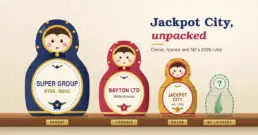

Jackpot City Casino is one of the oldest online casino brands still trading, online since 1998. It sits inside a large, publicly listed gambling group, holds a Malta gaming licence, and runs a shared loyalty and payout structure with several sister brands. This page is a neutral operator profile for New Zealand readers: who actually owns and licenses the brand, how its payout terms are reported to work, what holds up to scrutiny and what does not, and — most importantly in late 2026 — where New Zealand’s new online casino rules now leave the brand.
Operator Snapshot
| Brand launched | 1998 — one of the oldest online casinos still trading |
| Ultimate parent | Super Group (SGHC) Limited, Guernsey, listed on the New York Stock Exchange (SGHC); also owns Betway and Spin |
| Malta licensee | Bayton Ltd, under a Malta Gaming Authority licence shared with sister brands (commonly listed as MGA/B2C/145/2007 — verify on the MGA register) |
| Regional operators | Baytree Interactive Ltd (Kahnawake, most of Canada); Cadtree Ltd (iGaming Ontario) |
| Games | “Over 500” per the parent company; third-party counts vary and rotate |
| New Zealand status (Oct 2026) | Not NZ-licensed yet; Baytree Interactive won three rights to apply in the October 2026 auction |
| Free help in NZ | Gambling Helpline 0800 654 655, or free text 8006, any time |
Who owns Jackpot City Casino
The ownership of this brand is described in several different ways across casino listings, and not all of them are current. The clearest way to read it is as a chain, from the ultimate parent down to the company you actually contract with.
Ultimate parent: Jackpot City is a brand of Super Group (SGHC) Limited, a company headquartered in Guernsey and listed on the New York Stock Exchange under the ticker SGHC. Super Group also owns Betway and the Spin casino portfolio, among other brands. The brand appears on Super Group’s own corporate site, which lists it as established in 1998 with “over 500” casino games.
Malta licensing entity: for most players outside Canada, the operating company is Bayton Ltd, which holds a licence from the Malta Gaming Authority (MGA). Listings commonly cite licence number MGA/B2C/145/2007, shared with the group’s sister brands, though you should confirm the current holder and number on the MGA’s own public register rather than trusting a third-party page.
Regional operating entities: which company you contract with depends on where you are. Independent reporting identifies Baytree Interactive Ltd, a Guernsey-registered Super Group company, as the operator for much of Canada under a Kahnawake permit, while Ontario players contract with Cadtree Ltd, a Super Group subsidiary registered with iGaming Ontario that also covers Spin, Royal Vegas and Ruby Fortune. The practical lesson: the footer of whichever version of the site you reach tells you the operating entity and the regulator, and for a multi-market brand that is the only reliable way to know which company holds your account.
Older listings still name “Digimedia” or the “Palace Group” as the owner. Those references are out of date. The entity that genuinely owns the brand today — a stock-exchange-listed parent — is the point most often left out, which is odd, because a public listing is a genuine mark in the operator’s favour. Public companies file audited accounts, disclose material events and answer to shareholders, obligations that most offshore casinos do not carry. If you want to see how the wider family is structured, our guide to casino sister-site networks explains how shared licences and loyalty systems work across brands like Spin Casino and Betway.
Can New Zealanders play at Jackpot City in 2026?
This is the question that comes before all the others, and the answer changed significantly during 2026. New Zealand passed the Online Casino Gambling Act 2026, which is now in force and creates the country’s first licensing regime for online casinos. Under it, the Department of Internal Affairs (DIA) is issuing up to 15 licences, each covering a single brand, each running up to three years with a renewal option, and no operator permitted to hold more than three.
The timeline matters:
- Expressions of interest ran from 17 July to 14 August 2026.
- An ascending clock auction ran from late September to mid-October 2026. It drew 32 bidders over 10 rounds and closed at NZ$15 million per licence.
- On 13 October 2026 the DIA named 11 entities that won the right to apply for the available licences.
- From 1 December 2026, any provider that served New Zealanders before 1 May 2026 but has not applied for a licence must stop offering online casino gambling here. Operators with an application still under assessment may keep running under an exemption, but may not advertise, until a decision is made.
- The first licences are expected from early 2027, after which the DIA will publish a public register of licensed operators and licensed sites must display a unique registration icon.
Here is the part specific to this brand. Among the 11 entities that won the right to apply is Baytree Interactive Limited — the Super Group company identified above as the operator behind Jackpot City and its siblings outside Ontario — and it secured three rights to apply, the maximum any group can hold. In other words, the parent group is actively inside the New Zealand process rather than leaving it. Because each licence covers a single brand, winning three rights to apply does not tell us which three brands the group will ultimately put forward, so whether Jackpot City specifically ends up licensed in New Zealand is not yet confirmed.
What this means in practice: as of October 2026, Jackpot City is not a New Zealand-licensed casino, and the protections of the new regime do not yet apply to a New Zealand account here. That position could change in 2027 if the group is granted a licence for this brand. Until the DIA register goes live, the only sure test is to check the operator’s own cashier and terms, and to watch the register once it is published. Our explainer on New Zealand’s 2026 gambling rules tracks the timeline as it develops.
The withdrawal cap and payout terms
The single most important term to understand before depositing is how withdrawals are limited, because independent casino databases report a structure that is easy to miss on the casino’s own pages.
Those listings describe a weekly withdrawal limit of around €4,000 that applies where a withdrawal is five times or more your total deposits, and — this is the detail that catches people out — the cap is reported to be counted across every casino in the group, not just this one. Points and loyalty status are shared across the family too, so holding accounts at three sibling brands does not give you three separate caps; it gives you one. Progressive jackpot wins are reported to be exempt from the limit.
Two caveats are important. First, listings disagree: some quote €4,000 per week, others cite figures as high as $10,000 per week or method-specific limits, and the minimum withdrawal is variously given as around $20 rising to roughly $50 for bank transfer. Second, several reviewers report that withdrawals are not processed at weekends, so a request made on a Friday afternoon realistically starts moving on Monday — which sits awkwardly against any “24-hour internal review” promise. None of these figures comes from an official terms page in our checks, so treat them as a prompt to read your own cashier rather than as settled fact.
The real-world effect is worth spelling out. A large win is not paid in one lump: it is released in weekly instalments, so a five-figure balance can take roughly a month to reach your bank, sitting in your account as playable funds the whole time unless it came from an exempt jackpot. If payout speed is your priority, our guide to casino withdrawal times in New Zealand explains how different methods and limits actually behave.
Withdrawal Terms
- Weekly cap (reported): around €4,000 where a withdrawal is 5x or more your total deposits; some listings instead quote figures up to $10,000 per week.
- Shared across the group: the cap is reported to be counted across every brand in the family, not per casino — three sibling accounts give you one cap, not three.
- Minimum withdrawal: commonly cited at around $20, rising to roughly $50 for bank transfer.
- Weekends: several reviewers report withdrawals are not processed at weekends, so a Friday request realistically moves on Monday.
- Jackpots: progressive jackpot wins are reported to be exempt from the cap.
- Large wins: paid in weekly instalments, not all at once — a five-figure balance can take about a month to clear.
- Caveat: these figures come from third-party listings and disagree with one another; the operator’s own cashier and terms are authoritative.
Verification and account checks
One area where this operator is genuinely clearer than the market average is identity verification, usually called KYC (Know Your Customer): the standard checks a licensed casino runs to confirm who you are, your age and your payment details. The brand names the documents it wants, explains why each is needed, and advises that a photo of a bank card should show only the first and last four digits with the rest covered.
It also encourages you to complete verification during signup rather than waiting until you request a payout. That is sound: leaving KYC until withdrawal is the single most common cause of payout delays at any casino, so clearing it early removes the usual bottleneck. It is not a favour the casino is doing you; it is simply the moment at which the paperwork is least frustrating.
Games and software
Super Group’s own corporate page lists Jackpot City as offering “over 500” casino games, spanning slots, table games and live-dealer tables, with progressive jackpots promoted heavily. Third-party listings quote higher and inconsistent counts — 600+, 500+, even 600–800+ — so take any single lobby figure with caution. Lobby counts usually include game variants and rotate as titles are added and retired, which is why the operator’s own “over 500” is the more conservative and more trustworthy number.
The important point for a new player is not the headline count but the mix: a brand of this age typically carries a broad slots catalogue plus a live-dealer studio, and the specific titles matter far more than the total. If you are comparing game ranges across the group, remember that sister brands on the same platform often share much of the same library.
Bonuses and wagering
Bonus terms are rarely published alongside the headline offer here, and the usual justification is that amounts change, so the page keeps only an “evergreen” description. That reasoning is half right. Amounts do change, but the figures that actually decide whether a bonus is worth taking — the wagering multiple, the maximum bet while a bonus is active, and any cap on what you can cash out — change far less, and those are exactly the things an evergreen page could and should state.
Reporting for other markets puts this operator’s welcome package at around 35x wagering on a non-sticky basis (meaning your own deposited funds are kept separate from the bonus). That is a reasonable figure by industry standards, but because it is not published on the offer itself, you must confirm the current terms in your own account before opting in. If the mechanics are unfamiliar, our explainer on wagering requirements walks through how playthrough is calculated and what to watch for.
One claim that appears in some write-ups deserves a flag: that support staff are trained on New Zealand payment methods “including POLi”. POLi does not appear in this casino’s own list of deposit methods, so that is invented specificity rather than a verified feature. Trust the cashier screen, not the marketing copy.
The mobile app and browser play
The brand promotes a dedicated Android app via a direct APK download “for devices where Google Play access is limited”. It is worth understanding why that framing exists. Google restricts real-money gambling apps in its Play Store to countries whose licensing regimes it recognises; New Zealand has not had one, so the absence has been regulatory rather than technical. That may shift once the new licensing regime is fully operational, but it has not yet.
Installing an APK means switching on Android’s “install unknown apps” permission on a device you probably also bank with, and that permission stays enabled afterwards unless you turn it off. The simpler and safer route is the mobile browser: the operator’s own pages confirm the full lobby, banking and account management all work there, with nothing to install. Our guide to Android casinos in New Zealand covers the security trade-offs in detail.
Responsible gambling tools and your own controls
The account settings include the standard set of harm-reduction tools: deposit limits, session reminders (reality checks), a short “take a break” option and self-exclusion. A useful detail is that a request to increase a limit is subject to a cooling-off delay, while a request to decrease one takes effect immediately — the right way round. These tools are real and worth using.
The controls that matter most, though, are the ones the casino cannot switch off because it does not run them. Blocking software such as BetBlocker and Gamban works against this operator and is installed on your own device, and many New Zealand banks let you set a gambling block on your card. Because these sit outside any operator’s control, they keep working no matter which brand or sister site you encounter. Our practical guide to self-exclusion and gambling blocks explains how to set each one up, and it is a fairer question to settle before opening an account than after.
Getting help in New Zealand
Free, confidential help is available in New Zealand at any time. The Gambling Helpline, the phone line for the government’s Safer Gambling Aotearoa service, can be reached on 0800 654 655 or by free text to 8006, with specialist Māori, Pasifika and youth lines also available. Support is free and does not depend on which operator, if any, you have used.
What to check before you sign up
Because the New Zealand picture is mid-transition and several key terms are not published on the casino’s own pages, a short pre-signup checklist is worth more here than a star rating:
- Licensing status: look for the operating entity and regulator in the site footer, and once the Department of Internal Affairs register goes live in 2027, check whether this brand is on it and whether it displays the required registration icon.
- Withdrawal limits: open the cashier before depositing and read the weekly and monthly caps and the minimum withdrawal for your chosen method, rather than relying on the figures in any review.
- Bonus terms: confirm the wagering multiple, maximum bet while a bonus is active and any cashout cap in writing before opting in.
- Sister accounts: if you already hold an account at a group brand, remember the loyalty balance and the withdrawal cap are reported to be shared, so a second account does not double your limits.
- Your own safeguards: set a deposit limit at the start, and if there is any doubt, install device-level blocking or a bank gambling block, which no operator can override.
Treated this way, Jackpot City reads as a long-established, publicly owned brand with clear verification and genuine responsible-gambling tools, set against payout terms that are less generous than the marketing implies and a New Zealand status that is still being decided. Neither the praise nor the caution should be taken on trust — both are things you can check for yourself in a few minutes.
Disclaimer
This page is published for information only. It is not financial, legal or gambling advice, and nothing on it is a recommendation to gamble or an endorsement of any operator. You must be 18 or older to gamble online in New Zealand.
No link on this page goes to an operator’s cashier. Licensing, ownership, bonus terms, withdrawal limits and country availability all change, sometimes within weeks, and this page covers a period in which the New Zealand market is being restructured. Confirm the current position in the operator’s own terms and on the regulator’s own register before acting on anything here. If gambling is causing harm, free and confidential help is available from the Gambling Helpline on 0800 654 655, or by free text to 8006, at any time.
Reference sources
- Jackpot City brand page — Super Group (SGHC), the listed parent company
- Online gaming licence verification — Malta Gaming Authority register
- Online Casino Gambling Act 2026 — New Zealand Legislation
- Information for online casino customers — Department of Internal Affairs
- Jackpot City: withdrawal limits and group aggregation — Casino Listings
- Jackpot City: shared loyalty network, minimum withdrawal and weekend processing — YummySpins
- Jackpot City: operating subsidiaries by region and payment availability — Gamesville
- eCOGRA — independent testing and dispute-resolution body
- BetBlocker — free device-blocking software run by a registered charity
- Gambling Helpline Aotearoa New Zealand — free, confidential support, any time
Frequently Asked Questions
Can New Zealanders still play at Jackpot City Casino?
As of October 2026 the brand is not licensed in New Zealand, so the new regime’s protections do not apply to an account here yet. However, Baytree Interactive — the Super Group company behind the brand — won three rights to apply in New Zealand’s October 2026 licence auction, so it is pursuing a licence rather than leaving. From 1 December 2026 any provider without a pending application must stop serving New Zealanders. Check the operator’s cashier and the Department of Internal Affairs register before assuming you can play.
Who owns Jackpot City Casino?
The ultimate parent is Super Group (SGHC) Limited, which is listed on the New York Stock Exchange and also owns Betway and Spin. The Malta licensing company is Bayton Ltd, with Baytree Interactive Ltd and Cadtree Ltd operating in different regions. References to Digimedia or the Palace Group are out of date.
Is there a withdrawal limit, and is it shared with sister brands?
Independent listings report a weekly cap of around €4,000 where a withdrawal is five times or more your total deposits, counted across every casino in the group rather than per brand, with progressive jackpot wins exempt. Figures vary between sources, so confirm the exact limits in your own cashier before depositing.
What is the wagering requirement on the welcome bonus?
It is not published alongside the offer. Reporting for other markets puts the welcome package at around 35x on a non-sticky basis, which is reasonable by industry standards, but you should confirm the current terms in your account before opting in.
Is the Android app safe to install?
The dedicated app is offered as a direct APK download, which requires enabling Android’s “install unknown apps” permission on your device. The safer option is the mobile browser, where the full lobby, banking and account tools work with nothing to install. The app’s absence from the Play Store has been down to licensing, not a technical fault.