
This is a factual profile of SkyCity Casino, an operator that currently accepts New Zealand players. It carries no rating, no offer and no link to any casino cashier. Its purpose is narrow: to set out who runs the brand, under which licence, what its public record shows, and what has changed as New Zealand builds a regulated online-casino market across 2026 and 2027.
SkyCity is the one brand on this site where a New Zealand reader might reasonably assume that domestic regulatory protection covers the online casino. It does not — at least not yet — and understanding why is the substance of this page.
Key points
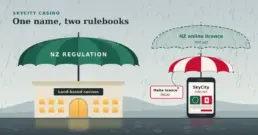
- SkyCity is two businesses under one name: New Zealand land-based casinos, and a separate online casino operated from Malta.
- The online casino launched in August 2019 and runs under a Malta Gaming Authority licence held by Silvereye Entertainment (Gaming Innovation Group), not a New Zealand licence.
- On 13 October 2026 SkyCity won the right to apply for two New Zealand online casino licences (NZ$15 million each, excluding GST) — but that is a right to apply, not a licence.
- Disputes about the online casino currently go to a Maltese regulator; the New Zealand regulator oversees the land-based venues.
- Minimum age is 18 online but 20 at a land-based casino.
- A funded class action is testing the lawfulness of the offshore online offering; SkyCity denies liability and is defending it.
Two businesses, one name
The licensing position is often summarised as “licensed in NZ, Malta remote operations”. That shorthand is wrong in the way that matters most, because it blurs two separate businesses that happen to share a name.
SkyCity Entertainment Group does hold New Zealand casino licences — for its physical venues in Auckland, Hamilton and Queenstown, regulated by the Department of Internal Affairs under the Gambling Act 2003. Those licences are real and they carry real obligations, from host-responsibility duties to anti-money-laundering controls.
They do not extend to the online casino. SkyCity Online Casino launched in August 2019 and has been run from Malta, under a Malta Gaming Authority licence, not a New Zealand one. The practical consequence is concrete: a complaint about the Auckland gaming floor goes to a New Zealand regulator, while a complaint about the online casino is a dispute with a Malta-licensed entity under Maltese rules. The familiar name and the local branding do not change that.
Comparison
| Feature | Land-based casinos | Online casino |
|---|---|---|
| Where | Auckland, Hamilton and Queenstown | Operated from Malta |
| Operating entity | New Zealand group (SkyCity Casino Management Limited) | Silvereye Entertainment (Gaming Innovation Group) |
| Licence | New Zealand venue licences under the Gambling Act 2003 | Malta Gaming Authority licence |
| Regulator | Department of Internal Affairs / Gambling Commission | Malta Gaming Authority |
| Complaints go to | A New Zealand regulator | A Maltese regulator |
| Minimum age | 20 | 18 |
| NZ online licence | Not applicable | None yet; holds the right to apply for two (October 2026) |
The reason the online arm sits in Malta is not preference. Under the Gambling Act 2003 it has been unlawful for a company based in New Zealand to offer online casino gambling to New Zealanders, with narrow exceptions for TAB NZ and Lotto NZ. Operating the online brand through an offshore structure was, until the 2026 reforms, how a New Zealand company could lawfully run a New Zealand-facing online casino at all.
The Malta-based online casino, explained
The online platform is operated from Malta by Silvereye Entertainment, a subsidiary of Gaming Innovation Group (GiG), the technology company that supplies and runs the site on SkyCity’s behalf. Silvereye holds the Malta Gaming Authority licence, and the casino operates for SkyCity’s overseas subsidiary rather than for the New Zealand group that owns the land-based venues. SkyCity describes this turnkey, outsourced model as standard industry practice.
For a player, the key point is where accountability sits. If you open an account, the operating entity named in the site footer will be the Malta-based company, the licence number you can check belongs to a Maltese regulator, and the terms you agree to are governed accordingly. Our guide to how the offshore SkyCity site works for New Zealand players walks through the structure in more detail, and the SkyCity Online Casino review covers the platform itself.
Where SkyCity sits in the new licensing process
New Zealand is replacing the old prohibition with a licensed market. The Online Casino Gambling Act 2026 and the Online Casino Gambling Regulations 2026 create a capped set of licences, allocated first through a competitive auction and then through a detailed application and assessment stage. A clear timeline matters here, because “taking part” and “holding a licence” are very different things.
- Expression of interest (closed 14 August 2026) — operators registered their interest in the limited pool of licences. SkyCity was among the parties involved, alongside international operators such as Entain.
- Auction (from 29 September 2026) — an ascending-clock auction decided which operators could proceed to apply. Reporting put the process at around ten rounds with a final price of about NZ$15 million per licence right. Up to 15 licences are available, no party may control more than three, and each licence covers a single brand.
- Auction result (announced 13 October 2026) — the DIA confirmed 11 successful companies. SkyCity announced that it had secured the right to apply for two licences, at a fee of NZ$15 million (excluding GST) per licence, held through subsidiaries named SkyCity NZ Online NO1 Limited and NO2 Limited. Chief Executive Jason Walbridge said the company intends to pair the trust New Zealanders place in the SkyCity brand with its local-market knowledge to build an online business.
- Application and assessment (from October 2026) — winning the right to apply does not grant a licence. Each applicant must still submit a business plan covering harm minimisation, advertising and consumer protection, and pass assessment.
- From 1 December 2026 — online casino operators, including offshore ones, may not serve or advertise to New Zealand unless they hold or have applied for one of the licences. A problem-gambling levy of 1.24% of gross gaming revenue applies to the regulated market.
- From early 2027 — the first licences are expected to be issued and the DIA publishes a public register. For licensed operators, the online casino duty is set at 16% of gross gaming revenue (up from an earlier proposed 12%), with four percentage points ring-fenced for community causes, alongside GST at the standard 15% rate.
So the picture has moved on from “stated an intention to bid”. SkyCity has now won the right to apply for two licences. What it does not yet have is a licence: applications must still be assessed, and the market is not expected to open until 2027. Until the DIA publishes its register, no operator — this one included — can accurately be described as a licensed New Zealand online casino. Our guide to New Zealand’s 2026 gambling laws sets out the full framework, and the New Zealand online casino market page tracks how the licensed sector is taking shape.
Class-action proceedings over the online casino
Unlike the regulatory matters further down this page, this one concerns the online casino directly, so it belongs in any honest profile of the brand.
In a disclosure to the NZX on 6 March 2026, SkyCity confirmed it had received notice of proceedings naming SkyCity, SkyCity Auckland Holdings and the Malta-licensed Silvereye Entertainment. The claim, before the High Court at Auckland, seeks leave to proceed as a funded class action on behalf of New Zealanders who lost money to SkyCity Online between February 2020 and February 2026, and it tests whether offering that online gambling to New Zealanders was lawful. SkyCity has stated that it denies liability and will actively defend the proceedings, noting that Silvereye holds the Malta licence and that the platform is supplied and operated by Gaming Innovation Group.
Nothing here is a finding. A claim that is yet to be decided proves nothing on its own. It is reported because the lawfulness of the offshore model is the live question at the centre of the brand, and a profile that left it out would not be complete.
Regulatory record of the land-based business
SkyCity is a publicly listed company, so its regulatory dealings are a matter of public record. The following concerns the New Zealand land-based business rather than the Malta-based online casino, and it is included because compliance history is relevant context for any operator now seeking an online licence.
- Anti-money-laundering proceedings. In February 2024 the Department of Internal Affairs announced it would file civil penalty proceedings in the High Court against SkyCity Casino Management Limited, the group subsidiary that holds the venue licences, over alleged breaches of the Anti-Money Laundering and Countering Financing of Terrorism Act 2009. SkyCity described the matters as largely historical and some as self-reported. The company and the Department put the maximum potential liability at around NZ$8 million in aggregate — a ceiling for the claims, not a penalty already imposed; any figure would be set by the court.
- Licence suspension application. In September 2023 the DIA applied to the Gambling Commission to temporarily suspend the licence of SkyCity Casino Management Limited over host-responsibility failures at the Auckland casino.
Why this is here: the operator is routinely described elsewhere as having strong, locally compliant responsible-gambling tools, often with a high score attached and no mention of its regulatory history. A profile that describes an operator’s compliance posture while omitting the regulator’s own enforcement action against it is not a neutral profile. Equally, these matters concern the land-based subsidiary and do not by themselves establish how the online platform treats its customers. They are reported as public record, not as a conclusion about either business, and a reader can weigh them for themselves.
Games and software
The online platform draws on content from a broad set of established suppliers, with a live-dealer lobby streamed from third-party studios. Alongside pokies (slot machines) there are software-based table games, video poker and speciality formats. Three points apply generally rather than to this operator specifically, and they matter more than any headline game count.
- Game count says nothing about return. Whether a lobby holds 600 or 2,000 titles tells you about breadth, not value. The return-to-player (RTP) rate — the share of stakes a game pays back over time — is set per game and shown in each game’s own information panel.
- The same title can return very different amounts. One game name can vary widely depending on its paytable; a poorly configured version can pay back several percentage points less than a generous one.
- Live and table games count differently toward bonuses. Wagering contributions on those games are commonly cut to 10–20%, which multiplies the effective playthrough requirement several times over. Our live casino guide works through that arithmetic.
Bonuses and loyalty
Welcome offers at the offshore site have historically been structured as tiered deposit matches across the first several deposits, bundled with the operator’s own loyalty currency and carrying a wagering requirement in the region of 35x. Two observations, rather than a description of any current offer:
- Tiered welcome packages have no lawful equivalent in the licensed New Zealand market. Under the Online Casino Gambling Regulations 2026, an inducement from a licensed operator is tightly capped — broadly, no more than NZ$100, or the lesser of NZ$100 and 200% of the deposit or bet, depending on the circumstances. An operator that obtains a New Zealand licence will have to restructure its offers accordingly.
- Loyalty currency is not cash. Points earned through play and redeemable for spins or bonus credit are a retention mechanism, and redeemed credit typically carries its own wagering terms. Our page on how casino bonus terms work explains what to read before opting in.
Verification and withdrawals
Identity verification is required before a first withdrawal, to meet anti-money-laundering obligations. Expect to supply a government-issued identity document and proof of address, and expect a few business days for the check to clear.
The practical advice is the same for every operator: complete verification at registration rather than at payout. Documents requested during a withdrawal add days; the same documents supplied at sign-up add nothing. Watch too for any weekly or monthly withdrawal cap, which can stretch a large cash-out over weeks regardless of how quickly each payment clears. Our guide to casino withdrawal times in New Zealand explains the stages of a withdrawal and where the delays actually come from.
Age limits differ between the two businesses
This catches people out, and it follows directly from the two-entity structure. Entry to a licensed land-based casino in New Zealand requires a minimum age of 20. The minimum age for online casino gambling under the new regime is 18, with mandatory age verification.
In other words, someone who can lawfully open an online account may still not be able to walk onto the Auckland gaming floor.
What to check for yourself
If you are weighing up the brand, a few checks cut through the marketing:
- The operating entity named in the site footer — which will be the Malta-based company, not the New Zealand group.
- The licence number, verified on the Malta Gaming Authority’s own register rather than taken on trust from the footer. In time, also check the DIA register for any New Zealand online licence.
- The withdrawal terms, including any weekly or monthly cap and the verification requirements.
- The harm-minimisation tools, including deposit limits and whether self-exclusion offers an indefinite option. Our guides to responsible gambling in New Zealand and self-exclusion explain what good tools look like.
Disclaimer
This page is published for information. It is not financial, legal or gambling advice, and nothing on it is a recommendation to gamble or an endorsement of any operator. You must be 18 or older to gamble online in New Zealand, and 20 or older to enter a land-based casino.
No link on this page goes to an operator’s cashier, and none will. Licensing, ownership, bonus terms, withdrawal limits and country availability all change, sometimes within weeks, and this page covers a period in which the New Zealand market is being restructured. Confirm the current position in the operator’s own terms and on the regulator’s own register before acting on anything here.
Free, confidential help is available in New Zealand from the Gambling Helpline on 0800 654 655, or by free text to 8006, 24 hours a day. PGF Services offers free counselling on 0800 664 262, and support is also available to whānau and friends.
Sources
- Online gambling: information for customers — Department of Internal Affairs
- Online gambling: licensing and compliance for providers — Department of Internal Affairs
- Online Casino Gambling Act 2026 — New Zealand Legislation
- Online Casino Gambling Regulations 2026 — New Zealand Legislation
- SkyCity: successful participant in online casino licence auction (13 October 2026) — NZX market announcement
- SkyCity: notice of proceedings — SkyCity Online — NZX market announcement
- SkyCity faces class action over Malta-based online casino brand — iGaming Business
- A new frontier: New Zealand’s online casino market — Asia Gaming Brief
- SkyCity eyes trusted local leader status for NZ igaming — InterGame
- Specialist services — Gambling Helpline Aotearoa New Zealand
- Safer Gambling Aotearoa — Health New Zealand | Te Whatu Ora
Frequently asked questions
Is SkyCity Online Casino licensed in New Zealand?
Not yet. The online casino operates from Malta under a Malta Gaming Authority licence held by Silvereye Entertainment. SkyCity Entertainment Group holds New Zealand licences for its physical casinos in Auckland, Hamilton and Queenstown, but those do not extend to the online business. In October 2026 SkyCity secured the right to apply for two New Zealand online casino licences, though a licence has not yet been granted.
Why is a New Zealand company’s online casino based in Malta?
Because under the Gambling Act 2003 it has been unlawful for a company based in New Zealand to offer online casino gambling to New Zealanders, with narrow exceptions for TAB NZ and Lotto NZ. Running the brand through a Malta-based operator was how a New Zealand company could lawfully offer a New Zealand-facing online casino before the 2026 reforms created a domestic licensing route.
Has SkyCity won a New Zealand online casino licence?
It has won the right to apply for two licences. On 13 October 2026 SkyCity confirmed it was a successful participant in the licence-rights auction, at a fee of NZ$15 million (excluding GST) per licence. Winning that right is not the same as holding a licence: applications must still be assessed, and licences are expected to be issued from early 2027 when the DIA publishes its register.
Has SkyCity faced legal or regulatory action?
Yes, on two fronts. A funded class action filed in 2026 names SkyCity and the Malta-licensed Silvereye Entertainment over losses to SkyCity Online between February 2020 and February 2026; SkyCity denies liability and will defend it. Separately, on the land-based business, the Department of Internal Affairs announced AML/CFT civil penalty proceedings against SkyCity Casino Management Limited in 2024 (maximum liability estimated at around NZ$8 million) and in September 2023 applied to suspend that subsidiary’s licence over host-responsibility failures.
Is the minimum age the same online as at the Auckland casino?
No. Entry to a licensed land-based casino in New Zealand requires a minimum age of 20. The minimum age for online casino gambling under the new regime is 18, with mandatory age verification. Someone who can lawfully open an online account may not be old enough to enter the physical casino.