Read our expert Kiwi Casino review. Discover top NZD pokies, exclusive welcome bonuses, and fast Poli payments. Is this the best kiwi casino for New Zealanders?

Kiwi Casino Review: What NZ Players Need to Know Under the 2026 Rules

“Kiwi Casino” is one of those names that sounds purpose-built for New Zealand. It has been used both as the brand of an offshore gambling website aimed at New Zealanders and, more loosely, as shorthand for any online casino that leans on Kiwi imagery, the silver fern and New Zealand dollars. If you searched the term expecting a simple thumbs-up or a star rating, the honest answer in late 2026 is more useful than that: New Zealand has just introduced its first-ever system of licensed online casinos, and that completely changes what “a casino for Kiwis” legally means. This guide explains what the name refers to, where any site called Kiwi Casino sits under the new rules, and how to check whether an online casino is actually allowed to serve you.
Key Points
- “Kiwi Casino” is a marketing name, used both for offshore gambling sites aimed at New Zealanders and as generic shorthand for any NZ-targeted casino — it is not an official New Zealand operator.
- New Zealand had no licensed online casinos until the Online Casino Gambling Act 2026 came into force on 1 May 2026.
- From 1 December 2026, only operators approved through the Department of Internal Affairs auction and application process may legally serve New Zealand players.
- As of 13 October 2026 the 15 application rights are held by 11 entities (including SkyCity, Stake NZ, TAB NZ and Super Group/Baytree); a brand simply called “Kiwi Casino” is not among them.
- Full licences are expected from early 2027, with a public DIA register and a registration icon to identify legal sites.
- Always verify licensing on the DIA register rather than trusting an on-site badge, and read the withdrawal and bonus terms before depositing.
What “Kiwi Casino” actually refers to
There is no single, official business called “The Kiwi Casino”. The phrase is used in two overlapping ways, and it helps to separate them before deciding whether a site is worth your time.
- As a specific brand: Over the years one or more offshore websites have traded under the name “Kiwi Casino”, marketing themselves to New Zealand players with NZD balances and local payment options. These sites are operated from overseas, not from New Zealand.
- As a generic description: “Kiwi casino” is also everyday shorthand for any online casino that targets New Zealanders — regardless of its real brand name — by advertising NZD support, pokies and Kiwi-themed promotions.
The distinction matters because New Zealand historically did not license any locally based online casino. For most of the past two decades, the only lawful online gambling run from within the country was the state-sanctioned Lotto, Keno and TAB racing and sports betting; everything else sat offshore. That is the backdrop against which “Kiwi Casino” and dozens of similar brands have operated — and it is precisely the backdrop that changed in 2026. For a fuller picture of how the market developed, see our overview of the New Zealand online casino market.
The big change: New Zealand’s Online Casino Gambling Act 2026
The single most important fact for anyone evaluating a Kiwi casino today is that New Zealand now regulates online casino gambling directly. The Online Casino Gambling Act 2026 came into force on 1 May 2026, and the supporting Online Casino Gambling Regulations 2026 took effect on 3 July 2026. Together they create a licensing system run by the Department of Internal Affairs (DIA), replacing the old position in which no online casino could be licensed to operate for New Zealanders at all.
Under the new system the number of licences is deliberately limited. Up to 15 licences were offered, each covering a single brand, each running for up to three years with the possibility of renewal, and no single operator allowed to hold more than three. Licences were allocated through a competitive auction rather than handed out on application alone. You can read a plain-English breakdown of the framework in our guide to New Zealand’s casino licence for online pokies, and the wider legal context in our New Zealand gambling laws guide.
What changes on 1 December 2026
The timetable has a hard edge that every player should know. Overseas casinos that were already serving New Zealanders before 1 May 2026 were allowed to keep operating through a transition window — but they were not permitted to advertise to New Zealanders during it. From 1 December 2026, that window closes: only operators that won the right to apply at the DIA auction, and have lodged a licence application, may continue to offer online casino gambling to customers in New Zealand. Every other online casino is required to stop serving the New Zealand market.
Full licences are expected to be issued from early 2027 onwards, with the regulated market operating during 2027. The DIA has said it will publish a public register of licensed casinos and introduce a registration icon so players can recognise a legal site at a glance. Until that register is live, caution is warranted — the absence of a New Zealand licence is the norm, not the exception, for offshore brands. The official position for players is set out on the Department of Internal Affairs online gambling page.
Who won the right to apply
The auction ran from 29 September to 12 October 2026, and the DIA published the results on 13 October 2026. The final price was NZ$15 million per licence (excluding GST). The 15 application rights are held by 11 entities:
- Baytree Interactive Limited (part of Super Group, which owns Betway) — three rights, the maximum any group may hold
- Playvia Gaming (NZ) Limited — two rights
- Rock Swift Group Limited — two rights
- SkyCity NZ Online NO1 Limited and SkyCity NZ Online NO2 Limited — one right each
- Stake New Zealand Limited, TAB New Zealand, One Casino Limited, Rush Entertainment Limited, Skill On Net Limited and Christchurch Online NZ Limited — one right each
Winning the auction is not the same as holding a licence. Each of these entities must now pay the auction price and submit a full application covering its advertising strategy, consumer-protection measures and harm-minimisation plans, which the DIA will assess before deciding whether to grant a licence. SkyCity — the company behind New Zealand’s land-based casinos — is a familiar name on that list; you can read more in our review of SkyCity’s online casino.
Key Dates
| Date | What happens |
|---|---|
| 1 May 2026 | Online Casino Gambling Act 2026 comes into force; the new licensing regime begins |
| 3 July 2026 | Online Casino Gambling Regulations 2026 take effect |
| 17 Jul – 14 Aug 2026 | Expressions of interest open for operators (via the GETS portal) |
| 29 Sep – 12 Oct 2026 | Licence auction held (ascending-clock format), NZ$15m per licence |
| 13 October 2026 | Results published: 11 entities confirmed holding the 15 application rights |
| 1 December 2026 | Only approved operators that have applied may serve NZ players; all other online casinos must stop and may not advertise to New Zealanders |
| Early 2027 | DIA expected to begin issuing full licences; public register and registration icon introduced |
Is Kiwi Casino licensed in New Zealand?
Based on the published auction results, no operator trading simply as “Kiwi Casino” is among the 11 entities that secured the right to apply for a New Zealand licence. That has a direct, practical consequence: unless a site is operated by one of the approved entities (or later appears on the DIA’s register of licensed casinos), it will not be permitted to serve New Zealand players from 1 December 2026.
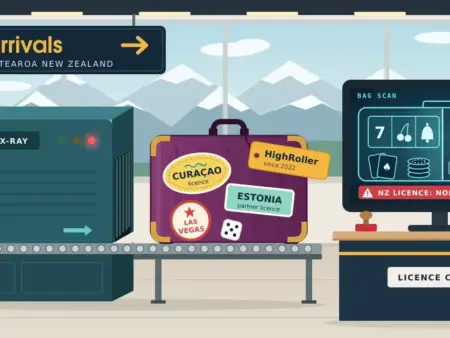
You may still see sites badged “Kiwi Casino” describing themselves as licensed by an overseas regulator such as the Malta Gaming Authority or the Curacao authorities. An overseas licence is not the same as a New Zealand one. It may offer some consumer protection in the operator’s home jurisdiction, but it does not make the site a licensed New Zealand casino, and from December 2026 an overseas licence alone does not entitle a site to accept New Zealand customers. We cannot verify a current, specific licence for any “Kiwi Casino” brand, and we do not link to or recommend operators that lack the local right to operate.
The sensible reading, then, is to treat “Kiwi Casino” as a marketing name rather than a guarantee of legality. The Kiwi branding tells you who a site is aimed at; it tells you nothing about whether the site is allowed to be there.
How to check whether an online casino is legal for NZ players
You do not need to take any badge at face value. A few checks will tell you far more than a glossy homepage:
- Look for a New Zealand licence, not just any licence. From early 2027, legal operators will appear on the DIA’s public register and carry an official registration icon. Before then, assume an offshore site is unlicensed in New Zealand unless it is run by one of the approved entities.
- Check the operator and licence details. A legitimate site names its operating company and licence number. If a claimed Malta or other overseas licence is shown, confirm it on that regulator’s own public register rather than trusting the footer logo.
- Read the terms before you deposit. Withdrawal limits, bonus wagering and identity-verification rules are where disputes usually start. If the terms are vague or contradictory, that is a warning sign in itself.
- Watch for pressure tactics. Countdown timers, “exclusive” codes and promises that sound too good to be true are classic hallmarks of low-quality or outright unsafe sites. Our guide on how to spot scam casinos walks through the red flags in detail.
What a genuinely NZ-focused casino should offer
Setting legality aside for a moment, the features that make a site feel built for New Zealanders are easy to list. These are the things Kiwi-branded casinos tend to advertise — useful to understand so you can judge any site, licensed or not, on its merits.
Payments in New Zealand dollars
A site that genuinely serves Kiwis holds balances in NZD and processes deposits and withdrawals in dollars, so you are not losing 2–3% to currency conversion each time money moves. New Zealand bank-linked methods, debit cards and some e-wallets are the common options. We cover the trade-offs of paying in dollars in our guide to online casinos that settle in NZD. Whatever the method, expect to complete identity verification — commonly called KYC, or “Know Your Customer” — before your first withdrawal; submitting ID and proof of address early prevents delays later.
Games and software
Most casinos aimed at New Zealanders lean heavily on pokies (online slot machines), alongside table games such as blackjack, roulette and baccarat, and live-dealer tables streamed from a studio. Games are supplied by third-party studios — names like Microgaming, NetEnt, Play’n GO, Pragmatic Play and Evolution appear across many sites — so the library is rarely unique to one brand. The number that matters is the return to player (RTP), the percentage of all wagers a game is designed to pay back over the long run. A higher RTP is better for the player, but no RTP guarantees a session result, and the house edge always applies.
Bonuses and wagering
Welcome offers and reloads are the main marketing hook, but the headline figure is the least important part. What decides whether a bonus is worth taking is the wagering requirement — the multiple of the bonus (and sometimes the deposit) you must stake before any bonus-derived winnings can be withdrawn. A 100% bonus with a 40x wagering requirement on a NZ$200 bonus means NZ$8,000 of turnover before a cash-out. Game weightings also matter: pokies usually count 100% toward wagering, while table and live games often count far less. Remember that under the 2026 rules, approved operators will face advertising restrictions, so aggressive bonus marketing to New Zealanders is being reined in rather than expanded.
Support and responsible-gambling tools
Round-the-clock live chat is useful given New Zealand’s time zone (UTC+12, or UTC+13 in daylight saving), which rarely aligns with offshore support hours. More important than chat speed, though, are the harm-minimisation tools: deposit limits, time-outs, reality checks and self-exclusion. These are a core requirement of the new licensed framework, and you can read how exclusion works across venues, pokies and bank blocks in our guide to self-exclusion in New Zealand.
Common mistakes Kiwi players make
Most problems reported with offshore “Kiwi” casinos are avoidable. The recurring ones are worth naming plainly:
- Assuming a Kiwi name means a Kiwi licence. It does not. The branding is a marketing choice, not a regulatory status.
- Depositing before reading the withdrawal and bonus terms. Weekly withdrawal caps and high wagering requirements are the most common causes of frustration.
- Leaving identity verification until the first withdrawal. This is where payouts stall. Verify your account up front.
- Chasing losses. No strategy, system or demo-play session changes a game’s built-in house edge. Betting more to recover a loss simply increases exposure.
- Ignoring the 2026 transition. A site that is happy to take New Zealand deposits today may be required to stop serving New Zealanders from 1 December 2026 — which can complicate withdrawals if funds are left sitting in an account.
Who this suits — and the bottom line
If you are researching “Kiwi Casino” to decide where to play, the most important takeaway is not a score out of five; it is timing. New Zealand is in the middle of moving from an unregulated offshore market to a licensed one, and the safest path for a New Zealand player is to wait for — and then use — operators that appear on the DIA’s register from 2027, or that are among the approved entities permitted to continue during the transition. Until a site can show a New Zealand licence, treat any “Kiwi Casino” brand as an unlicensed offshore option and weigh the reduced protections accordingly.
For readers who simply want to understand the landscape, the short version is this: the Kiwi name signals who a site is marketed to, the game library and NZD support signal how it is set up to serve them, and the DIA licence — once issued — is the only thing that signals whether it is genuinely allowed to. Keep those three separate and you will read any casino, Kiwi-branded or not, far more clearly.
Responsible gambling and legal disclaimer
This article is general information about online casino branding and New Zealand regulation. It is not gambling advice, financial advice or legal advice, and it is not an inducement to gamble. Online casino gambling involves real risk of financial loss; outcomes are random and the house edge always applies, so no bonus, system or demo session improves your long-term chances. You must be 18 or older to gamble online in New Zealand. Regulation is changing: from 1 December 2026 only operators approved through the Department of Internal Affairs licensing process may serve New Zealand players, and full licences are expected from early 2027. If gambling is affecting you or someone you know, free and confidential help is available from the Gambling Helpline on 0800 654 655 or through Safer Gambling New Zealand. Set a budget, use deposit limits and self-exclusion tools, and never chase losses.
Sources
- Department of Internal Affairs — Online Gambling for players
- Department of Internal Affairs — Online Gambling for Providers
- Department of Internal Affairs — Gambling legislation and regulation
- Newswire — Eleven companies win right to apply for NZ online casino licences
- MinterEllison — Licence to operate: New Zealand’s Online Casino Gambling Act 2026
- Safer Gambling New Zealand
Frequently Asked Questions (FAQ)
Is Kiwi Casino a real, licensed New Zealand casino?
“Kiwi Casino” is a marketing name used by offshore websites and, more loosely, for any casino aimed at New Zealanders. It is not an official New Zealand operator, and no brand simply called Kiwi Casino appears among the 11 entities that won the right to apply for a licence at the 2026 Department of Internal Affairs auction. Treat it as an overseas, unlicensed option until a site can show a genuine New Zealand licence on the DIA register.
Can I legally play at an offshore Kiwi casino right now?
New Zealand’s new regime targets operators rather than individual players, but the practical position is changing fast. Overseas casinos that served New Zealanders before 1 May 2026 were allowed to continue through a transition period without advertising, and from 1 December 2026 only operators approved through the DIA auction and application process may offer online casino gambling to New Zealand customers. Playing at a site that has to withdraw from the market can make it harder to recover any funds left in your account.
What is the Online Casino Gambling Act 2026?
It is the law that, for the first time, lets online casinos be licensed to serve New Zealanders. It came into force on 1 May 2026, with regulations following on 3 July 2026. The Department of Internal Affairs runs the system, offered up to 15 licences through a competitive auction, and plans to publish a public register and registration icon so players can identify legal sites. Licences are expected to be issued from early 2027.
How do I know if an online casino is allowed to serve New Zealand players?
From 2027, check the Department of Internal Affairs public register and look for the official registration icon. Before then, assume an offshore site is unlicensed in New Zealand unless it is run by one of the approved entities. Always confirm any claimed overseas licence on that regulator’s own register, read the withdrawal and bonus terms before depositing, and be wary of pressure tactics or offers that seem too generous.
What should I do instead of relying on a star rating?
Focus on verifiable facts rather than scores. Confirm the operator and licence, check whether the site holds balances in New Zealand dollars, read the wagering requirements on any bonus, complete identity verification early, and make sure deposit limits and self-exclusion tools are available. If gambling stops being entertainment, use those tools or contact the Gambling Helpline on 0800 654 655.
Recent Gambling News