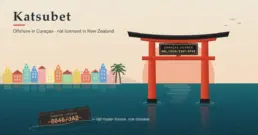

Katsubet is an offshore online casino with a Japanese visual theme that has appeared in New Zealand-facing listings, including an earlier version of this page. This profile sets out what can be verified about the brand and what cannot, with particular attention to its licensing, its advertised welcome bonus and its payment methods. It carries no rating, no offer and no link to the operator. Its purpose is to help you check a site like this for yourself, against the sources that actually settle each question.
Key points
- Katsubet is an offshore, crypto-friendly casino operated from Curaçao by Scores55 Tech B.V. (company No. 162990); it is not licensed in New Zealand.
- Older listings cite the obsolete master licence 8048/JAZ; the current footer shows a direct Curaçao Gaming Authority licence, OGL/2024/1307/0748, which should be confirmed on the regulator’s public register.
- The advertised welcome bonus is described four incompatible ways, from about NZ$400 to roughly NZ$6,000 to 5 BTC, so it cannot be stated reliably.
- Any of those figures would exceed New Zealand’s cap of NZ$100 or 200% of the deposit, whichever is lower.
- The banking line-up leans on Canadian rails (Interac, iDebit, PurplePay) that are unusable from New Zealand.
- Katsubet is not among the entities that progressed through New Zealand’s October 2026 licence auction; unlicensed operators must stop serving New Zealand by 1 December 2026.
What Katsubet is and who operates it
Katsubet is a cryptocurrency-friendly casino that is generally reported to have launched around 2020 and operates from Curaçao. Across independent listings a consistent core emerges: a large game library drawn from a wide set of studios, a live dealer lobby supplied by third-party providers, customer support by live chat and email with no telephone line, and both conventional and crypto payment options. That much is broadly stable from one source to the next.
The operating entity named in the site’s own footer is Scores55 Tech B.V., a Curaçao company (registration No. 162990, registered at Scharlooweg 39, Willemstad). Several third-party listings and some older copies of the footer render the name as “ScoresS5”, but the operator’s own documentation uses Scores55 Tech B.V. The company is listed as holding a direct Curaçao Gaming Authority licence, OGL/2024/1307/0748. An overseas licence of this kind is not a New Zealand authorisation, a distinction the final section returns to.
Quick facts
| Brand | Katsubet |
|---|---|
| Operator entity | Scores55 Tech B.V. (sometimes rendered “ScoresS5”) |
| Company number | 162990 (Curaçao) |
| Registered office | Scharlooweg 39, Willemstad, Curaçao |
| Overseas licence | Curaçao Gaming Authority, OGL/2024/1307/0748 |
| Launched | Reported around 2020 |
| Theme | Japanese visual style |
| Games | Large library from many studios (published counts conflict) |
| Live casino | Yes, third-party providers |
| Payments | Cards, Neosurf, Payz, crypto (BTC, LTC, USDT) and Canadian methods |
| Support | Live chat and email; no telephone line |
| New Zealand status | Not licensed in New Zealand; no NZ register is live yet |
Beyond that core, the published specifics are inconsistent enough that they cannot be reported as fact. Game counts appear variously as “3,000+”, “more than 5,000” and “more than 5,000 titles from over 60 providers”, with the provider count given as both 60 and 69. Stated withdrawal times range from “1–3 hours” to “within 24 hours” for the same methods. Where a page disagrees with itself like this, the honest position is that the number is unknown, not that one of the versions is correct.
The licence number to check, and why Curaçao’s rules changed
Older listings describe Katsubet as holding “a master licence issued by the Government of Curaçao (Licence no. 8048/JAZ)”. That number belonged to Antillephone N.V., one of four private companies that sold sub-licences under a system that no longer exists. It is worth understanding the change, because almost every Curaçao casino profile written before 2025 carries the same obsolete claim.
Curaçao rebuilt its gambling framework through the National Ordinance on Games of Chance, usually abbreviated to the LOK (its Dutch initials). The reform is recent, substantial and easy to verify:
- The old system, from 1996. Four private “master” licence holders sold sub-licences to operators worldwide. The master numbers were 1668/JAZ, 365/JAZ, 5536/JAZ and 8048/JAZ, the last being Antillephone N.V. There was no effective government regulator supervising the market, and a sub-licence number was close to unverifiable from the outside.
- 24 December 2024 — the LOK comes into force. It abolished the master-and-sub-licence model, created a single regulator, the Curaçao Gaming Authority (CGA), and provided for every operator and supplier to be licensed directly.
- Early 2025 — legacy sub-licences fall away. The old sub-licences ceased to have effect, with no grandfather provision carrying them forward.
- Direct licensing and a public register. The CGA now issues licences directly, maintains a public register of licensees, investigates beneficial ownership, enforces anti-money-laundering and responsible-gambling obligations, and provides a formal complaints route with independent dispute resolution.
- Transitional seals expired. The interim seals that bridged the changeover expired permanently on 15 October 2025, and from 1 January 2026 licensed operators are expected to maintain a genuine physical presence on the island.
The practical upshot for a reader is simple. If a casino’s footer still shows a master licence number ending in /JAZ, that tells you the footer has not been updated since 2024. It does not by itself prove the operator is unlicensed, but it does mean the displayed credential is not the current one. Katsubet’s footer does appear to have moved on: it now cites Scores55 Tech B.V. under CGA licence OGL/2024/1307/0748 rather than the 8048/JAZ reference still quoted elsewhere. Under the new regime the correct test is no longer a number in a footer; it is whether that licence appears, active, on the CGA’s own public register.
Why the advertised welcome bonus cannot be pinned down
The single clearest problem with the material published about this brand is its welcome offer. Across the listings and the operator’s own pages, the “welcome bonus” is described in four ways that cannot all be true at once.
| Where it appears | The offer as stated | Wagering stated |
|---|---|---|
| Summary table | 5 BTC plus 100 spins | Not stated |
| Body copy, one variant | Four tiers of NZ$400, NZ$500, NZ$1,000 and NZ$4,100 — roughly NZ$6,000 in total | 50× |
| Body copy, another variant | Four tiers of NZ$100 each — NZ$400 in total | 45× on deposit and bonus, 50× on spins |
| Homepage banner (NZ view) | “1st deposit bonus, 100% up to NZ$400 + 100 free spins” | Not stated on the banner |
These are not variations on one offer. A total of NZ$400 and a total of roughly NZ$6,000 differ by a factor of fifteen, and 5 BTC is a different order of magnitude again. At least two of the descriptions must be wrong, and there is no basis within the published material for choosing between them. A page that states its own headline offer four incompatible ways is not a reliable source for any single version of it.
What can be stated with confidence is the regulatory position. Under New Zealand’s Online Casino Gambling Regulations 2026, a bonus or inducement from an operator licensed in New Zealand cannot exceed NZ$100, or 200% of the deposit or bet, whichever is lower. Every figure in the table above sits above that ceiling, so whatever the operator’s actual offer turns out to be, it has no lawful equivalent in the licensed New Zealand market. Our casino bonuses page explains the cap and the terms that decide what any offer is really worth, and our guide to wagering requirements shows how a playthrough multiplier changes the picture.
One term is worth carrying regardless of the headline amount: maximum bet limits usually apply while a bonus is in play. Exceeding a stake cap before wagering is complete can void the bonus and any winnings derived from it under the terms, and the problem typically surfaces only at withdrawal, after the money appears to have been won.
What the payment methods reveal
The banking line-up is the most telling part of this listing, because the methods a site leads with usually reveal the market it was built for. Katsubet’s differs from many brands aimed at New Zealand: alongside cards and crypto it leans on Canadian payment rails.
| Method listed | Home market | Usable from New Zealand? |
|---|---|---|
| Interac | Canada | No — requires a Canadian bank account |
| iDebit | Canada | No |
| PurplePay | Canada-focused | No |
| Prezzy Card | New Zealand | Named in the prose, but absent from the operator’s own listed methods |
| POLi | New Zealand | Named in the prose, but absent from the listed methods; also carries a security warning from a major NZ bank |
| Bitcoin, Litecoin, Tether | Global | Yes, with irreversibility and value movement as the trade-offs |
| Visa, Mastercard, Neosurf, Payz | International | Potentially, subject to acceptance, fees (cards around 2.5%) and currency conversion |
Three of the ten listed deposit options are Canadian, and the two New Zealand methods mentioned appear only in prose rather than in the operator’s structured list. That combination points to an international, Canada-weighted dataset with New Zealand references written over the top, which is consistent with what we have found on other profiles assembled from the same kind of operator databases.
Two further points matter for a New Zealand reader. POLi, one of the NZ methods named, has been the subject of a published warning from Consumer NZ about the way it interacts with online banking security, so it is not a method to use casually. And under the 2026 rules, credit cards and credit-linked payment methods, including buy-now-pay-later, are banned for operators licensed in New Zealand. Cryptocurrency sits outside that ban but brings its own considerations: transactions are effectively irreversible, and the value of the coin can move between deposit and withdrawal. Our casino deposit methods page sets out which routes actually apply here, including the POLi position in more detail.
Withdrawals, verification and account terms
Because the published withdrawal timings contradict one another, the sensible approach is to treat the speed as unverified and to focus instead on the terms that reliably determine whether a withdrawal completes at all.
- Identity verification (KYC). Like any regulated-market casino, the brand can require identity and address documents before a withdrawal is paid. The time to gather and approve these often matters more than the headline payout speed. Our guide to casino withdrawal times explains where the delays usually sit.
- Bonus locks. Where a deposit is tied to a bonus, the funds are typically locked until wagering is complete; a deposit cannot simply be withdrawn mid-playthrough without forfeiting the bonus.
- Free-spin and bonus caps. The brand’s own terms cap winnings from certain free spins (for example, NZ$100 or NZ$200 depending on the promotion), which limits what a “free” reward can actually pay out.
- Withdrawal limits. Daily, weekly or monthly caps on how much can be withdrawn are common and can stretch a large balance over a long period; they are worth reading before depositing, not after winning.
- Cancelling pending withdrawals. Some sites allow a pending withdrawal to be reversed back into a playable balance, which quietly works against the player. Whether that is possible is worth checking in the account settings.
Where New Zealand’s 2026 rules leave Katsubet
New Zealand moved from an unregulated position to a licensed one in 2026. The Online Casino Gambling Act 2026 took effect on 1 May 2026, and the accompanying Online Casino Gambling Regulations 2026 followed on 3 July 2026, with oversight handed to the Department of Internal Affairs (DIA). The headline design is a small, licensed market rather than an open one.
- Up to 15 licences are available, each covering one brand for an initial three-year term, renewable once for a further five years. The regulator is not obliged to issue all 15.
- The auction stage has concluded. In mid-October 2026 the DIA confirmed the entities that won the right to apply, following an auction that drew 32 bidders. Reported names include SkyCity (through two subsidiaries), Entain-linked entities, Stake, Super Group, One Casino, Rush Entertainment, Rock Swift Group, Christchurch Online and Skill On Net. Winning an auction place is not a licence; a full application assessment still follows.
- Katsubet is not on that list. Neither the brand nor Scores55 Tech B.V. appears among the entities that progressed, on the reporting available.
- A hard cut-off applies. Operators that did not take part, or were unsuccessful, must stop offering online casino gambling to people in New Zealand by 1 December 2026.
- A public register is coming. Licensed operators are expected to appear on a DIA register and to display a unique registration icon, with licences anticipated from early 2027.
Until that register is live, no operator can accurately be described as licensed for online casino gambling in New Zealand, and a /JAZ or even a current Curaçao number does nothing to change that. Our New Zealand gambling laws guide sets out the full timeline, and our overview of the New Zealand online casino market explains how the licensed field is taking shape.
How to check an operator like this for yourself
The same handful of checks will tell you more about any offshore casino than a star rating ever could. For a brand like this one, work through the following:
- The operating entity and registration number in the footer — here, Scores55 Tech B.V., No. 162990 — and whether they match the company named in the terms and conditions.
- The licence. For a Curaçao brand, check whether the number shown is a current direct CGA licence or an expired master number ending in /JAZ, and confirm it on the regulator’s public register rather than trusting a footer seal.
- The real bonus terms, read from the operator’s own terms page rather than a headline: the amount, the wagering multiplier, the maximum bet during bonus play and any winnings cap.
- The withdrawal terms, including any daily or weekly cap and whether a pending withdrawal can be cancelled back into a playable balance.
- The New Zealand position: whether the operator is on the DIA’s licensed register once it opens, and whether its payment and bonus practices would even be lawful here.
Our casino reviews hub sets out this checklist across brands, and our guide to spotting scam casinos covers the warning signs that a site is not what it claims.
Responsible gambling
You must be 18 or older to gamble online in New Zealand. If gambling is causing harm to you or someone you know, free and confidential help is available. The Gambling Helpline Aotearoa is open 24 hours a day on 0800 654 655, or by free text to 8006. PGF Services offers free, professional counselling on 0800 664 262. Support is available to whānau and friends as well as to the person gambling.
Disclaimer
This page is published for information. It is not financial, legal or gambling advice, and nothing on it is a recommendation to gamble or an endorsement of any operator.
No link on this page goes to an operator’s cashier, and none will. Reach any casino by typing the address yourself.
Licensing, ownership, bonus terms, withdrawal limits and country availability all change, sometimes within weeks, and this page covers a period in which the New Zealand market is being restructured. Confirm the current position in the operator’s own terms and on the regulator’s own register before acting on anything here.
Reference sources
- Online Casino Gambling Act 2026 — New Zealand Legislation
- Online Casino Gambling Regulations 2026 — New Zealand Legislation
- Information for online casino customers — Department of Internal Affairs
- Licence to operate: New Zealand’s Online Casino Gambling Act 2026 — MinterEllisonRuddWatts
- SkyCity, Entain and Stake among 11 entities to progress through New Zealand’s online casino licence auction — Asia Gaming Brief
- Curaçao approves LOK gambling licensing framework — iGaming Business
- Curaçao as an iGaming jurisdiction: the LOK reform explained — Latest Casino Bonuses
- Curaçao iGaming licence 2026: LOK reform, transition and enforcement — Zitadelle AG
- Curaçao online gaming: master licence expiry and direct licensing — Advennt
- POLi payments: how it affects and breaches your banking security — Consumer NZ
- Fair Trading Act — Consumer Protection, New Zealand Government
- Gambling Helpline Aotearoa New Zealand — free, confidential support service
Frequently Asked Questions
Is the Curaçao licence number 8048/JAZ still valid?
No. That number belonged to Antillephone N.V., one of four master licence holders under a system abolished by the National Ordinance on Games of Chance (the LOK), which came into force on 24 December 2024. Legacy sub-licences fell away in early 2025 with no grandfather provision. Operators now need a direct licence from the Curaçao Gaming Authority, which can be checked on its public register. Katsubet’s footer now cites a current direct licence, OGL/2024/1307/0748, rather than the old 8048/JAZ reference still quoted elsewhere.
What is Katsubet’s welcome bonus?
It cannot be established from what is published. Four incompatible descriptions circulate, ranging from four tiers totalling NZ$400, through roughly NZ$6,000, to 5 BTC. Because they contradict one another, none can be reported as the offer. Whatever it is, it exceeds the New Zealand ceiling: a bonus from a licensed New Zealand operator cannot be more than NZ$100, or 200% of the deposit or bet, whichever is lower.
Can I use Katsubet’s payment methods from New Zealand?
Several cannot be used here. Interac, iDebit and PurplePay are Canadian and generally require a Canadian bank account. The two New Zealand methods named, POLi and Prezzy Card, appear only in the prose and not in the operator’s own listed options, and POLi carries a published security warning. Crypto works globally but is irreversible and its value can move. Under the 2026 rules, credit cards and credit-linked methods are banned for licensed New Zealand operators.
Is Katsubet licensed in New Zealand?
No, and no online casino is yet. New Zealand’s licensing auction concluded in October 2026, and the Department of Internal Affairs named the entities that may now apply; Katsubet and Scores55 Tech B.V. are not among them. Licences are anticipated from early 2027, and licensed sites will then appear on a public register and display a registration icon. Operators that did not take part must stop offering to New Zealand by 1 December 2026.
Does this site recommend Katsubet?
No. This page describes an operator; it does not recommend one. It publishes no rankings, scores, offers or sign-up links, and it does not link to any casino. Its aim is to help you verify a site’s licence, bonus terms and payment methods for yourself before deciding anything.
Katsubet Operator Profile: Licence, Bonus and New Zealand Status Details