
This is a factual profile of an online casino operator that was accepting New Zealand players under the transitional rules of New Zealand’s new online gambling regime. It carries no offer, no rating and no link to any casino cashier. The aim is simply to set out who runs the brand, how its most important terms work, and where it sits under the law as it stands in 2026 — so you can judge it for yourself rather than take a marketing claim at face value.
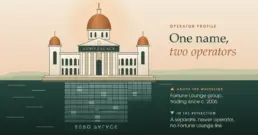
Before anything else, one point determines whether the rest of this page even applies to you: two unrelated operators trade under the Euro Palace name. Confusing them has real consequences for anyone holding an account or a balance, so it is worth settling first.
Two operators use the Euro Palace name
| The long-standing brand | The newer, unrelated platform | |
|---|---|---|
| Group | Part of the Fortune Lounge group | A separate operator, no Fortune Lounge connection |
| Trading since | Around 2006 (the most commonly cited date) | A newer arrival at a different web address |
| Licence | Reported to hold Malta / Kahnawake papers (disputed) | Operates under a Curaçao licence |
| Independent testing | Associated with the eCOGRA seal | Does not display the eCOGRA seal |
| Positioning | Games Global / Microgaming platform | Marketed as crypto-friendly |
They are separately licensed and separately operated, and hold no shared account history. An account, balance or complaint at one does not carry over to the other. Check the footer — the operating company, its registration number and the licence number identify which platform you are on.
Which Euro Palace are you looking at?
A search for “Euro Palace Casino” can land you on either of two platforms that have nothing to do with one another. One is the long-standing brand within the Fortune Lounge group, which has traded since the mid-2000s and runs on the Games Global (formerly Microgaming) platform. The other is a newer, separately operated site at a different web address that holds a Curaçao licence and markets itself as crypto-friendly.
This is not a technicality. The two platforms hold different licences, answer to different regulators, and share no account data whatsoever. Independent reporting on the newer platform notes that the shared name causes genuine confusion over login credentials and account history — meaning some players have arrived expecting to find an existing account and found none. An account at one is not an account at the other; a balance at one does not exist at the other; and if something goes wrong, the body you would complain to is different in each case.
How do you tell them apart? Read the footer, not the banner. The operating company, its registration number and the licence number identify which platform you are actually on. The name above the door does not. Everything in the rest of this profile concerns the long-standing Fortune Lounge brand.
Who operates it
Euro Palace is part of the Fortune Lounge group, and that single fact matters more than any other, because group membership — not the individual brand — determines the terms that affect your money. Its sister brands include Royal Vegas and Vegas Palms, which run on the same platform and share key banking rules. The group has long been associated with independent testing by eCOGRA, an agency that audits game fairness and payout reporting.
Beyond that, the public record is genuinely muddled, and we would rather show you the disagreement than pretend it is settled.
Operator profile
| Group | Fortune Lounge group — consistent across all sources. |
| Sister brands | Include Royal Vegas, Vegas Palms and other Fortune Lounge sites. Withdrawal caps are calculated across the group. |
| Launch year | Disputed. Sources give both 2006 and 2010; most independent reporting favours 2006. |
| Licensing authority | Disputed. Malta and Kahnawake are both cited, by different sources and at different times. Verify the current licence in the site’s own footer. |
| Operating company | Disputed. Baytree Interactive Ltd (Guernsey) appears in some reporting; other Fortune Lounge brands are attributed to Malta-registered entities. |
| Independent testing | eCOGRA certification is consistently reported for the Fortune Lounge platform. |
| New Zealand licence | None. No operator holds one — the DIA register of licensed sites is expected to open from early 2027. |
| Game software | Games Global, formerly Microgaming, with content from a wide range of associated studios. |
Three items are marked disputed rather than resolved. Where reputable sources disagree about who operates a casino and under which licence, that disagreement is itself worth knowing — and the site’s own footer, cross-checked on the regulator’s register, is the only current answer.
Three fields in that table are marked disputed, and it is worth being straightforward about why. Reputable listing sites give different answers for Euro Palace’s launch year, its licensing authority and the exact company behind it. Individual reviews frequently contradict themselves within a few hundred words — quoting 2006 in one paragraph and 2010 in the next, or Malta in a summary box and Kahnawake in the body text. Some reporting attributes the brand to Baytree Interactive Ltd of Guernsey; other Fortune Lounge sites are tied to Malta-registered entities.
Rather than pick one answer and present it as fact, we flag these as unresolved. Where credible sources disagree about who runs a casino and under whose licence, that disagreement is itself the finding — and the operator’s own current footer, cross-checked against the named regulator’s public register, is the only reliable answer at any given moment. What is not in dispute is the group membership, and that is enough to understand the terms below.
The withdrawal cap
The structural term that most affects a winning player at Fortune Lounge and the wider Palace Group of brands is a weekly limit on withdrawals of winnings that are large relative to deposits. Two features of it deserve attention.
First, the cap is typically calculated across the group rather than per site. Winnings at Euro Palace, Royal Vegas and the other associated brands can be pooled when the weekly figure is worked out, so opening accounts at several sister sites does not multiply how fast a large win can be paid out.
Second, and more importantly, a published player complaint documents the mechanism in action: an amount above the cap was paid and then the balance was reversed back into the casino account under the weekly-limit terms. That is the detail worth carrying away. Capped money does not sit quietly in a payment queue. It returns to a gambling balance, where it is fully playable — and in that documented case it was substantially played back down over the following weeks.
This is exactly the practice the UK Gambling Commission moved against. It prohibited reverse withdrawals across all remote operators after finding the function presents a clear risk to engaged and vulnerable gamblers, because money earmarked for payout can be clawed back into play. Our guide to fast payout casinos covers that finding and what a genuinely quick, no-reversal withdrawal process looks like.
There is also a New Zealand angle. The Fair Trading Act 1986 prohibits unfair terms in standard-form consumer contracts, and the Commerce Commission can apply to the courts for a declaration that a specific term is unfair and therefore unenforceable. A weekly cap that quietly returns your own winnings to a playable balance is the kind of term a careful player should read in full before depositing.
Games and software
The library is built on Games Global content — the studio formerly known as Microgaming — drawing on a wide range of associated development studios. Alongside pokies (online slots) you will find software-based table games, video poker, a live dealer section streamed with real croupiers, and speciality formats such as keno and scratch cards. Progressive jackpot pokies, including long-running network games, feature prominently.
Three points apply to any casino of this type, not just this operator, and they matter more than the headline game count.
- Game count is not a quality measure. Whether a lobby holds six hundred titles or two thousand tells you about breadth, not value. The return-to-player (RTP) rate — the share of stakes a game pays back over the long run — is set per game and is usually visible in each game’s own information panel.
- The same title can return very different amounts. Operators sometimes deploy different paytables for the same game. Our video poker guide shows how one game name can range from roughly 95% to 99.54% depending on its paytable, and our rules of blackjack page explains how a single table rule shifts the odds by more than a full percentage point.
- Progressive jackpots are a separate proposition. They are often exempt from the weekly withdrawal cap, which is genuinely relevant here. The trade-off is a lower base return on the feeder games, because a slice of every stake is diverted to the jackpot pool rather than returned to players.
Bonuses and welcome offers
Welcome offers at this brand have historically been structured as deposit matches split across the first few deposits — for example a package of up to several hundred New Zealand dollars delivered as separate 100% matches — with wagering requirements in the region of 30x and a maximum-bet restriction while bonus funds are active. Rather than describe any current promotion, which changes constantly, two observations are more useful.
- Multi-part welcome packages have no lawful equivalent in New Zealand’s licensed market. Under the Online Casino Gambling Regulations 2026, an inducement from a licensed operator is capped at the lesser of NZ$100 or 200% of the customer’s deposit or bet, and sign-up inducements may only be shown on the operator’s own platform, not advertised on social media, television, radio or affiliate sites. A large, multi-deposit welcome package offered to New Zealanders is a sign the operator is not working within the licensed framework.
- The maximum-bet rule is the term that most often costs players their winnings. Exceeding the stake cap while wagering is still outstanding — even once, even by accident — can void the bonus and any winnings attached to it, and it usually surfaces only at withdrawal. Our guide to casino bonuses explains wagering requirements, stake caps and game weightings in full.
Deposits, withdrawals and verification
The brand’s banking page has historically listed familiar methods for New Zealand players — Visa and Mastercard, together with options such as Instadebit, Paysafecard and MuchBetter — with balances handled in New Zealand dollars on the NZD-facing version of the site. Available methods, fees and processing times change often, so treat any list as a snapshot rather than a guarantee.
Two process points matter more than the logos on the cashier screen. First, identity verification (known as KYC, or “know your customer”) is normal and required: expect to confirm your identity, address and payment method before a first withdrawal clears, and ideally complete it early rather than at the moment you try to cash out. Second, check whether a pending withdrawal can be cancelled back into a playable balance. A pending-withdrawal reversal is the same harm the UK regulator targeted — money you have asked to be paid out can be pulled back into gambling while it waits in the queue.
Where this operator stands under New Zealand’s new rules
New Zealand’s Online Casino Gambling Act 2026 came into force on 1 May 2026 and, with the accompanying regulations, replaced an unregulated offshore “grey market” with a licensed one. The practical timeline is short and specific:
- Operators that were serving New Zealand customers before 1 May 2026 may continue during a transitional window, but they must not advertise to New Zealanders in the meantime.
- That window closes on 1 December 2026. From then on, only operators that succeeded at the Department of Internal Affairs (DIA) auction may keep offering online casino services here while their full licence applications are assessed; everyone else must exit the New Zealand market.
- Up to 15 operators were able to win the right to apply at auction — a right to apply, not a guaranteed licence — against several hundred sites that had been serving New Zealanders. The DIA expects to begin issuing licences, and to publish a public register of licensed sites carrying a registration icon, from early 2027.
Euro Palace was serving New Zealand players before 1 May 2026, so it fell within the transitional arrangements. Whether it applied to be one of the licensed operators is not something the public can currently confirm, because the DIA has not published an applicant list. One relevant precedent sits in this operator’s own history: player records show the brand has previously withdrawn from a national market and notified affected customers by email that the site would close to them. Market exits are a normal part of its track record, and 1 December 2026 is a date on which many offshore sites will do exactly that.
If you hold a balance at a site you are unsure about, resolving it before that date is far more straightforward than chasing it afterwards. Our New Zealand gambling laws guide sets out the full timeline and what the licensed market will look like.
What to check for yourself
Because the licensed register does not yet exist and the ownership record for this brand is contested, the most reliable information is what you can verify directly. Before trusting any site that carries the Euro Palace name, confirm each of the following:
- The operating company and its registration number, taken from the footer — this also tells you which of the two Euro Palace platforms you are on.
- The licence number, verified on the named regulator’s own public register rather than simply read from the footer.
- The withdrawal terms, including any weekly cap and whether it is calculated per brand or across the whole group.
- Whether a pending withdrawal can be cancelled back into a playable balance.
- Whether the operator appears on the DIA register once it is published from early 2027 — until then, no site can honestly be described as licensed for online casino gambling in New Zealand.
Our casino reviews hub sets out the full checklist and applies it consistently across every operator we profile.
Disclaimer
This page is published for information. It is not financial, legal or gambling advice, and nothing on it is a recommendation to gamble or an endorsement of any operator. You must be 18 or older to gamble online in New Zealand.
No link on this page goes to an operator’s cashier, and none will. Licensing, ownership, bonus terms, withdrawal limits and country availability all change, sometimes within weeks, and this page covers a period in which the New Zealand market is being restructured. Player accounts described here are individual reports rather than findings. Confirm the current position in the operator’s own terms and on the regulator’s own register before acting on anything here.
Free, confidential help is available in New Zealand from the Gambling Helpline on 0800 654 655, or by free text to 8006, 24 hours a day. PGF Services offers free counselling on 0800 664 262, including support for whānau and friends.
Sources
- Euro Palace Casino assessment — Wizard of Odds
- Euro Palace Casino player ratings and complaint records — AskGamblers
- Euro Palace Casino review, complaints and terms analysis — Casino Guru
- Assessment of Palace Group casinos — Wizard of Odds, on the wider group
- Prohibition of reverse withdrawals for all remote operators — UK Gambling Commission
- Information for online casino customers — Department of Internal Affairs
- Online Casino Gambling Act 2026 — New Zealand Legislation
- Online Casino Gambling Regulations 2026 — New Zealand Legislation
- Unfair contract terms — Commerce Commission New Zealand
- Gambling Helpline Aotearoa New Zealand — free, confidential support service
Frequently Asked Questions
Are there two different Euro Palace casinos?
Yes. There is the long-standing Fortune Lounge brand and a separate, newer platform operating under a Curaçao licence at a different web address. They are unrelated, hold different licences, and share no account history. Read the footer to confirm which one you are on before depositing or signing in.
Who operates Euro Palace and under what licence?
Sources disagree. Malta and Kahnawake are both cited, and the operating company is variously reported, with Baytree Interactive Ltd of Guernsey appearing in some records. What is consistent is membership of the Fortune Lounge group. Verify the current company, registration number and licence number in the site’s own footer, then check that licence on the regulator’s public register.
Is Euro Palace licensed in New Zealand?
No — and at present no operator is. The Department of Internal Affairs expects to begin issuing licences and to publish its public register of licensed online casinos from early 2027. Until then, any claim that a site is “licensed in New Zealand” cannot be verified, and licensed sites will display an official registration icon once the register is live.
Is there a limit on how much I can withdraw, and what happens to capped winnings?
Yes. Fortune Lounge brands apply a weekly limit on winnings that are large relative to total deposits, calculated across the group rather than per brand. A published player complaint records amounts above that cap being reversed back into the casino account rather than queued for payment, where the money remains fully playable — which is precisely why the UK Gambling Commission banned reverse withdrawals across all remote operators on harm grounds.
Where can I get help if gambling is causing problems?
The Gambling Helpline is free and available 24 hours a day on 0800 654 655, or by free text to 8006. PGF Services offers free counselling on 0800 664 262, and support is also available to whānau and friends. These services are confidential and independent of any operator.