
This is a factual profile of Spin Casino, an online operator that currently accepts New Zealand players during the transition to the country’s new licensing regime. It carries no offer, no rating and no link to the operator — only information you can check for yourself.
Two things are worth knowing before any of the marketing: an independent casino analyst has placed the whole group this brand belongs to on a warning list, and the withdrawal limit that applies here is shared across several other casinos you might hold accounts with without realising they are connected.
Key points
- One company, two names: Spin Casino is the rebranded Spin Palace (renamed around 2019–2020); the operator, Malta-registered Bayton Ltd, did not change.
- Independent warning: Wizard of Odds lists the wider Palace Group among casinos to avoid, citing affiliate non-payment and unilateral changes to player terms.
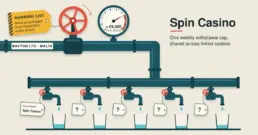
- Shared withdrawal cap: a roughly €4,000-per-week limit on large non-progressive wins is calculated across the whole group — Spin Casino, Royal Vegas, Ruby Fortune and All Slots together — not per site.
- No New Zealand licence: no online casino is NZ-licensed yet; the DIA expects to issue the first of up to 15 licences from early 2027.
- Bonuses now capped: a licensed NZ operator’s inducement cannot exceed the lesser of NZ$100 or 200% of the deposit, so historic multi-deposit welcome packages are not lawful here.
Who operates Spin Casino
The brand changed name, but the company behind it did not. Spin Casino traded as Spin Palace from its launch in 2001 until a rebrand around 2019–2020. The operating company, the licence and the software platform carried across unchanged, so older reviews written under either name describe the same operation. If you come across a “Spin Palace” review, treat it as a review of this casino.
The casino is operated by Bayton Ltd, a company registered in Malta, and licensed by the Malta Gaming Authority (the MGA, Malta’s gambling regulator). A Malta licence is a recognised European authorisation, but it is not a New Zealand one — a point that matters a great deal under the country’s 2026 law, and one covered in full further down. Because the exact legal entity and licence number printed in a casino’s footer can differ from what review sites report, the live footer and the MGA’s own public register are the two places to confirm who you are actually dealing with.
A different company uses the same name elsewhere. In the United States, “Spin Palace” is run by a separate operator under individual state licences, unconnected to the Malta company serving New Zealand. Brand names are reused across markets by different businesses, which is exactly why the operating entity in the footer identifies who runs a site — not the name above the door.
The sister brands matter more than they look. Royal Vegas, Ruby Fortune, All Slots and others sit in the same group, historically associated with The Palace Group and the Buffalo Partners affiliate programme. (An “affiliate programme” is the marketing arm that pays third-party websites commission for sending players to a casino.) These brands advertise separately and look like unrelated businesses — but, as the withdrawal section below explains, their payout limit is not separate.
Quick facts
| Brand | Spin Casino |
| Former name | Spin Palace — rebranded around 2019–2020 with no change to the operating company or licence |
| Launched | 2001 |
| Operating company | Bayton Ltd, registered in Malta |
| Licence | Malta Gaming Authority (MGA). Not a New Zealand authorisation |
| Group and sister brands | The Palace Group / Buffalo Partners affiliate programme; Royal Vegas, Ruby Fortune, All Slots and others. The withdrawal cap is shared across the group |
| New Zealand licence | None. No online casino holds one; the DIA register of licensed operators is expected from early 2027 |
| Game software | Predominantly Games Global (formerly Microgaming), with live-dealer tables from third-party studios |
| Independent assessment | Wizard of Odds lists the Palace Group among casinos to avoid (see the sources section) |
What independent reviewers say
We report the following rather than adjudicate it. The long-running analyst site Wizard of Odds carries a warning on this operator and lists the Palace Group of casinos among those it advises players to avoid. The reasons it gives are specific and checkable: non-payment and aggressive conduct toward affiliate partners, unilateral changes to player terms and conditions, and breached affiliate contracts. The same source notes that the group had a stronger reputation in earlier years, which is why its assessment reads as a decline rather than a site that was always problematic.
Independent reviewers are not regulators, and a warning is an opinion rather than a legal finding. But for an operator that holds no New Zealand licence, independent assessments are among the few external checks a player has. The sensible approach is to read them at source — the links are gathered in the reference section at the foot of this page — and to weigh them alongside the operator’s own current terms rather than treating any single verdict as the last word.
The group-wide withdrawal cap
This is the single term most likely to affect a New Zealand player in practice, and it is absent from most of what is written about the casino.
As reported by independent reviewers, non-progressive winnings are subject to a cap of roughly €4,000 per week where a withdrawal is five times or more the player’s total deposits. Progressive jackpot wins — the pooled prizes that build up across many players — are reported to be exempt. The unusual part is how the limit is calculated: it is applied across the Palace Group of casinos as a whole, not per individual site.
In plain terms, if you hold accounts at more than one of these connected brands, you share one cap between them. Opening a second account on a sister site does not give you a second allowance. A worked example makes the effect concrete: win a sum well above the weekly ceiling and it is not paid in one transfer; it is released in weekly instalments until the balance is cleared, with each week’s payout counted against the single group-wide limit. A player can therefore be subject to a ceiling they had no reason to know applied.
Why this matters beyond the inconvenience: money sitting inside a gambling balance is not the same as money paid out. A long or capped payout schedule keeps winnings within reach of further wagering, which is why withdrawal friction is treated as a harm issue, not merely a service niggle. Our guide to casino withdrawal times works through how long each payment method takes and why slow or capped payouts matter.
There is a consumer-law angle too. The Fair Trading Act 1986 prohibits unfair terms in standard-form consumer contracts, and the Commerce Commission can ask the courts to declare a specific term unfair and therefore unenforceable. Whether any particular withdrawal cap would meet that test is a matter for the courts, not for this page — but it is a reason to read the banking terms before depositing rather than after a win.
Games and software
The library is built predominantly on Games Global content — the studio formerly known as Microgaming — which reflects the brand’s early-2000s origins. Alongside pokies (the New Zealand term for online slot machines) there are software-based table games, video poker and a live-dealer lobby streamed from third-party studios with real croupiers.
Three points apply to any casino catalogue rather than to this one specifically, and they are worth understanding before game count or screenshots sway a decision:
- Game count is not a quality signal. Whether a site lists 600 or 900 titles tells you nothing about how much it pays back. The figure that matters is the return to player (RTP) — the percentage of all money wagered that a game returns to players over the long run. It is set per game and shown in each game’s own information panel.
- The same game name can pay very differently. A single title can range from about 95% to 99.5% RTP depending on which paytable the operator has switched on, and a blackjack table’s payout rule can move the odds by more than a full percentage point. The name on the thumbnail does not fix the maths behind it.
- Live and table games count less toward bonuses. Wagering contribution on those games is commonly cut to 10–20%, which multiplies the effective playthrough on a bonus several times over. A requirement that looks modest on pokies can become unreachable on blackjack or roulette.
Bonuses and the new New Zealand limits
Welcome offers at this operator have historically been multi-part deposit matches spread across the first several deposits, each carrying a wagering requirement (the number of times bonus funds must be bet before a withdrawal is allowed) and a maximum-bet restriction while bonus money is active. The following are observations about how such offers sit against New Zealand’s new rules, not a description of any current promotion.
- Large multi-part welcome packages have no lawful equivalent in the licensed New Zealand market. Under the Online Casino Gambling Regulations 2026 (in force from 3 July 2026), an inducement that requires the customer to spend their own money is capped at the lesser of NZ$100 or 200% of the deposit or bet, while an inducement requiring no spend cannot exceed NZ$100 at all. A four-part package worth hundreds or thousands of dollars simply cannot be offered by a licensed operator in New Zealand.
- A bonus interacts badly with the withdrawal cap. Accepting a bonus layers a wagering requirement on top of a payout ceiling that already limits what can leave the account. If your aim is to place a few bets and withdraw, declining the bonus removes one of those two constraints. Our explainer on casino bonuses sets out how match offers, free spins and their terms actually work.
How Spin Casino compares with its sister brands
Because Royal Vegas, Ruby Fortune, All Slots and Spin Casino share one operator, one platform heritage and, crucially, one withdrawal cap, comparing them is not a comparison of independent payout headroom. The differences are cosmetic — branding, game-shelf layout and promotional calendars — while the term that governs how much money you can actually extract is common to all of them.
That is useful to know if you are weighing two of these sites against each other: our Royal Vegas profile and our Ruby Fortune comparison describe the same group from different angles, and holding accounts at several of them does not multiply what you can withdraw in a week.
Where Spin Casino stands under New Zealand’s 2026 law
New Zealand’s Online Casino Gambling Act 2026 created a licensing regime for online casinos for the first time. The Department of Internal Affairs (DIA), the government agency now responsible for the sector, expects to begin issuing licences from early 2027, and only up to 15 online casinos will be licensed in total.
Because Spin Casino was serving New Zealand players before 1 May 2026, it falls within the transitional arrangements and may continue operating here until 1 December 2026 — but it must not advertise to New Zealanders during that window. From 1 December 2026, only operators that have secured one of the 15 licences through the DIA’s auction and application process may continue; those with an application still under assessment can operate under an exemption until a decision is made. Every other site must leave the New Zealand market.
Whether this particular operator has applied, or succeeded, is not something a player can currently confirm from a public list. Until the DIA publishes its register of licensed casinos — each of which must also display a unique registration icon on its site and in any advertising — no operator can accurately be described as “licensed in New Zealand.” The DIA is blunt about the consequence: if you use an unlicensed platform, you will not have the same player protections. Our New Zealand gambling laws guide sets out the full timeline and what the protections are.
What to check for yourself
Four things are verifiable directly and take only a few minutes. Treating them as a routine before depositing anywhere — not just here — is the most reliable protection a player has while the licensed market is still being built:
- The operating entity and company registration number shown in the site footer.
- The licence number, checked against the regulator’s own public register (the MGA for a Malta licence) rather than trusted from the footer alone.
- The withdrawal terms, including any weekly or monthly cap and whether it is calculated per brand or across a group.
- Whether the site offers a “reverse withdrawal” feature, which lets a pending payout be pulled back into a playable balance and quietly works against ever cashing out.
Our casino reviews hub sets out the full checklist and applies it to other operators serving New Zealand.
Disclaimer
This page is published for information only. It is not financial, legal or gambling advice, and nothing on it is a recommendation to gamble or an endorsement of any operator. You must be 18 or older to gamble in New Zealand.
No link on this page goes to an operator’s cashier, and none will. References to independent warnings describe third-party opinions and reports on the public record; any disputes they mention may be contested, and nothing here should be read as a finding that any party has broken the law.
Licensing, ownership, bonus terms, withdrawal limits and country availability all change — sometimes within weeks — and this page covers a period in which the New Zealand market is being restructured. Confirm the current position on the regulator’s own register and in the operator’s own terms before you deposit.
Gambling costs money over time by design. Decide on a deposit limit before your first deposit, not after a losing session. Free, confidential support is available in New Zealand 24 hours a day on 0800 654 655, or by free text to 8006.
Sources
- Spin Palace / Spin Casino assessment and warning — Wizard of Odds
- Spin Palace Casino review and withdrawal terms — Casino Listings
- All Slots Casino assessment — Wizard of Odds, on the same management group
- Information for online casino customers — Department of Internal Affairs
- Information for online casino providers: licensing and compliance — Department of Internal Affairs
- Online Casino Gambling Act 2026 — New Zealand Legislation
- Online Casino Gambling Regulations 2026 — New Zealand Legislation
- Unfair contract terms — Commerce Commission New Zealand
- Gambling Helpline Aotearoa New Zealand — free, confidential support service
Frequently asked questions
Is Spin Casino the same as Spin Palace?
Yes. Spin Palace rebranded to Spin Casino around 2019–2020, with no change to the operating company, licence or platform, so the two names describe one casino. A separate and unrelated operator uses the Spin Palace name in the United States under state licences.
Is Spin Casino licensed in New Zealand?
No, and at present no online casino is. The site is operated by a Malta-registered company under a Malta Gaming Authority licence, which is not a New Zealand authorisation. The DIA expects to begin issuing New Zealand licences from early 2027, and it will publish a register of licensed operators at that point.
Is there a limit on how much I can withdraw?
Independent reviewers report a cap of about €4,000 per week on non-progressive winnings where a withdrawal is five times or more your total deposits, with progressive jackpots exempt. It is calculated across the whole Palace Group, not per site, so holding accounts at several of the group’s casinos does not increase what you can withdraw.
Do independent reviewers rate Spin Casino well?
No. Wizard of Odds carries a warning on the operator and lists the Palace Group among casinos to avoid, citing non-payment to affiliate partners, aggressive practices and unilateral changes to player terms. This is an independent opinion rather than a regulatory finding, so read it at source and weigh it with the operator’s current terms.
Where can I get help if gambling is causing problems?
The Gambling Helpline is free and available 24 hours a day on 0800 654 655, or by free text to 8006. PGF Services offers free counselling on 0800 664 262, and support is also available to whanau and friends, not only to the person gambling.