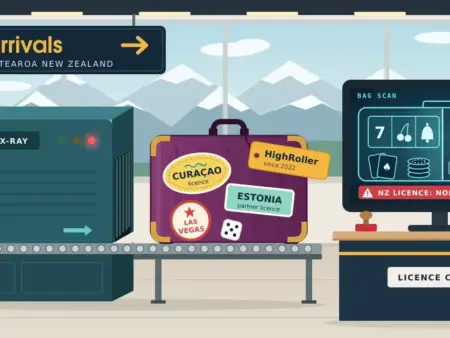
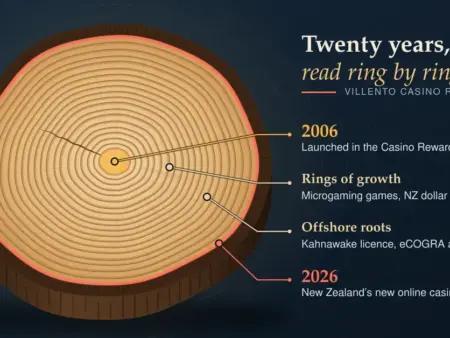
New Zealand is licensing online casinos for the first time, and the picture shifted again in October 2026 when the regulator named the operators allowed to apply for a licence. This page explains where that process now stands, what the official statistics actually measure, and which widely quoted figures are estimates rather than counts.
Most of what circulates about the size of this sector is modelled rather than recorded. The figures below come from official national surveys and from the regulator; anything that cannot be sourced that way is flagged here as an estimate.
What the official statistics show
Participation has fallen, not risen. The share of adults who gambled in any form over the previous twelve months was 67.2% in 2018 and 69.3% in 2020, but 64.1% in the most recent national survey — the 2023/24 New Zealand Gambling Survey, released in 2025. That runs against the common assumption that this activity is simply growing; the measured direction is down.
The majority of New Zealanders who gamble do so without experiencing harm, which belongs alongside the harm figures rather than as a footnote to them. On risk, the survey put moderate-risk gambling at 1.9% of adults and problem gambling at 0.5% — a combined 2.4% of people aged 15 and over, or roughly 104,000 adults.
Harm is concentrated in one product. The Department of Internal Affairs describes pokies — electronic gaming machines — as one of the most harmful forms of gambling and the leading reason people seek gambling-related help in Aotearoa, citing research that 50.3% of people who played pub or club machines at least monthly experienced some level of harm. That harm also falls disproportionately on Māori, Pacific and Asian communities and on people with lower incomes. Our pokie machines guide looks at the Class 4 sector in more detail.
One important figure is simply not collected: what New Zealanders spend at offshore online casinos. Those operators file no returns here and answer to no domestic regulator, so every market-size or forecast number for this sector is built on assumptions. Licensing is expected to produce the first measured figures, because licensed operators will report to the Department. Until then, treat any confident total — including the ones that circulate widely — as unsourced.
Key statistics
| Measure (official national survey and regulator data) | Figure |
|---|---|
| Adults gambling in any form, previous 12 months — 2018 | 67.2% |
| Adults gambling in any form, previous 12 months — 2020 | 69.3% |
| Adults gambling in any form, previous 12 months — 2023/24 survey (released 2025) | 64.1% |
| Moderate-risk gambling (2023/24) | 1.9% |
| Problem gambling (2023/24) | 0.5% |
| Combined moderate-risk and problem gambling | 2.4% — about 104,000 adults |
| Monthly pub or club pokie players reporting some level of harm | 50.3% |
| New Zealanders’ spend at offshore online casinos | Not measured by anyone |
Where the licensing process stands
Two regimes moved in opposite directions inside about a year. Sports and racing betting closed to offshore operators on 28 June 2025: under amendments to the Racing Industry Act 2020, only TAB NZ may lawfully accept a sports or racing bet from a person in New Zealand. Online casino, by contrast, opened. The Online Casino Gambling Act 2026 came into force on 1 May 2026, with supporting regulations following on 3 July 2026. Advertising offshore casinos to New Zealanders has been prohibited since commencement, while existing operators may continue for now under transitional arrangements.
The licence process runs in three stages — expressions of interest, a competitive auction, then full applications — and the auction stage has now concluded:
- 17 July 2026 — expressions of interest opened, at a non-refundable fee of NZ$19,000 (plus GST).
- 29 September – 12 October 2026 — a competitive ascending auction for the right to apply; it closed after ten rounds at NZ$15 million per licence.
- 13 October 2026 — the Department of Internal Affairs named 11 entities, from 32 bidders, that won the right to apply for up to fifteen licences. SkyCity, Entain (through Playvia Gaming), Super Group (through Baytree Interactive, which took the maximum three rights), Stake and TAB were among them.
- 1 December 2026 — the first hard cut-off: operators without a pathway into the process must stop serving New Zealanders, backed by substantial penalties. Operators with pending applications may continue, without advertising, until a decision.
- First half of 2027 — licensing decisions expected, with a final cut-off for pending applicants by 1 July 2027; a declined application means leaving the New Zealand market.
- 2027 — licensed operators expected to launch, alongside a public register published by the Department.
Winning the auction only buys the right to apply: each winner must still pay the auction price and submit a full application covering its business plan, advertising, consumer protection, harm prevention and compliance before any licence is granted. Our New Zealand gambling laws guide sets out the wider framework.
The process is already changing who accepts New Zealand players. Several offshore groups have closed to new New Zealand registrations ahead of the deadlines while continuing to serve existing account holders under the transitional arrangements. The practical point for anyone holding a balance offshore: withdraw it well before December, because operators with weekly withdrawal caps release a large balance in instalments over several weeks, so the effective deadline arrives sooner than it looks.
What a licence will actually require
The gap between a licensed operator in 2027 and an offshore one today is wider than the word “licensed” suggests. The regulations set concrete rules that do not exist offshore: welcome bonuses capped at the lesser of NZ$100 or 200% of the deposit, with sign-up inducements allowed only on the operator’s own platform; mandatory deposit- and spend-limit prompts at sign-up and monthly thereafter; self-exclusion that must take effect within 24 hours; a ban on autoplay and on running more than one pokie at once; and a prohibition on credit cards as a funding method.
Perhaps the most practical difference is where a complaint goes. Against a licensed operator it goes to the Department of Internal Affairs; against an offshore one it goes to a regulator in Malta, Curaçao or Kahnawake, if anywhere at all. None of these protections exists offshore today, which is the substance of what the change is for.
Comparison: licensed vs offshore
| Protection | Licensed NZ operators (from 2027) | Offshore operators (today) |
|---|---|---|
| Welcome/match bonus | Capped at the lesser of NZ$100 or 200% of the deposit | No cap — packages run to thousands |
| Where sign-up offers appear | Only on the operator’s own platform | Promoted widely, often through affiliates |
| Deposit and spend limit prompts | Mandatory at sign-up and monthly | Optional, if offered at all |
| Self-exclusion | Must take effect within 24 hours | Depends on the operator honouring it |
| Autoplay and multiple slots | Autoplay banned; one pokie at a time | Both widely available |
| Credit cards | Prohibited as a funding method | Accepted where banks permit |
| Where a complaint goes | Department of Internal Affairs | Malta, Curaçao or Kahnawake, if anywhere |
Three things are worth watching. Whether the licensed market captures offshore spending — the entire policy rationale is steering players toward regulated operators, and their reporting will be the first time anyone can measure the sector. What happens to players at operators that do not obtain a licence, particularly those with weekly withdrawal caps. And whether the harm profile changes, which the next national survey will answer rather than this one. What a licence will not change is the economics: every game keeps a house edge, and gambling still costs money over time by design. Regulation makes the transaction fairer and the recourse real; it does not make it profitable.
A note on game variety
A common line in commentary is that operators need very large game libraries to compete. That is a commercial observation rather than consumer information. From a player’s point of view the useful version is shorter: library size tells you very little. A lobby of three thousand titles and one of five hundred draw on the same handful of studios, and the headline number is a marketing figure that counts variants separately.
What is worth checking on a specific game is its published return, shown in the game’s own information panel — typically around 96% for a modern pokie, and materially lower on progressive-jackpot titles where a slice of every wager funds the pool.
One general rule worth carrying
Never reach a casino cashier through a link in an article. Misspelled versions of well-known gambling domains are routinely registered by people running cloned sites that copy the design exactly, accept deposits, request identity documents and pay nothing out. Arriving at one through a typo in a link is exactly how people reach them.
Type the address yourself, or reach the site from the operator’s own verified app or communications. If a site asks for a large “verification deposit” before letting you withdraw, stop and check the domain letter by letter — that request is a known marker of clone sites, and several operators have publicly warned their own customers about it. Our guide to scam casinos lists the warning signs. From 2027, the Department’s public register will make an operator’s status checkable in a single search; until then it is on you.
If gambling is causing problems
Free, confidential support is available in New Zealand at any hour: the Gambling Helpline on 0800 654 655 or free text 8006, and PGF Services on 0800 664 262. Both support whānau and friends as well as the person gambling, and neither requires you to be in crisis.
Our self-exclusion guide covers bank gambling blocks and device-blocking software — the two protections that do not depend on any operator honouring anything — and our responsible gaming page has more. You must be 18 or older to gamble online in New Zealand, and 20 or older to enter the gambling floor of a physical casino.
Disclaimer
This page is published for information. It is not financial, legal or gambling advice, and nothing on it is a recommendation to gamble or an endorsement of any operator. You must be 18 or older to gamble online in New Zealand, and 20 or older to enter the gambling floor of a casino.
Statistics quoted are drawn from the sources listed below and describe the periods those surveys cover. New Zealanders’ spending at offshore online casinos is not measured by anyone, and any market-size or forecast figure for it — wherever you meet it — is an estimate rather than a count. The licensing process is under way and its detail continues to change; dates, fees, licence numbers and operator availability should be confirmed on the Department of Internal Affairs’ own pages rather than relied on from here. Gambling costs money over time by design, and regulation does not change that. Free, confidential support is available 24 hours a day on 0800 654 655, or by free text to 8006.
Reference sources
Official statistics, legislation, regulator guidance and New Zealand support services. Every figure above is drawn from these, and no link below goes to a gambling operator.
- New Zealand Gambling Survey — Ministry of Health, source of the national participation and risk figures.
- Kupe data explorer — Health and Lifestyle Survey gambling indicators — Health New Zealand | Te Whatu Ora.
- Gambling Harm Needs Assessment 2024 — Ministry of Health, with the participation time series and the distribution of harm.
- DIA — reducing pokies harm — the Department’s statement that pokies are the leading reason people seek gambling-related help.
- DIA — minimising gambling harm — the 50.3% figure for monthly pub and club machine players.
- DIA — gambling statistics — machine numbers, venues and expenditure, updated quarterly.
- DIA — online gambling regulatory implementation — the Department’s own account of where the process stands.
- DIA — online gambling licensing for providers — the three-stage process, the fee, the fifteen-licence cap and the deadlines.
- DIA — information for online casino customers — what the change means for players, and where the register will be published.
- Online Casino Gambling Act 2026 — New Zealand Legislation.
- Online Casino Gambling Regulations 2026 — New Zealand Legislation, setting the game design and harm prevention rules.
- Senet — what the 2026 regulations require of operators — a summary of the inducement cap, the limit prompts and the game design prohibitions.
- DIA — law changes for online racing and sports betting — the 28 June 2025 prohibition and the notice to offshore operators.
- Racing Industry Act 2020 — New Zealand Legislation, as amended in 2025.
- Safer Gambling Aotearoa — Health New Zealand | Te Whatu Ora, with tools, self-assessment and support services.
- PGF Services — free counselling and financial mentoring, including for whānau and friends.
- Gambling Helpline Aotearoa New Zealand — free, confidential support, 24 hours a day.
Frequently Asked Questions
Is gambling participation in New Zealand rising?
No. Adult participation in any form of gambling was 64.1% in the most recent national survey (the 2023/24 New Zealand Gambling Survey), down from 69.3% in 2020 and 67.2% in 2018.
How much do New Zealanders spend at online casinos?
Nobody has a measured figure. Offshore operators file no returns in New Zealand, so every total is an estimate. Licensing is expected to produce the first counted numbers once operators report to the Department of Internal Affairs.
Who won the right to apply for a New Zealand online casino licence?
On 13 October 2026 the Department of Internal Affairs named 11 entities, from 32 auction bidders, as eligible to apply for up to fifteen licences. SkyCity, Entain, Super Group, Stake and TAB were among them. Winning the auction only grants the right to apply; a full application still has to be assessed before any licence is granted.
When must unlicensed operators stop serving New Zealanders?
Operators without a pathway into the licensing process must stop by 1 December 2026. Those with pending applications may continue, without advertising, until a decision or the 1 July 2027 final cut-off, whichever comes first.
What will licensed operators have to do differently?
Cap welcome bonuses at the lesser of NZ$100 or 200% of the deposit, prompt deposit and spend limits at sign-up and monthly, action self-exclusion within 24 hours, ban autoplay and multiple simultaneous pokies, and refuse credit-card funding. None of that applies to offshore operators today.